For decades, the “return” has been the silent killer of ecommerce profitability. As logistics costs climb and environmental scrutiny over reverse supply chains intensifies, retailers have struggled to find a panacea for the high volume of goods shipped back to warehouses. However, a transformative shift is underway. New data from Adobe suggests that the rise of AI-aided shopping may offer the long-awaited solution to reducing product returns, fundamentally changing how consumers interact with digital storefronts.
According to Adobe’s August 2026 AI Traffic Trends Report, the integration of artificial intelligence into the shopping journey is not merely boosting conversion rates—it is fundamentally altering the quality of the purchasing decision itself. By acting as a sophisticated, pre-purchase filter, AI is helping consumers make more informed choices, thereby reducing the likelihood of “buyer’s remorse” and the subsequent logistical nightmare of the return process.
Main Facts: The Intersection of AI and Consumer Behavior
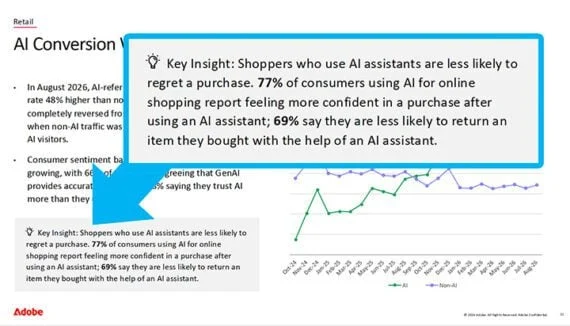
The Adobe report, which synthesizes data from over 1 trillion visits to U.S. retail sites and 100 million stock-keeping units (SKUs), serves as a bellwether for the future of digital retail. A critical highlight from the report—which surveyed 5,000 U.S. consumers in July 2026—reveals a significant shift in post-purchase sentiment: 69% of respondents who utilized AI-assisted tools during their shopping journey reported that they were less likely to return their items.
Furthermore, the data indicates a massive surge in consumer confidence. Approximately 77% of AI-using shoppers felt more secure in their purchasing decisions compared to traditional browsing methods. This shift suggests that AI is bridging the “information gap” that has historically plagued online shopping, where the inability to physically inspect a product often leads to misaligned expectations.
Chronology of a Paradigm Shift
To understand the magnitude of this change, one must look at the evolution of the shopping journey over the last several years.
- Pre-2023 (The Manual Era): The standard consumer journey involved multiple tabs, dozens of site visits, and a reliance on fragmented reviews or static product descriptions. Uncertainty was high, and the burden of research fell entirely on the consumer.
- 2024-2025 (The Emergence of Chatbots): Early AI implementations focused on basic customer service and rudimentary product discovery. While these tools improved engagement, they were often limited by narrow data sets and rigid decision-making capabilities.
- 2026 (The Era of Intelligent Discovery): As evidenced by tools like Meta’s Muse, AI has evolved into a proactive research agent. These systems now possess the capability to utilize virtual web browsers to traverse the open internet, compare specifications across competing platforms, and synthesize vast amounts of data before presenting a recommendation to the user.
This progression highlights a shift from “passive search” (where the user does the work) to “active discovery” (where the AI performs the due diligence).
Supporting Data: The Efficiency of AI Traffic
The economic implications for retailers are stark. Adobe’s data shows that AI-referred traffic is significantly more valuable than traditional, organic, or paid search traffic.
In July 2026, visitors arriving at retail sites via AI referrals converted at a rate 60% higher than non-AI-referred traffic. Perhaps more impressively, these consumers generated 53% more revenue per visit. These metrics suggest that when a customer lands on a product page via an AI assistant, the discovery process has already resolved the primary hurdles to conversion: price, compatibility, and feature verification.
By the time the transaction occurs, the AI has already acted as a vetting agent, narrowing down thousands of options to the one that best fits the specific parameters of the shopper. This is not just a win for the top line; it is a profound optimization of the entire retail funnel.
Implications for Merchants: The New Imperative for Data Hygiene
For ecommerce merchants, the rise of AI-assisted shopping creates a new set of strategic priorities. If AI is to become the primary gatekeeper of consumer demand, retailers must pivot their focus toward the quality and accessibility of their product data.

The Metadata Mandate
AI assistants are only as good as the information they ingest. If a product description is sparse, or if technical specifications (dimensions, compatibility, materials) are buried in an inaccessible format, the AI cannot effectively evaluate that product against a user’s specific query.
Merchants must treat their product information as a critical asset for AI optimization. This includes:
- Structured Data: Ensuring all specifications are tagged and machine-readable.
- Comprehensive FAQs: Anticipating the “why” behind a purchase to help AI address potential compatibility issues.
- Rich Media and Reviews: Providing high-quality visual data and aggregated feedback that an AI can parse to determine if a product meets a specific user need.
If a retailer fails to provide this depth of information, they risk being “filtered out” by AI agents, who will naturally favor products with high-fidelity descriptions that match a consumer’s requirements.
The Shrinking Return Gap
The most promising implication is the potential for a sustained decline in return rates. Returns have long been treated as a “cost of doing business,” but they are, in reality, a failure of information. When an AI agent ensures a product is the correct size, compatible with existing equipment, and aligned with the user’s stated preferences, the inherent friction of ecommerce—the “will this actually work?” factor—is drastically reduced.
While it is still early to declare a definitive downward trend in the industry-wide return rate, the current evidence is compelling. By minimizing purchase uncertainty, AI is transforming the transactional nature of online retail into a more consultative, precise experience.
Official Responses and Industry Outlook
Industry analysts have been quick to note that the impact of AI on returns is a lagging indicator. "We are seeing the early symptoms of a more intelligent marketplace," says one retail strategy consultant. "Retailers who invest in ‘AI-ready’ content today are not just chasing a trend; they are positioning themselves to capture the most high-intent traffic on the web."
The Adobe report also underscores that the effectiveness of these tools is tied to consumer trust. As shoppers realize that AI is saving them the hassle of returns and the disappointment of mismatched products, the reliance on these tools will likely accelerate. This creates a virtuous cycle: more usage leads to better AI training data, which leads to even more accurate recommendations, further driving down returns.
Strategic Conclusion
As we look toward the remainder of 2026 and beyond, the message for ecommerce leaders is clear: the battle for the customer will be fought in the discovery phase. The traditional model of “cast a wide net and hope for a conversion” is becoming obsolete.
Instead, success will be defined by how well a merchant can feed the AI ecosystem. By prioritizing the accuracy and depth of product information, retailers can align their inventories with the highly specific, pre-vetted requests of AI-assisted shoppers.
In this new landscape, the return rate may no longer be a static burden. Instead, it could become a key performance indicator of how well a brand communicates with the digital agents that now hold the keys to the modern consumer’s wallet. The technology is here, the data is supporting the thesis, and the merchants who adapt to this reality will likely define the next generation of profitable ecommerce.