You sit down to relax, hit play on a curated playlist, and let the music wash over you. In the streaming era, discovery is meant to be effortless. Yet, a growing number of listeners have found themselves caught in an unexpected game of digital detective work, wondering if the artist crooning through their speakers is a flesh-and-blood musician or a sophisticated sequence of algorithms.
This week, the music industry took a definitive step toward addressing this ambiguity. Two major streaming services—Google’s YouTube Music and the French-based platform Deezer—announced new, user-centric features designed to peel back the curtain on AI-generated tracks. As the line between human artistry and machine-generated content continues to blur, these platforms are betting that transparency is the key to maintaining listener trust.
The Dawn of Transparency: YouTube and Deezer Respond
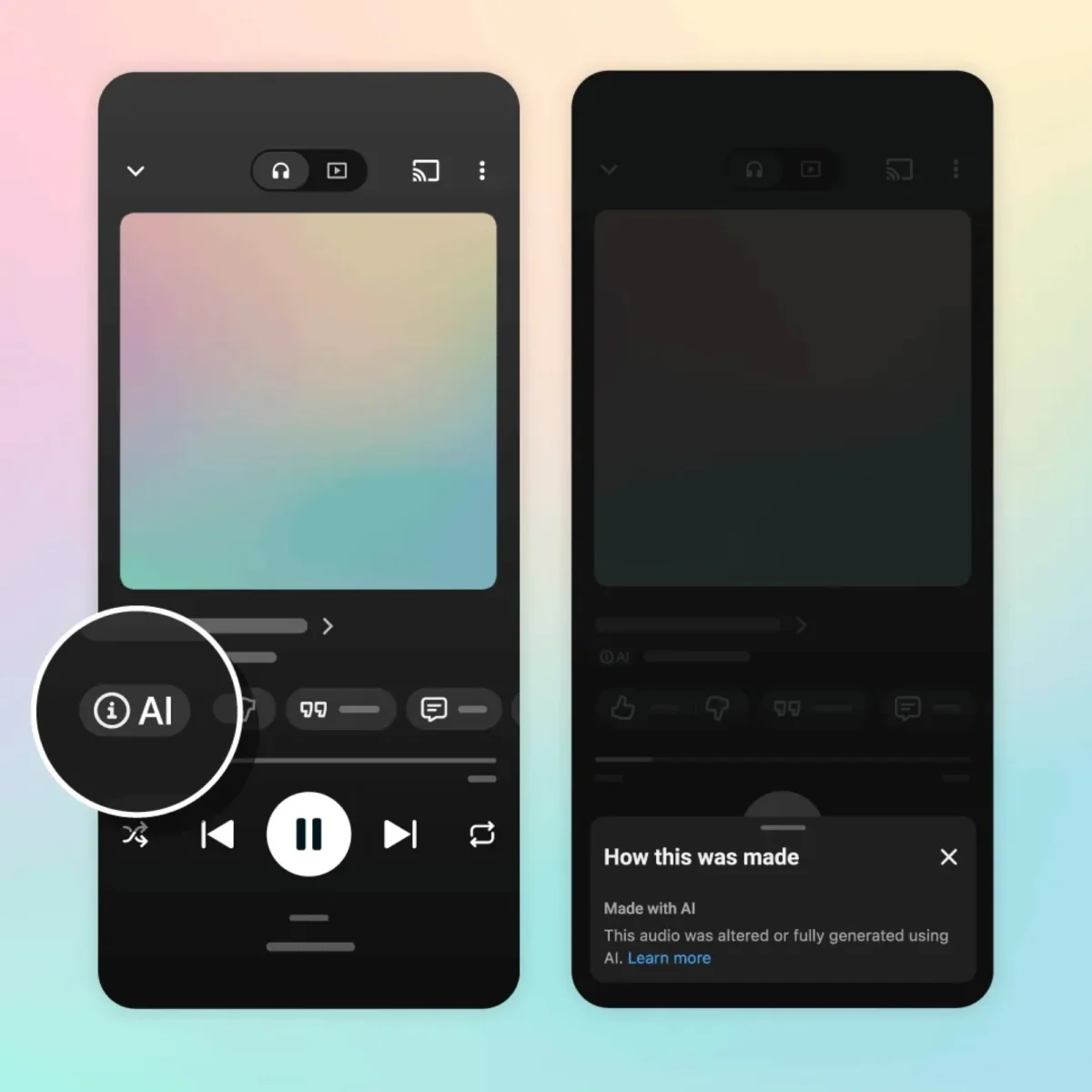
Starting October 14, YouTube Music began rolling out explicit labels for tracks created primarily through generative AI. These tags, which appear directly on the player interface, signify that the composition or vocals were produced by artificial intelligence. By tapping the label, users can access a "How this was made" panel, which offers deeper insight into the creative process—or lack thereof. YouTube, leveraging its proprietary detection tools and collaboration with industry partners, intends to extend these labels to the main YouTube application as well.
Simultaneously, Deezer is moving beyond mere labeling to offer a more radical form of agency: the ability to opt-out. By the end of 2026, the platform will introduce a global "filter" toggle. When activated, this feature will scrub search results of fully AI-generated tracks, albums, and associated artists. Deezer’s CEO, Alexis Lanternier, stated that the decision was driven by clear user demand for control. This initiative complements Deezer’s existing policy of excluding detected AI tracks from algorithmic and editorial recommendations, ensuring that machine-made music does not dominate the passive listening experience.
A Chronology of the AI Music Crisis
The industry’s sudden push for disclosure did not emerge in a vacuum. It is the culmination of years of escalating tension between creative expression, technological innovation, and digital fraud.
- 2022: The emergence of "virtual" artists like FN Meka brought the ethics of AI music into the public eye. When the project faced intense criticism for appropriating Black culture and misrepresenting the creative process, it sparked a national conversation about the human cost behind synthetic personas.
- November 2025: A landmark blind test conducted by Deezer and Ipsos revealed a startling reality: 97 percent of participants could not distinguish between a human-made song and a high-quality AI-generated track. This data proved that the "uncanny valley" had been effectively bridged.
- 2025 (Ongoing): The rise of ghost-acts like The Velvet Sundown—a band with hundreds of thousands of listeners but no verifiable real-world identity—showcased how AI could be used to manufacture artificial popularity.
- October 6, 2026: The legal reality of AI music fraud hit a crescendo when Michael Smith, a North Carolina musician, was sentenced to 18 months in prison for a multi-million dollar streaming fraud scheme. Smith had used AI to churn out hundreds of thousands of tracks, utilizing bot networks to rack up billions of streams and siphon royalties from the genuine music ecosystem.
The Data Behind the Synthetic Surge
The scale of AI-generated music is staggering. Deezer reports that it receives approximately 90,000 fully AI-generated tracks every single day. While these uploads represent a massive volume of data, they account for only 1 to 3 percent of the platform’s total streams.
However, the nature of these streams is deeply problematic. In 2025, internal data suggested that up to 85 percent of streams for fully AI-generated content were fraudulent. This "bot-driven" consumption is not just a nuisance; it is a financial drain on the global royalty pool. When bots stream AI music, they dilute the revenue share for human artists who rely on those payments to sustain their careers.

The case of Michael Smith serves as a sobering reminder of the financial implications. By diluting his streaming numbers across hundreds of thousands of songs, Smith avoided the algorithmic tripwires that might have flagged his account earlier. This "long-tail" strategy allowed him to extract $8 million from a royalty pool intended for human creators. For streaming services, the challenge is now two-fold: identifying the synthetic nature of the music while simultaneously preventing the gaming of the financial system.
The Competitive Landscape: How Other Giants Are Adapting
The approach to AI disclosure varies significantly across the streaming landscape, reflecting a lack of industry-wide standardization.
Spotify’s "AI Persona" Badges
Spotify has opted to focus on the identity of the artist rather than just the composition. Announced in August and rolling out since mid-September, their "AI Persona" badges identify artist profiles that depict photorealistic, AI-generated humans. By excluding these personas from editorial and algorithmic recommendations, Spotify aims to ensure that human-led discovery remains the default for its users.
Apple Music’s "Transparency Tags"
Apple Music has taken a more granular, albeit decentralized, approach. Their "Transparency Tags" allow labels and distributors to disclose exactly where AI was utilized—whether in the composition, the vocal performance, the album artwork, or the music video. The efficacy of this system, however, relies entirely on the honesty of the labels delivering the content. If a distributor fails to tag a track as AI-generated, the system remains silent.
Implications for the Future of Music
The push for labeling and filtering addresses the "who" and "how" of music creation, but it leaves open fundamental questions about the value of art in the age of generative models.
The Erosion of Authenticity
For listeners, the primary frustration is the loss of connection. Music has traditionally functioned as a bridge between the artist’s lived experience and the listener’s emotional state. When that connection is revealed to be a prompt-driven hallucination, the listener often feels misled. As Mashable’s Features Editor Rachel Thompson noted after a run-in with AI-generated funk music, the experience of "discovering" a great new artist turns into a feeling of betrayal when the artist is revealed to be a synthetic fabrication.
The Legal and Ethical Gray Zones
The "FN Meka" controversy highlighted a significant loophole: even if a song is human-performed, the branding of that song can be deeply problematic. A badge indicating "AI-Generated" might tell you the recording is synthetic, but it does not tell you if the voice was stolen from a human singer, or if the lyrics were written by a machine that was trained on the copyrighted works of thousands of songwriters without their consent.

Furthermore, as the technology becomes more sophisticated, the distinction between "fully AI-generated" and "human-assisted" will become increasingly difficult to define. Will a producer using an AI-based mixing tool be forced to label their track as "AI-generated"? Where does the tool end and the artist begin?
The Burden of Proof
The success of these new features rests on the shoulders of the streaming platforms. Currently, if a track is not labeled, users may assume it is human-made. But what happens when the detection tools fail? If an AI track slips through the net, the platforms are effectively endorsing it as "authentic."
There is also the question of whether listeners actually want this information. While the Deezer/Ipsos survey showed that 80 percent of users want AI-generated music to be labeled, it also indicated that 45 percent of users actively want the ability to filter it out. This suggests a growing divide in the market: a segment of the audience that is "AI-averse" and a segment that is indifferent to the origin of the sound as long as it fits their aesthetic preferences.
Conclusion: A New Era of Informed Listening
The introduction of labels and filters is a necessary, if preliminary, response to a rapidly changing environment. By providing users with the tools to identify and, in some cases, avoid AI-generated content, streaming services are attempting to restore the integrity of the music discovery process.
However, labeling is not a panacea. It is a temporary bridge to a more complex reality where the line between creator and tool will continue to vanish. As we move toward 2027, the focus must shift from merely identifying AI content to ensuring that human creators are protected, that royalties are distributed fairly, and that the "human touch" remains a verifiable, respected element of the musical experience. For now, the next time you hit play, you might have to do a little less detective work—but the question of what constitutes "real" music will remain the industry’s most pressing melody.