For generations, the "Stone Age" has been a misnomer, a byproduct of the archaeological record’s cruelest bias: the preservation of lithics over organics. While we have built our understanding of early human evolution around flint scrapers and bifacial handaxes, the reality of the Paleolithic was almost certainly a "Wood Age." Wood is infinitely more versatile, ergonomic, and abundant than stone, yet it is rarely afforded a place in history because it decays into nothingness within a few short years.
That narrative is undergoing a seismic shift. At Abric Romaní, a sheltered rock overhang in the limestone cliffs of Capellades, Spain, archaeologists have uncovered a rare, miraculous "time capsule" of prehistoric life. Here, mineral-rich spring water acted as a natural preservative, encasing wooden artifacts in a limestone-like crust. When the wood eventually rotted away, it left behind hollow, high-fidelity molds—negative impressions that act as a ghostly archive of Neanderthal daily life.
A landmark study published in Science Advances has now cataloged 597 wooden remains from this site, dating back between 62,000 and 40,000 years. These artifacts—ranging from humble firewood to sophisticated hunting spears and, most shockingly, a complex wooden club—provide irrefutable evidence that Neanderthals were not the lumbering, simple-minded cousins of Homo sapiens, but rather highly skilled craftsmen with deep, structural knowledge of their environment.
The Chronology of Discovery: 20,000 Years of Life
Abric Romaní is not merely a collection of tools; it is a long-term habitation site that offers a vertical slice of Neanderthal existence spanning two millennia. Since excavations began in earnest in 1983, the site has yielded a staggering array of materials that show an organized, routine domesticity.
The archaeological sequence at the site is divided into distinct living floors. As researchers peeled back these layers, they discovered that wood-working was not a sporadic activity, but a fundamental pillar of Neanderthal life. The sheer volume of wooden remains found in these layers indicates that the occupants were constantly bringing fresh timber into the shelter, processing it, and modifying it for specific, utilitarian purposes.
By mapping these layers, archaeologists have been able to distinguish between different zones of activity:
- The Domestic Core: Areas dominated by hearths, animal bone debris, and stone-knapping waste, where meals were prepared and tools were finished.
- The Sleeping Quarters: Located near the back wall, characterized by small, neatly arranged hearths and the presence of long, branchless poles—likely the skeletons of windbreaks or primitive hut structures.
- The Processing Zone: Areas where hunting gear and gathering implements were maintained, showing a high degree of specialization.
Travertine Molds: The Science of "Negative" Archaeology
The preservation at Abric Romaní is a freak geological occurrence. The site sits at the base of a massive travertine cliff. Travertine is a form of limestone deposited by mineral-rich springs. Over thousands of years, water dripping into the shelter carried high concentrations of calcium carbonate. When this water washed over discarded logs, pine cones, and abandoned tools, it coated them in a mineral film.
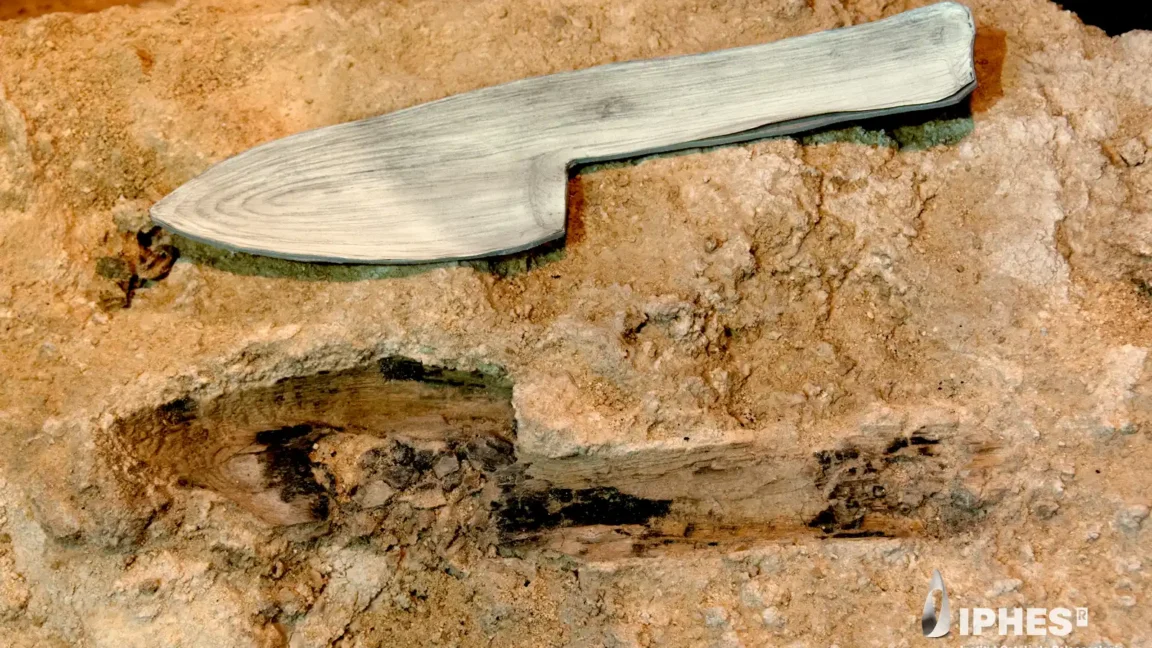
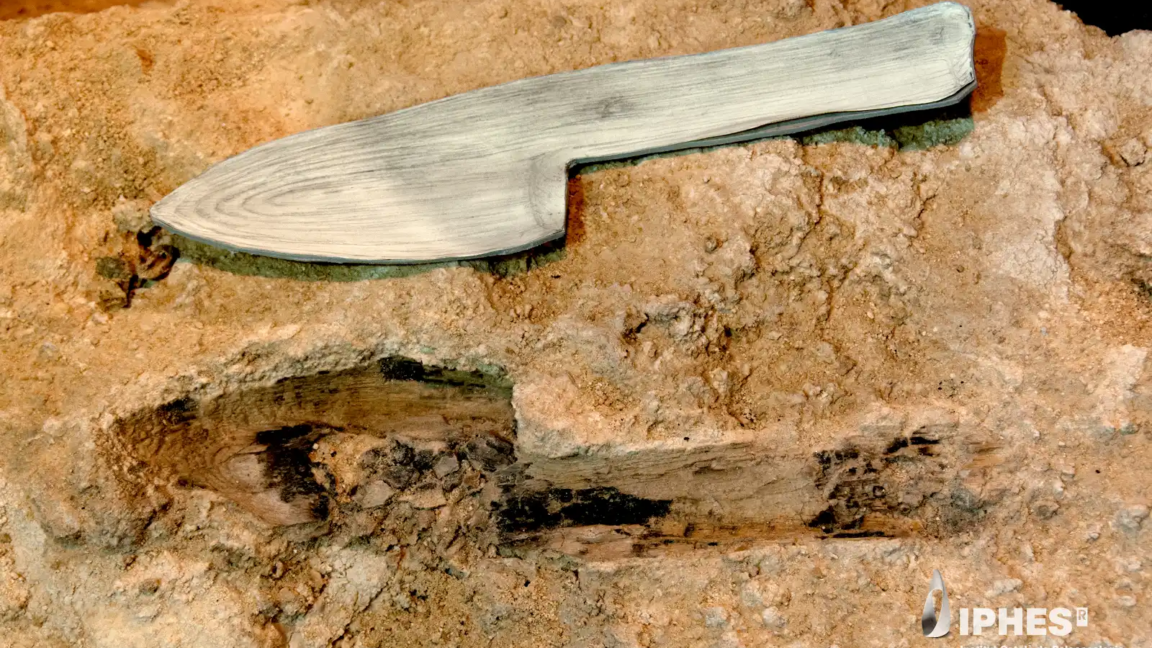
As the centuries passed, the organic matter inside the hardened crust decayed, leaving behind a hollow cavity—a perfect, detailed negative of the object. "These are perfect negatives of the original objects," explains M. Gema Chacón, an archaeologist at the Catalan Institute of Human Paleoecology and Social Evolution (IPHES-CERCA) and a lead author of the study. "Sometimes the molds are so detailed that the outlines of individual wood cells are visible under a microscope."
Excavating these voids requires a surgical touch. Because the crust is exceptionally fragile, the team at IPHES-CERCA has developed a sophisticated workflow. Each find is carefully mapped, outlined, and photographed before the crust is consolidated. Using modern 3D scanning and photogrammetry, the team digitizes the void. They then use 3D printing technology to create physical "positive" casts of the objects. This non-invasive method allows researchers to study the tools without risking damage to the delicate original molds, while also providing high-quality replicas for museum exhibitions.
Supporting Data: From Firewood to Specialized Gear
Of the 597 items identified, the majority were natural trunks and branches. However, 13 specific artifacts showed clear signs of anthropogenic modification. This small but significant group of tools provides a direct window into the technological capability of the Neanderthals.
The Household Toolkit
Among the most surprising finds were four shallow trays fashioned from the bark of juniper trees. The largest of these measured 55 by 20 centimeters. Their discovery near hearths suggests they were used for domestic chores—perhaps as containers for carrying food or as scoops for managing embers, mirroring the functionality of the "coolamons" used by Aboriginal Australians.
The team also identified crossed poles that may have functioned as a tripod or a rack for food processing. These findings challenge the long-held notion that Neanderthal living spaces were chaotic and disorganized; rather, they appear to have been structured environments designed for efficiency.

Hunting and Combat
The weapons found at the site are equally telling. The researchers uncovered a 2.45-meter-long spear that appears to have seen heavy use. When researchers created a cast of the spear’s tip, they found an impact fracture pattern identical to those seen on ethnographic spears from hunter-gatherer societies—damage consistent with striking bone or dense hide.
The most notable find, however, is a wooden club. Carved from a single piece of wood, the tool features a 16-centimeter handle and a triangular head. An abrupt right-angle transition between the handle and head suggests a design meant to prevent the hand from slipping during use. This artifact, which dates to the mid-Paleolithic, is one of the only known examples of a wooden club of its kind in the world, with the only comparable find coming from the 400,000-year-old site of Kalambo Falls in Zambia.
Official Responses and Theoretical Implications
The implications of the Abric Romaní findings are profound. For decades, the "Neanderthal as brute" trope hindered scientific progress, causing researchers to overlook evidence of complex behavior.
"When they went to look for wood, it was like when they went to look for stone; they knew exactly what they wanted to make," says Dr. Chacón. "This implies not only planning but a bit of complexity in the brain to organize your activities."
The selection of materials further supports this cognitive model. The Neanderthals showed a clear preference for specific woods for specific jobs: Scots pine was favored for its ease of work and quick drying time for temporary tools, while the fibrous, durable bark of the juniper was selected for containers. They differentiated between dry wood for fuel and fresh, green wood for tool manufacture, demonstrating a sophisticated understanding of material properties.
This study adds to a growing body of evidence—including the discovery of twisted cord fibers and symbolic artifacts—that confirms Neanderthals possessed a level of cognitive flexibility previously reserved for Homo sapiens.

The "Invisible" Archive: A Call for Caution
Despite the success at Abric Romaní, Dr. Chacón warns that the archaeological community may be losing vital data. The process of identifying these tools is grueling, often taking decades of analysis to distinguish between a natural branch and a human-modified tool.
"I hear from colleagues telling me, ‘Perhaps we found something that we thought was wood, we excavated it, we took pictures, but we didn’t keep it,’" Chacón notes. "Now they say, ‘Perhaps it could have been a tool.’"
This admission highlights a systemic issue in archaeology: the lack of time and funding to investigate sites that do not yield obvious, durable artifacts like stone. The "Wood Age" has likely been hiding in plain sight, discarded in the spoil heaps of earlier, less observant excavations.
The Abric Romaní study serves as a masterclass in how to treat ephemeral evidence. It suggests that if we shift our focus from the indestructible to the delicate, we might find that the Neanderthals were not only our peers in survival but pioneers of a complex, wooden-based technology that enabled them to thrive in the harsh environments of the Ice Age. As researchers continue to refine their 3D printing and scanning techniques, the ghostly molds of Capellades may prove to be the most important discovery in the history of human evolution.