In the high-stakes theater of Amazon’s major sales events, a tectonic shift has occurred within the UK market. During the recent "Prime Big Deal Days" (October 4–10, 2026), third-party (3P) sellers demonstrated a clear competitive edge, growing at nearly double the rate of Amazon’s first-party (1P) Vendor channel.
New data, analyzed by Venture Forge—which tracked approximately 1.6 million products—reveals that this performance gap was not a fluke driven by a few isolated power brands or deeper price slashing. Instead, it marks a fundamental change in how brands successfully capture consumer demand on the world’s largest marketplace. As we look toward the looming Black Friday period, these findings suggest that the traditional reliance on 1P, or Vendor Central, may no longer be the optimal strategy for every brand.
The Main Facts: A Tale of Two Channels
Historically, Amazon’s 1P model has been the "heavyweight" during deal events. Brands typically rely on Amazon to purchase their stock, manage distribution, and fund promotional discounts. During such events, 1P usually captures a disproportionately larger share of sales compared to the preceding weeks.
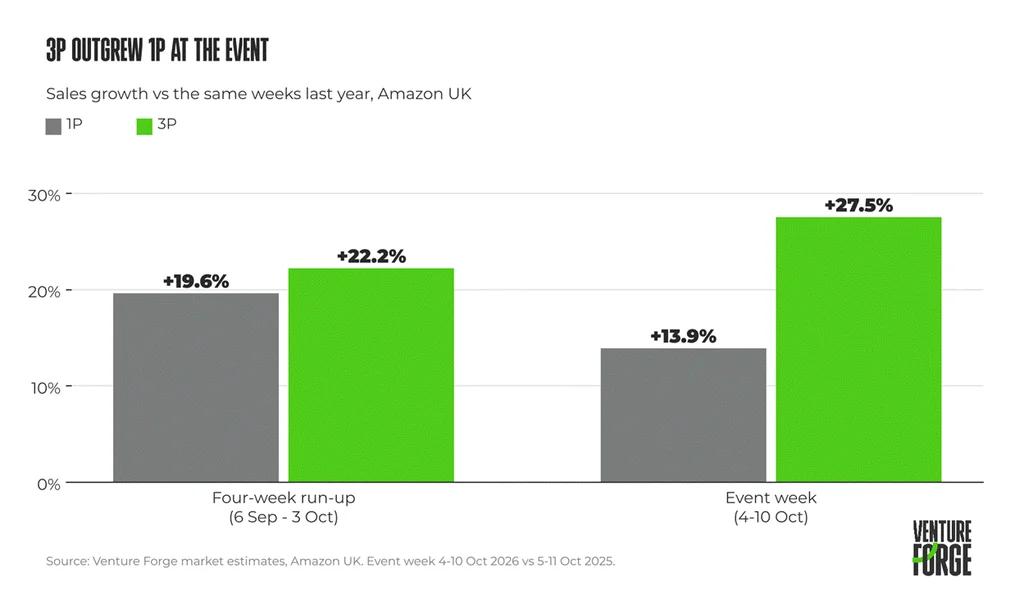
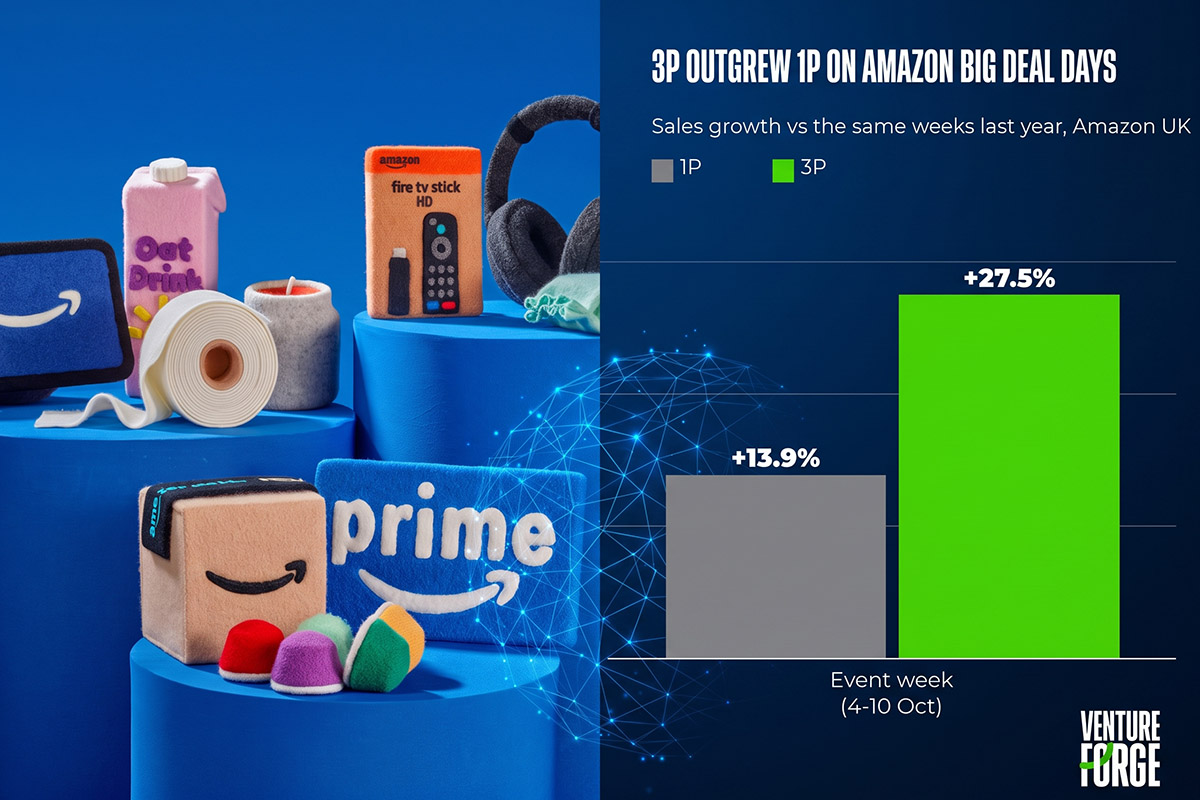
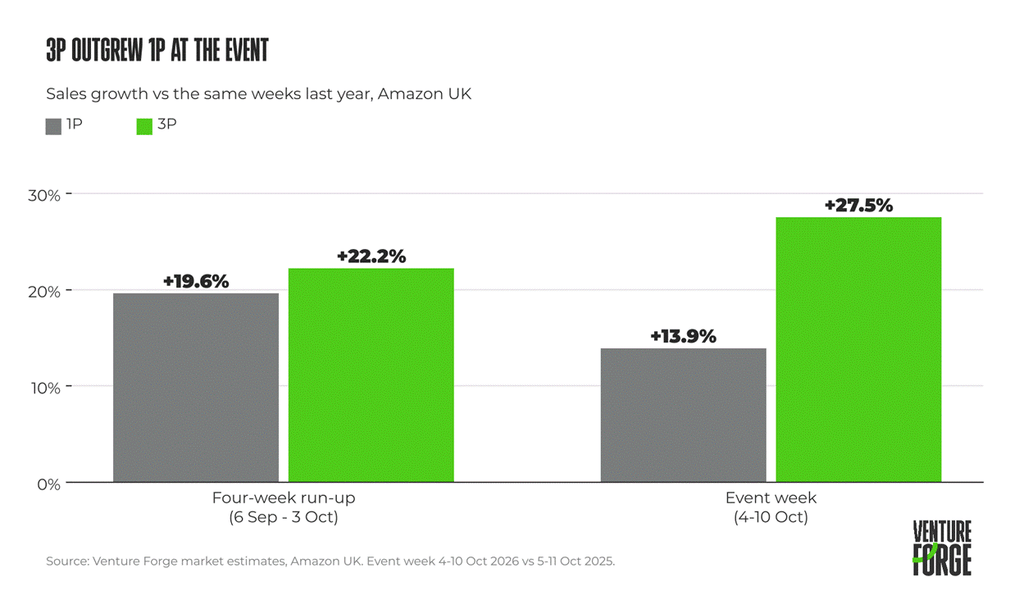
While that trend held true in terms of volume, the velocity of growth diverged sharply this October. Estimated 3P sales soared by 27.5% compared to the same event week last year, while 1P sales trailed significantly, managing only a 13.9% increase.
This is not a matter of a shrinking market. The total estimated revenue for Amazon UK during the event week reached £1.06bn, up from £864m last year. However, much of that 22% increase is attributed to a buoyant underlying market rather than the event’s specific draw. In the four weeks leading up to the sale, the market was already trending 21% ahead of the previous year. The event itself provided a further 38% uplift—a figure nearly identical to last year’s performance—proving that while the consumer appetite remained constant, the delivery of those products shifted firmly toward the Seller side.
Chronology and Market Context
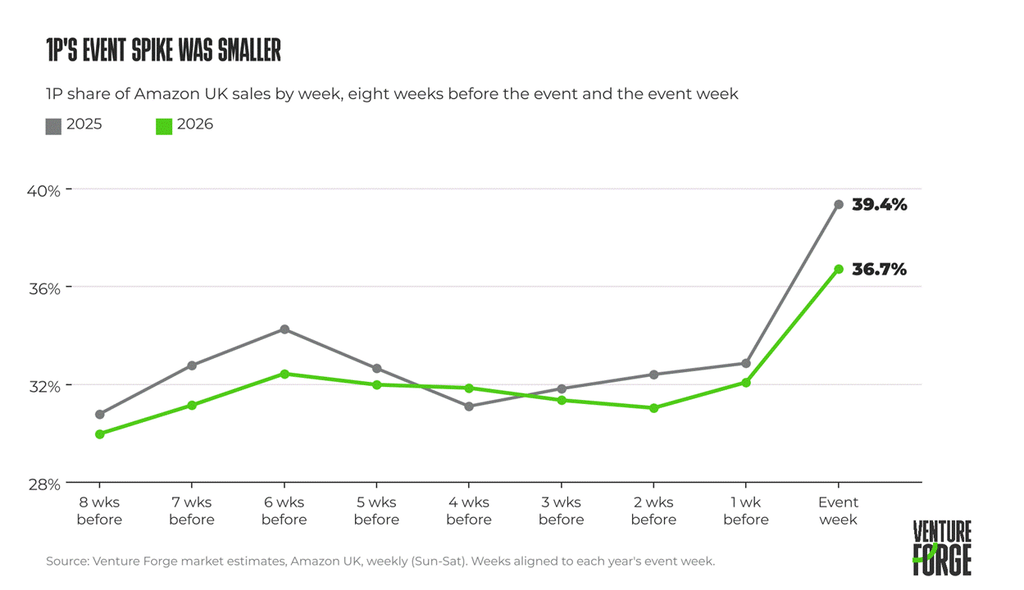
To understand the significance of this shift, one must look at the weeks preceding the event. In the lead-up to October 6th and 7th, 1P and 3P were growing in tandem at 19.6% and 22.2%, respectively. 1P’s market share remained stable, hovering between 32.1% and 31.6%.
The divergence occurred precisely when the "Prime Big Deal" banners went live.
- The 1P Surge: 1P sales were 60% above their standard weekly level, a decline from the 68% surge recorded during the 2025 event.
- The 3P Surge: 3P sellers saw their performance jump from 22% above their baseline to 27%.
This period, marked by a high-intensity focus on consumer discounting, revealed that the "Vendor" model’s reliance on Amazon’s automated purchasing (PO) systems may be creating a bottleneck. When a brand hands over the reins to Amazon for stock and deal funding, they lose the agility required to capture sudden spikes in demand—a flexibility that 3P sellers, who manage their own inventory and pricing, currently possess in abundance.
Supporting Data: Dissecting the Performance Gap
A common counter-argument is that "big brands" (like Apple or Samsung) might have had a weak week, skewing the numbers. However, the data confirms this was a structural, not anecdotal, trend.
When analysts stripped out major tech giants like Apple, Amazon, Samsung, HP, and Lenovo, 1P growth still lagged at 18%, while 3P growth surged to 28%. Narrowing the focus to the top 1,000 brands, 1P growth remained stagnant at 11%, compared to 27% for 3P. Most telling is the analysis of the top 10,000 products: while 3P sales grew by 21%, 1P sales actually fell by 8%.
Category-Specific Analysis
The disparity was most pronounced in specific sectors:
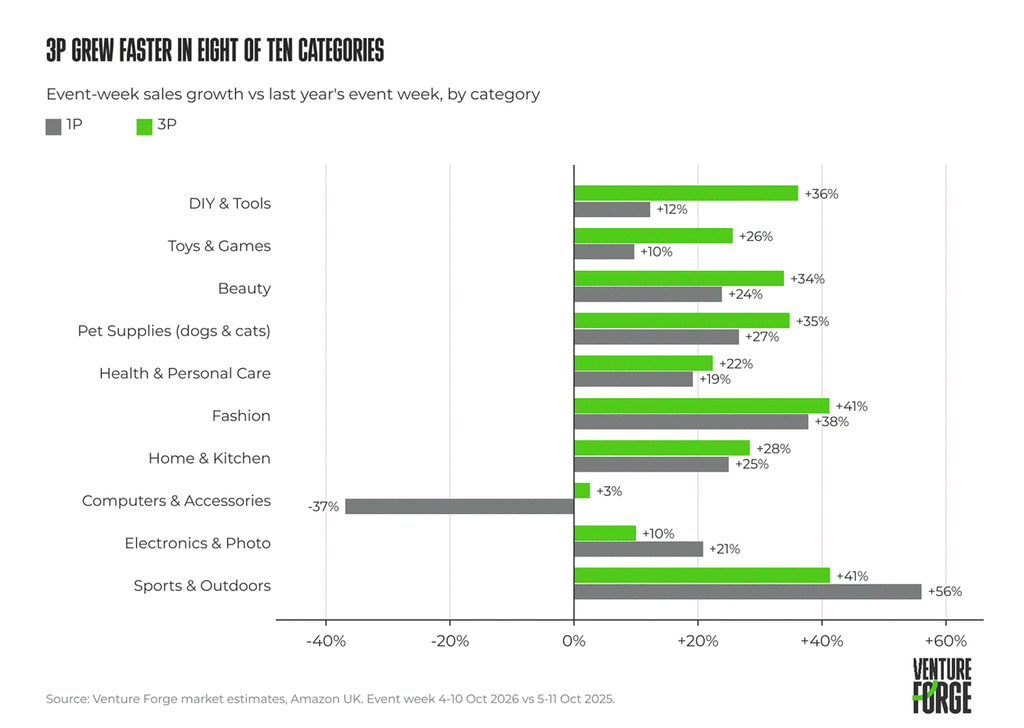
- DIY & Tools: 3P grew 36% versus 1P’s 12%.
- Toys & Games: 3P grew 26% versus 1P’s 10%.
- Beauty: 3P grew 34% versus 1P’s 24%.
Computers & Accessories proved to be the outlier, where 1P sales plummeted by 37%, and 3P grew by a modest 3%. This was the only major category to contract overall, signaling a wider macroeconomic cooling in high-ticket tech spending. Conversely, in Electronics & Photo and Sports & Outdoors, 1P actually outperformed 3P, suggesting that for specific, high-inventory categories, the traditional Vendor model still holds sway.
The Myth of Deeper Discounts
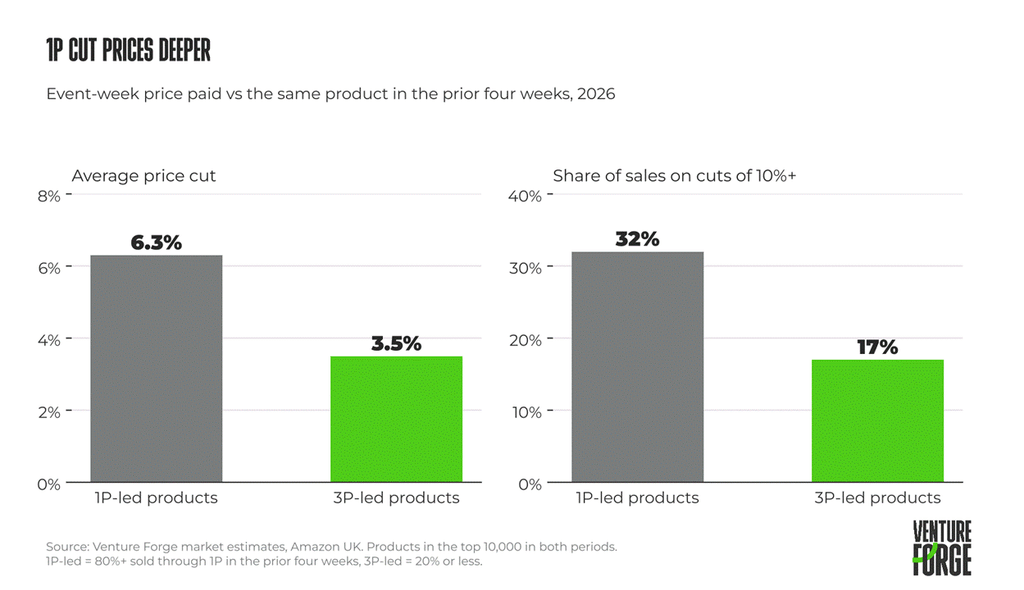
One might assume that 3P sellers won by simply cutting prices lower than 1P vendors. The data proves the opposite.
On products sold primarily through 1P, the average price cut was 6.3%, with 32% of sales coming from discounts of 10% or more. On 3P-led products, the average cut was a more conservative 3.5%, with only 17% of sales derived from double-digit discounts. Despite smaller price cuts, 3P sellers achieved higher volume growth. This suggests that growth was driven by brand control and availability rather than aggressive race-to-the-bottom pricing.
The success stories of the event, such as the Korean skincare brand medicube, illustrate this perfectly. Medicube scaled from £0.2m in last year’s event to £4.2m this year, with 95% of its sales processed through the 3P channel. By retaining control over their inventory and marketing, they were able to respond to consumer demand with a precision that 1P vendors often struggle to replicate.
Implications: The Rise of the Hybrid Strategy
For enterprise brands, the primary takeaway is that the "Vendor-only" strategy is no longer a safety net; it is a potential liability.
Risks of 1P Dependence
When a brand is exclusively 1P, their performance is tethered to Amazon’s purchasing algorithms. If Amazon does not issue enough Purchase Orders (POs) or fails to fund a specific deal, the brand is effectively sidelined. The case of brands like Funko and Russell Hobbs—which saw sales decline despite their categories being highly active—serves as a cautionary tale. These brands missed the event window because they were overly reliant on Amazon’s internal logistics and deal-selection processes.
The Hybrid Necessity
The most successful brands are now moving toward a "hybrid" model. The data shows that the brands that struggled most were those that fell into a "middle ground" by default, often through a lack of clear strategy. These brands grew at a sluggish 5%.
A deliberate hybrid approach allows brands to utilize 1P where Amazon’s infrastructure and massive marketing reach provide a genuine advantage, while shifting to 3P for products where inventory control, pricing flexibility, and speed-to-market are the deciding factors.
Preparing for Black Friday
As the retail industry pivots toward Black Friday, the "Prime Big Deal" results provide a blueprint for optimization:
- Benchmarking: Brands must stop viewing their growth in isolation. If your brand grew 15% but your category grew 30%, you are effectively losing market share.
- Audit the Channel Mix: Determine which of your SKUs are currently trapped in a 1P bottleneck. If you lack control over pricing or stock levels on your best-sellers, those items are prime candidates for a shift to 3P.
- Deal Depth Strategy: Data suggests that products with no price cut still sell 1.3x their normal volume during events. Don’t feel pressured to offer 25%+ discounts unless your margins and inventory volume support it. The "sweet spot" of 10–25% cuts currently captures the majority of event-driven growth.
A Final Thought
The 2026 Prime Big Deal Days have provided a clear message: the balance of power on Amazon is shifting. For established brands, the ability to control their own destiny—via the 3P channel—is becoming the ultimate differentiator. As we move into the final quarter of the year, brands that treat their channel strategy as a dynamic, data-driven tool rather than a fixed legacy arrangement will be the ones that win the Black Friday season.
Venture Forge’s analysis serves as a stark reminder that on Amazon, control is the most valuable commodity. Brands that fail to claim it may find themselves left behind, regardless of how popular their products might be.