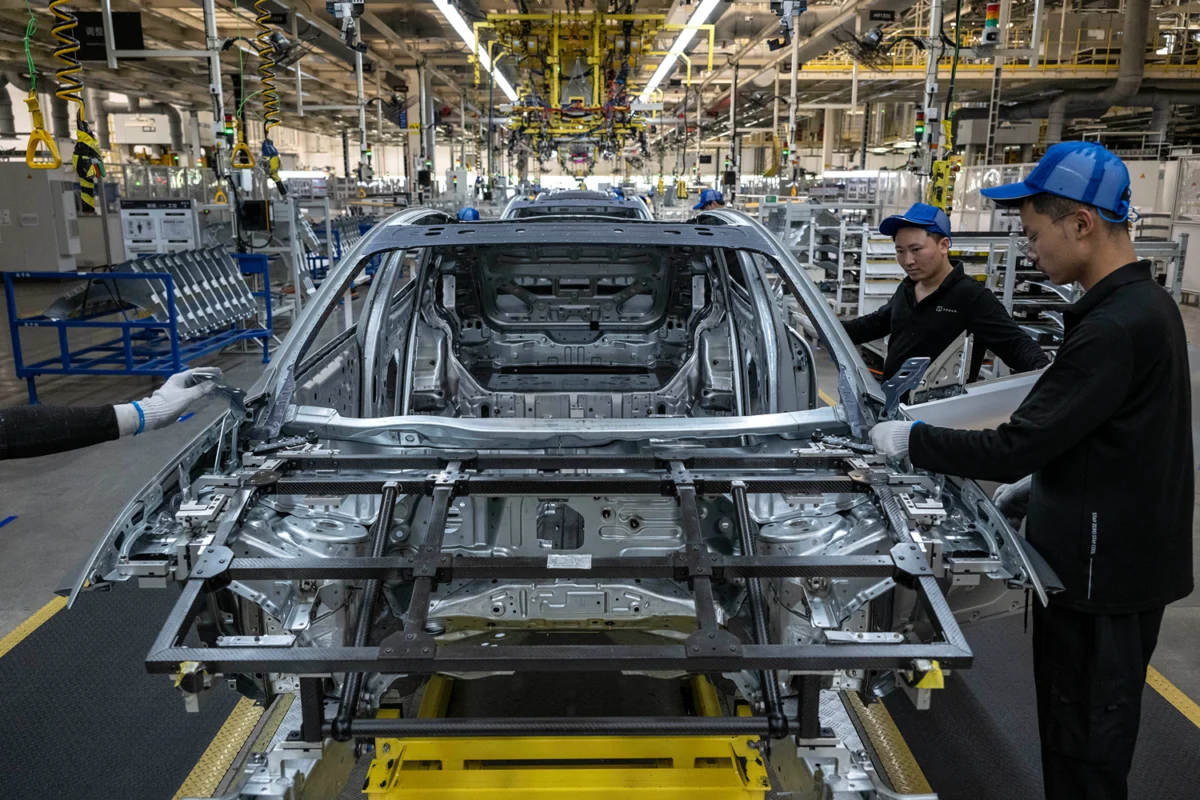
The global economy is currently grappling with a phenomenon that many Western policymakers have dubbed the "China shock." From the crowded ports of Europe to the emerging markets of Southeast Asia, the influx of Chinese goods—particularly electric vehicles (EVs), sophisticated robotics, and green energy infrastructure—has reached a scale that is fundamentally altering international trade dynamics. In August 2026 alone, China reported a record trade surplus of $119.1 billion, putting the country on a trajectory to eclipse its 2025 surplus of $1.2 trillion.
However, the prevailing Western narrative—that this dominance is the result of a monolithic, omnipotent Beijing orchestrating a grand, top-down industrial strategy—is increasingly viewed by experts as a dangerous oversimplification. The reality is far more chaotic. China’s manufacturing bulldozer is not a precision-engineered machine steered solely by the State Council; it is a sprawling, fragmented, and often uncontrollable force driven by fierce competition between local governments.
The Myth of Centralized Omnipotence
The conventional view suggests that China’s industrial might is the product of long-term strategic planning. While the central government certainly sets the national agenda, the results often diverge wildly from the initial blueprints.
Consider the high-speed railway program. In 2004, the State Council envisioned a modest network of 12,000 kilometers of track to be completed by 2020. By the time that deadline arrived, China had constructed nearly 38,000 kilometers. This was not a triumph of top-down planning, but rather a surrender to bottom-up pressure. Provinces and counties, desperate to link their jurisdictions to the national network to stimulate their own economies, engaged in relentless lobbying. Beijing, rather than curbing this expansion, repeatedly revised its plans to accommodate the clamor of local interests.
A similar divergence occurred in the automotive sector. The central government’s initial ambition was to consolidate the market around a few state-owned giants like First Automotive Works (FAW), partnering them with established foreign firms. Instead, the market was transformed by private, scrappy, and hyper-competitive firms such as BYD, Geely, and Nio. These companies did not rise because of a central directive; they rose because they were incubated, funded, and protected by ambitious local governments competing for the next big industrial win.
The Architecture of Overcapacity: A Chronology of Incentives
To understand how China’s overcapacity problem persists despite Xi Jinping’s vocal opposition, one must look at the structural incentives of the Chinese bureaucratic system.
- 1990s–2010s: The GDP Tournament: For decades, the Chinese Communist Party (CCP) used GDP growth as the primary KPI for official promotion. This created a "tournament" environment where local officials competed fiercely to attract investment and build infrastructure.
- 2015–2020: The Shift in Priorities: As the central government began emphasizing environmental protection and social welfare, the criteria for advancement became more nebulous. However, the nature of the competition did not change—only the metrics did.
- 2021–Present: The "Attention Economy": With GDP no longer the sole ticket to promotion, local officials now compete for the most scarce resource in China: the attention of senior leaders in Beijing.
Because the central government holds significant regulatory and financial power, local bureaucrats must constantly signal their alignment with national priorities. If Beijing signals a push for "New Quality Productive Forces"—such as AI, EVs, or robotics—every locality across the nation rushes to dump capital into these sectors simultaneously. The result is not a coordinated national strategy, but a frantic, uncoordinated "gold rush" that inevitably leads to massive overcapacity.
Data and Disparity: The Financial Cost of Competition
The economic data suggests that this system is reaching a breaking point. In July 2026, officials in Changchun, the home base of the state-owned FAW, admitted the city faced "unprecedented difficulties," with industrial profits plummeting 20 percent in 2025. Yet, despite such failures, the incentive structure forces local leaders to keep doubling down.
Local governments in China account for approximately 85 percent of general budget spending, yet they have few formal channels to influence central policy. To secure the funding and political favor they need, they resort to creative, sometimes absurd measures:
- Influential Ties: Deploying retired local officials who maintain personal connections to central leaders to lobby for specific projects.
- Mega-Events: Hosting international summits or games to force a visit from top leadership, creating a "camera-ready" moment that can be leveraged into billions of dollars in fiscal transfers.
This "attention economy" is a direct response to a massive information deficit. Because the central government struggles to verify the actual performance of thousands of local units, it relies on visible, photogenic, and "on-message" projects. Consequently, local bureaucrats prioritize building EV plants over solving structural social problems, because the former provides a clearer signal of loyalty to the center.
The Structural Impasse: Short Tenures and Moral Hazard
The problem is exacerbated by the "three-and-a-half-year itch." Provincial and city leaders typically serve in their posts for only 42 months. This short tenure creates a perverse incentive for "vanity projects." An official must show rapid, quantifiable results to earn a promotion, leaving them little time to focus on long-term sustainability.
When an official leaves office, the debt and the consequences of failed investment projects—often disguised as local government debt—remain behind. Because there is no mechanism to hold officials accountable for projects that fail five or ten years after they have been promoted, the cycle of overinvestment repeats with every leadership turnover. Successors often launch their own, brand-new projects to distinguish themselves, leading to a permanent state of redundant construction.
Official Responses and Global Implications
Beijing is not blind to these issues. President Xi Jinping has explicitly warned against "disorderly development" in the EV and AI sectors. However, these warnings are often toothless. In a system where the primary driver of career success is the ability to out-compete neighboring districts for central attention, the leader’s rhetoric is easily ignored in favor of the systemic pressure to grow.
The international implications are profound. Washington, Brussels, and the capitals of Southeast Asia often frame the "China shock" as a predatory trade strategy. While this is true in effect, it is not necessarily the result of a unified conspiracy. It is the output of a system designed to reward local competition, which has now reached a scale where it can overwhelm global markets.
Conclusion: The Folly of Rewarding A, While Hoping for B
The fundamental issue is what organizational theorist Steven Kerr famously called "the folly of rewarding A, while hoping for B." Beijing wants sustainable, high-quality growth (B), but its bureaucratic incentive structure rewards local officials for massive, visible, and rapid industrial investment (A).
Until the Chinese government can decouple the promotion of its officials from the cycle of short-term investment, the "China shock" will likely continue unabated. The central government is effectively trapped: it relies on local competition to drive its economy, but that same competition is the engine of the overcapacity that is currently sparking trade wars and economic instability worldwide. Restructuring these incentives is not merely a matter of economic reform; it is a deep-seated organizational challenge that may define the limits of China’s rise in the coming decade.