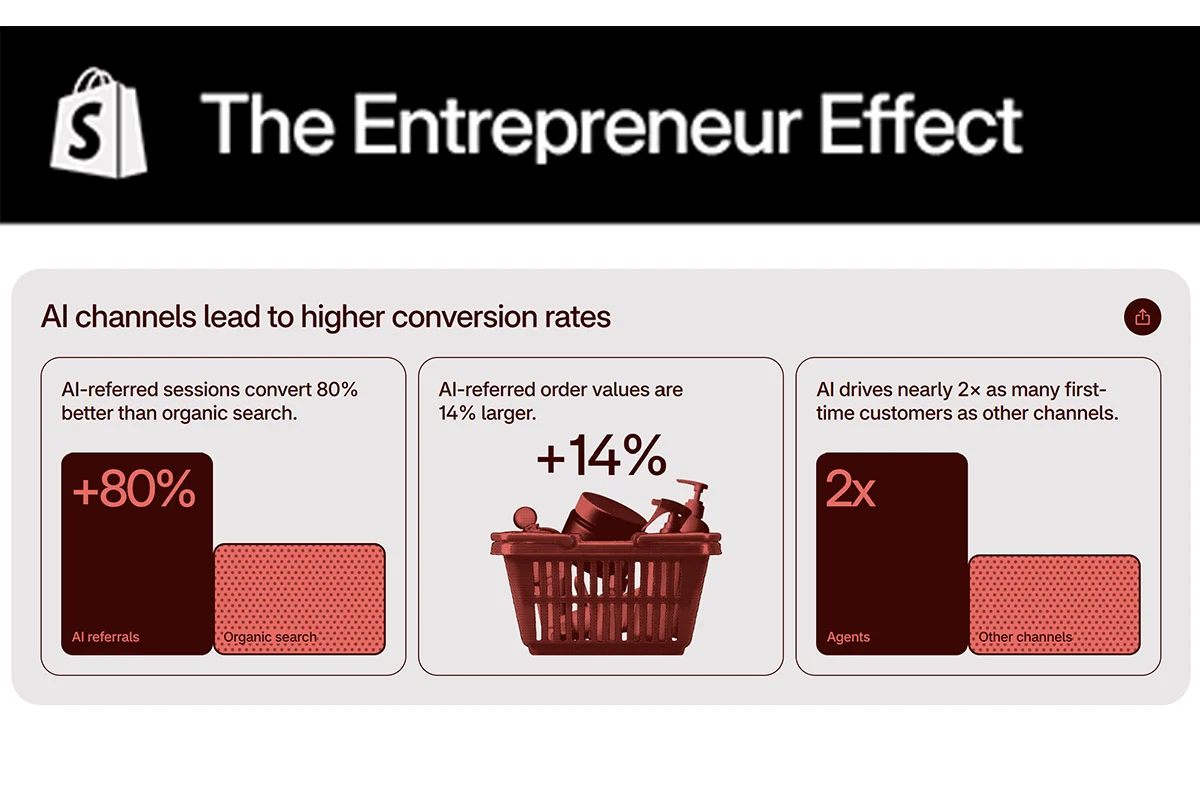
In the modern economic landscape, the traditional archetype of the "corporate ladder" is being rapidly eclipsed by the rise of the individual entrepreneur. No longer confined to the margins of the economy, small-to-medium-sized business owners have emerged as a primary force for global growth, innovation, and job creation. New data released by commerce giant Shopify confirms this seismic shift, revealing that its merchant and partner ecosystem generated a staggering $1.2 trillion in global economic activity over the past year—a 110% increase compared to 2022.
This surge in activity is not merely a statistical anomaly; it is a fundamental transformation of how commerce functions. As barriers to entry crumble under the weight of artificial intelligence and streamlined digital infrastructure, the "Entrepreneur Effect" is creating a ripple that is being felt from local communities to international trade corridors.
The Magnitude of the Impact: A Chronology of Growth
The evolution of the Shopify ecosystem offers a compelling timeline of how quickly the digital economy has matured. In recent years, the platform has transitioned from a niche service for small retailers to the backbone of a global commercial infrastructure.
By the end of the fiscal year ending June 30, 2026, the reach of these businesses had extended far beyond domestic borders. Shopify merchants generated $68.1 billion in cross-border sales during this period, highlighting a world where geography is no longer a limiting factor for growth. This trajectory has been mirrored by the platform’s capacity to sustain the labor market: Shopify-powered businesses supported approximately 9.6 million jobs worldwide last year, a 193% increase since 2022.
The acceleration is perhaps best captured by the speed at which new ventures come to life. In 2025 alone, approximately 1.2 million stores made their first sale on the platform—a rate of one new business opening every 26 seconds. Since 2018, the number of first-time sellers on Shopify has grown sevenfold, suggesting that we are currently living through an era of unprecedented entrepreneurial democratization.
The Entrepreneur Effect: Unveiling the Data Hub
To better understand these shifting dynamics, Shopify has launched The Entrepreneur Effect, a new global data hub. By synthesizing platform analytics, merchant and third-party surveys, and sophisticated economic-impact modeling, the hub serves as a diagnostic tool for the modern business landscape. It seeks to answer a fundamental question: What happens when the average person is given the tools and opportunity to build a business?
The findings suggest that entrepreneurship is no longer a "leap of faith" requiring years of planning and significant capital. Instead, it has become a responsive, agile endeavor. Dr. Gary Dushnitsky, an entrepreneurship professor at the London Business School, notes that the process of starting a business has undergone a radical transformation. "When we think about many of the innovations around us—whether that’s product innovation, cultural innovation, or new ways of building value—this happens through the act of entrepreneurship," Dushnitsky observes. "This is probably one of the most exciting times to be an entrepreneur, as starting a business has fundamentally changed from a matter of months to a matter of hours."
Official Perspectives: The Strategic Vision
The leadership at Shopify views this data as proof of a changing global ethos. Harley Finkelstein, President of Shopify, frames the rise of these independent businesses as the defining narrative of 21st-century commerce. "Entrepreneurship is what happens when ambition meets agency," Finkelstein stated during the launch of the hub. "We’ve never seen that happening faster, in more places, and with greater success, than we’re seeing today. The future of commerce is being written now."
This sentiment is echoed at the regional level, where the impact is tangible. Stephen Rogan, Head of Customer Success for EMEA at Shopify, points to the United Kingdom as a prime example of this momentum. "The ripple effect of entrepreneurship is clear," Rogan noted. "In the last year, Shopify data shows £71.1 billion in economic activity and 479,000 jobs supported in the UK. With cross-border sales increasing by 136%, British entrepreneurs are also reaching more customers beyond their home market."
Technological Catalysts: Why Now?
The core question driving this growth is why entrepreneurship is exploding at this specific moment in time. The answer lies in the intersection of three key technological shifts: the reduction of friction, the empowerment of AI, and the globalization of digital markets.
1. Lowering Barriers to Entry
Historically, the "gatekeepers" of commerce—large retail chains and complex logistics networks—made it difficult for individuals to compete. Today, technology has effectively flattened the field. The time, technical skills, and initial capital required to test a market idea have plummeted. Entrepreneurs can now launch a storefront, manage inventory, and process global payments without needing a degree in computer science or a warehouse of physical goods.
2. The AI "Superpower"
Artificial Intelligence is acting as a force multiplier for small teams. AI-led discovery, automated customer support, and personalized marketing tools allow a single entrepreneur to perform tasks that once required a marketing department and a data analyst. By reducing the cognitive load of running a business, AI allows founders to focus on the "human" elements of commerce: product design, brand storytelling, and community engagement.
3. Expanding the Opportunity Horizon
Digital commerce has effectively rendered geography irrelevant. A small craft business based in a rural village can now reach consumers in major metropolitan areas across the globe with the same ease as a multinational corporation. This access to global markets is not just an opportunity for profit; it is an opportunity for cultural exchange and the scaling of niche ideas that would have been commercially unviable just a decade ago.
Economic Implications: A New Social Contract
The data presented by The Entrepreneur Effect has profound implications for policymakers, educators, and the global workforce. If 9.6 million jobs are being supported by a single platform’s ecosystem, it indicates that entrepreneurship is becoming a critical pillar of social stability and economic resilience.
Job Creation vs. Traditional Employment
As large organizations undergo structural shifts and layoffs, the entrepreneurial sector is providing a vital alternative. The jobs supported by Shopify merchants range from logistics and warehouse fulfillment to digital design and influencer marketing. This creates a more diversified labor market, where individuals are less dependent on single large employers and more integrated into a decentralized network of businesses.
The Decentralization of Wealth
By empowering individuals to capture the value of their own ideas, the digital economy is, in many ways, decentralizing wealth. The ability to sell directly to consumers allows for higher margins for the creator and a more transparent value chain. This shift empowers the "middle class" of the global economy, as small business owners reinvest their earnings back into their local communities.
Challenges and Future Outlook
Despite the overwhelmingly positive trends, the data also highlights the necessity for ongoing support. As the barrier to entry lowers, the barrier to sustainability remains a hurdle. Scaling from a "side hustle" to a durable, long-term business requires a different set of skills—financial literacy, supply chain management, and long-term strategic planning.
The future of commerce, as indicated by the report, will likely be defined by "hyper-personalization." As AI continues to evolve, the businesses that succeed will be those that use technology not just to sell, but to build deep, lasting relationships with their customers.
Conclusion
The findings from Shopify’s The Entrepreneur Effect paint a portrait of a world in the midst of a commercial renaissance. We are moving away from an economy dominated by monolithic entities and toward a more vibrant, interconnected, and decentralized system powered by millions of individual ambitions.
Whether it is the 1.2 million new stores launched in 2025 or the $1.2 trillion in economic activity generated by the ecosystem, the message is clear: entrepreneurship is the most effective tool we have for driving global prosperity. As we look toward the remainder of the decade, the ability to turn an idea into a global business in a matter of hours will not just be an advantage—it will be the standard. The "future of commerce" is not a distant prediction; it is a reality being built, one click at a time, by the next generation of global entrepreneurs.