The landscape of e-commerce is undergoing a seismic shift. For two decades, the "blue link" search result—the foundational architecture of Google—defined how brands acquired customers. Today, that paradigm is being eclipsed by the rise of "Agentic Commerce," where generative AI models like ChatGPT and Google AI Mode act as shopping concierges.
A landmark behavioral study, In AI Shopping, the Product Card Is Your Storefront, commissioned by ReFiBuy and executed by Clickstream Solutions, has identified a singular, non-negotiable element that determines success in this new ecosystem: the product card. As AI begins to curate the path to purchase, these visual modules—which aggregate images, pricing, and key product data—are no longer just supplemental information; they are the primary point of conversion.
The Architecture of AI Shopping: Main Facts
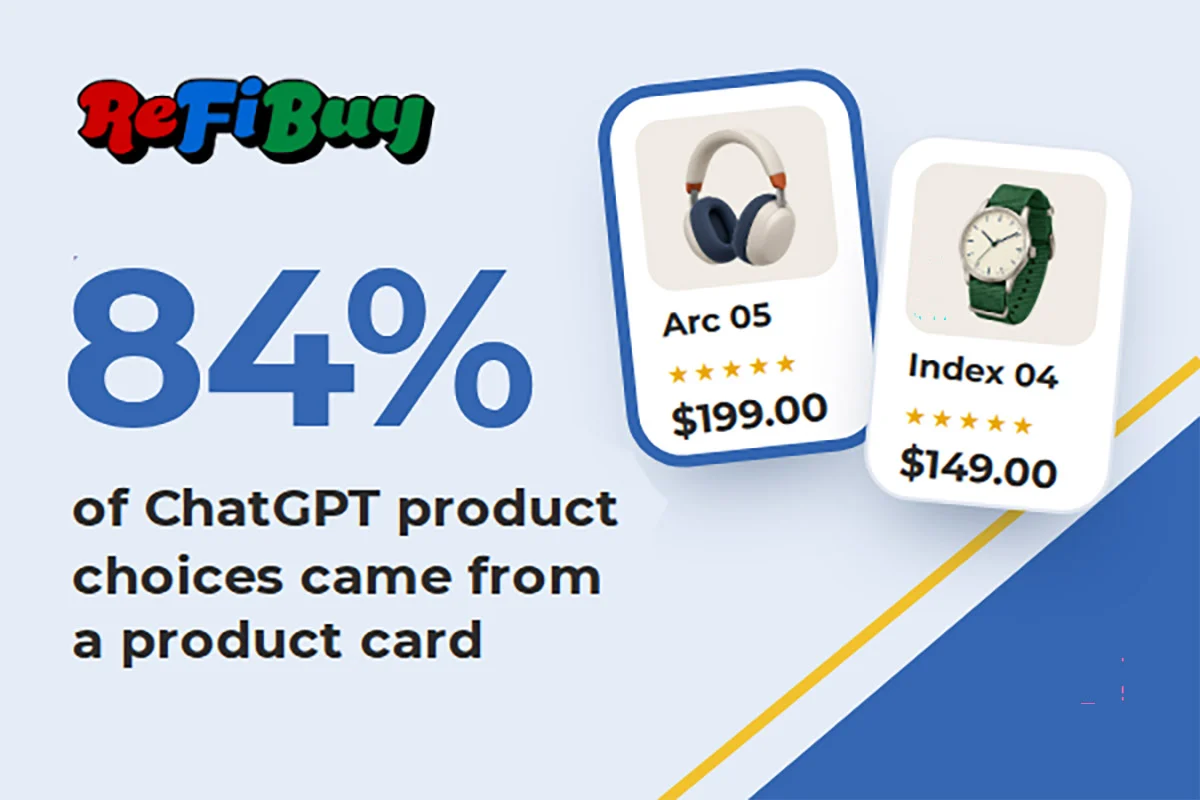
The study, which tracked 40 U.S. participants through 224 distinct shopping tasks across six product categories, offers the first granular look at how humans interact with AI-generated commerce recommendations. The data reveals a startling trend: 84% of final product selections in ChatGPT were made directly from product cards.
This statistic marks a fundamental change in the digital funnel. In traditional SEO, a user might click a link, visit a landing page, read reviews, and eventually purchase. In the age of AI, the "storefront" has been compressed into a single, high-fidelity visual card. If a brand’s product does not manifest in a card format, or if that card fails to convey the necessary information, the brand is effectively invisible, regardless of how high they might rank in a text-based search query.
A Chronology of the Shift: From Search to Suggestion
To understand the significance of this study, one must look at the evolution of digital discovery.
- The Era of Passive Search (2000–2015): The era of the "ten blue links." Users typed keywords into a search bar, evaluated a list of websites, and navigated away from the search engine to perform the purchase on a retailer’s site.
- The Era of Marketplaces (2015–2022): The dominance of the Amazon "Buy Box." Shoppers began bypassing general search in favor of specialized commerce engines, prioritizing convenience and speed.
- The Era of Agentic Commerce (2023–Present): The rise of AI assistants. AI now synthesizes vast amounts of data to provide a curated list of recommendations. The user no longer "searches"; they "consults."
The study captures this transition in real-time. By observing users as they compared, rejected, and ultimately selected products via ChatGPT and Google AI Mode, the researchers captured not just the what of consumer behavior, but the why. Participants provided spoken commentary that revealed a psychological reliance on the AI’s curated output. If the AI presented a product card, the user felt a higher level of trust and urgency to convert within that interface.
Supporting Data: The Power of Position
Perhaps the most striking finding in the report is the correlation between card position and conversion rates. Much like the "Golden Triangle" of traditional SEO, where the top organic result received the lion’s share of clicks, AI shopping follows a strict hierarchical bias.
According to Eric Van Buskirk, founder of Clickstream Solutions, the data demonstrates a "first-mover advantage" that is significantly more pronounced in AI than in traditional web search. "When an AI assistant showed two or more product cards, shoppers chose the first one 43.4% of the time," Van Buskirk noted. "Chance would put that at about 29%. Nearly all of the advantage goes to the top slot. The second card was chosen less often than chance would predict."
This indicates that AI shopping is not a browsing experience—it is a decision-making experience. Users are looking for the AI to validate their choice. When the AI presents a primary recommendation in the first card, the cognitive load on the consumer is reduced, leading them to abandon the search for alternatives and finalize the purchase. This "winner-take-all" dynamic is forcing a radical re-evaluation of how brands must approach their digital presence.
Official Perspectives: The Industry Mandate
The industry response to these findings has been swift. Scot Wingo, co-founder and CEO of ReFiBuy, has been vocal about the implications for retailers, drawing a direct parallel between the new AI paradigm and the legacy of the Amazon Buy Box.
"The Agentic Commerce user behavior study proved our thesis that, like the Amazon Buy Box, product cards on ChatGPT are critical to winning the consumer’s buying decision," Wingo stated. "Being mapped correctly to a product card and appearing as high as possible in the offer-card list are absolutely critical to optimizing for ChatGPT."
Wingo’s perspective underscores a reality that many marketing departments have yet to fully internalize: the traditional website is losing its role as the primary "storefront." Instead, the "storefront" is now wherever the AI decides to display it. Brands that fail to optimize for the AI’s extraction algorithms will find themselves excluded from the most important real estate in the digital economy.
Implications for Brands: The Rise of ACO
For brands currently invested in Answer Engine Optimization (AEO) and Generative Engine Optimization (GEO), the study offers a clear roadmap. Visibility is merely the baseline; the competitive battlefield has moved to the "Agentic Commerce Optimization" (ACO) layer.
1. The Death of Information Discrepancy
One of the most revealing aspects of the study was the consumer’s reaction to price and variant inconsistencies. Participants frequently identified mismatches between the product card, the offer card, and the actual product page. In the context of an AI-led purchase, these inconsistencies were often fatal to the conversion. When the AI displays a price on a card that differs from the final checkout page, the "trust bridge" is broken. Brands must now ensure that their data feeds are flawlessly synchronized across every touchpoint.
2. Prioritizing the "Top Slot"
Because the first product card commands 43.4% of choices, ACO is now a game of ranking. Brands must optimize their metadata, product descriptions, and visual assets to satisfy the AI’s preference for clarity and relevance. This includes utilizing high-quality imagery and structured data that AI models can easily ingest and translate into a card format.
3. The New Content Strategy
The study suggests that content strategy must pivot. Instead of creating long-form blog posts designed to rank for keywords, brands should focus on creating "AI-ready" assets. This means providing concise, structured information that directly answers consumer questions, which the AI can then summarize into a card.
4. Monitoring the "Non-Click"
ReFiBuy’s study also tracked product cards that were considered but never clicked. This data is invaluable. It suggests that brands need to understand the "rejection criteria" of AI users. Why did a user see a card and decide not to click? Was the price too high? Was the image unappealing? Was the description vague? By analyzing these "near-misses," brands can iterate on their digital storefronts more effectively.
Conclusion: Adapting to the New Reality
The transition to Agentic Commerce is not a trend; it is a structural change in how consumers interact with the internet. As ChatGPT, Google AI, and other LLM-based interfaces continue to integrate into the daily lives of billions, the "search and browse" model will continue to decline in favor of the "ask and buy" model.
The research conducted by ReFiBuy and Clickstream Solutions provides a sobering reality check for brands: your website is no longer your primary store. Your product card is. Brands that fail to prioritize ACO, neglect their data hygiene, or ignore the primacy of the top-slot position in AI results will find their customer acquisition costs rising and their market share eroding.
The future of retail is being written in the code of generative AI. For those who understand that the product card is the new storefront, the opportunity to dominate this new landscape is significant. For those who remain tethered to the strategies of the past, the storefront doors may soon be closing.