The North American supply chain is entering a protracted period of structural strain. Despite a generally tepid freight demand environment, cross-border trucking capacity between the United States, Mexico, and Canada is expected to remain severely constrained well into 2027. This paradox—soft demand paired with high rates and limited truck availability—is being driven by a confluence of regulatory tightening, a generational labor crisis, and a prohibitive financial environment that has effectively frozen fleet expansion.
Executives at the logistics provider TRAFFIX have sounded the alarm, noting that the typical market response to high freight rates—an influx of new carriers—is conspicuously absent. Unlike the post-COVID-19 surge, which saw a wave of new entrants capitalize on record-high rates, the current market is defined by defensive positioning and capital preservation.
The Financial "Iron Curtain": Why Fleets Cannot Expand
The primary engine behind this capacity stagnation is the cost of capital. During the pandemic, the trucking industry was fueled by government stimulus and low-interest-rate loans, allowing owner-operators and small fleets to scale rapidly. That era has definitively ended.
Today, prospective entrants face interest rates ranging from 8% to 9%, a significant hurdle for those looking to finance heavy-duty equipment. Alex Fuller, vice president of commercial intelligence at TRAFFIX, notes that this shift is fundamental to the current market behavior.
"We’re only four or five years later, and we’re not seeing that [market expansion]," Fuller explained. "It’s like, okay, well, what’s different? The answer is the regulatory landscape and the cost of entry. Financing isn’t just expensive; it’s prohibitive for smaller players who would typically provide the ‘swing capacity’ during peak shipping seasons."
Because carriers cannot afford to add new trucks, the industry is seeing a permanent reduction in its ability to handle sudden volume spikes. This ensures that freight rates will remain elevated for a much longer duration than the rapid corrections observed in previous cycles.
Chronology of a Crisis: From Pandemic Boom to Structural Shortage
To understand the current bottleneck, one must look at the progression of the last 48 months:
- 2020–2022: The "Gold Rush" period. High freight rates and cheap credit triggered a massive, albeit often inefficient, expansion of the North American carrier base.
- 2023–2024: The correction. As demand cooled, smaller, debt-burdened carriers began to exit the market. Simultaneously, interest rates began their ascent, effectively closing the door on new equipment financing.
- 2025 (Year-to-Date): The Regulatory Squeeze. Increased enforcement regarding cabotage and visa compliance—particularly at the U.S.-Mexico border—has systematically removed thousands of qualified drivers from the available pool.
- Late 2026 and Beyond: The "New Normal." The industry has reached a state of equilibrium where capacity is structurally lower than pre-pandemic levels, leading to the current tightening of the market.
Supporting Data: The North American Cross-Border Index
The TRAFFIX North American Cross-Border Index serves as a barometer for this strain. In October, the index registered 57 for Canada and 54 for Mexico. In the context of this data, any reading above 50 signals an environment defined by higher costs, limited truck availability, and regulatory friction.
Even as shipment volumes remain relatively flat, the index shows that the "ease of shipping" has plummeted. Shippers are finding that when their primary contracted carriers fail to cover a load, the secondary and tertiary options are either non-existent or prohibitively expensive.
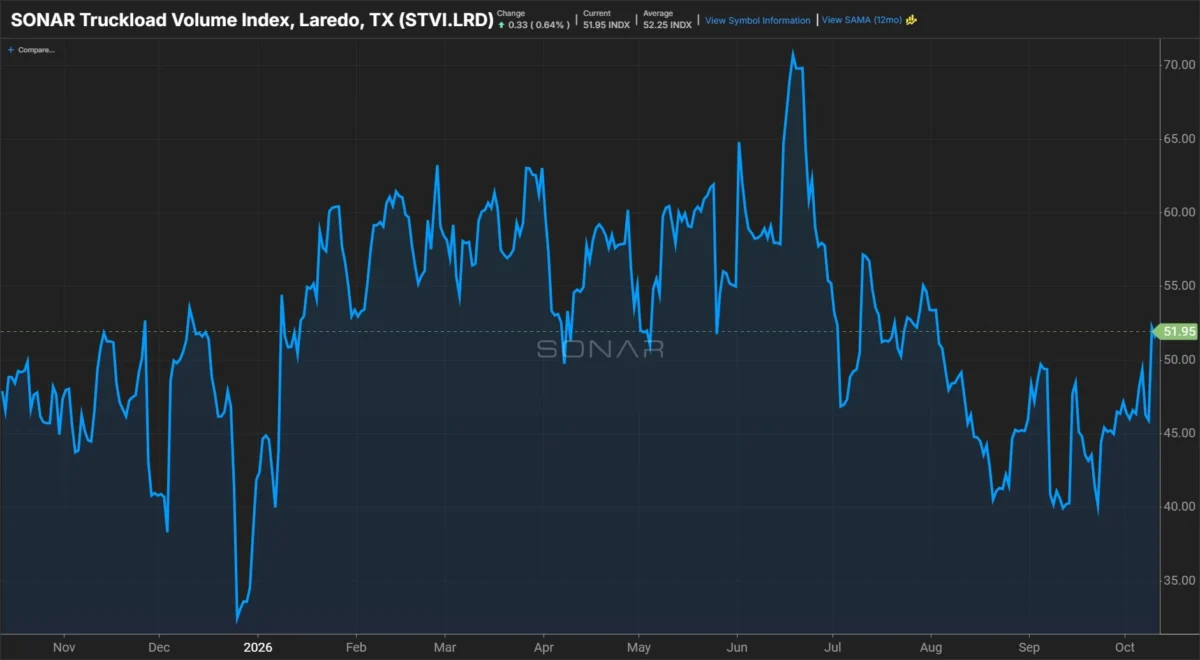
Furthermore, real-time data from FreightWaves’ SONAR platform confirms this reality in key corridors. In Laredo, Texas—the heartbeat of U.S.-Mexico trade—the Outbound Tender Volume Index (STVI.LRD) surged from 39.95 in mid-September to 51.95 by mid-October. Simultaneously, the Weighted Rejection Index (SWRI) flipped from negative to positive territory, indicating that carriers are increasingly turning down contract loads, forcing freight into the more expensive, volatile spot market.
Mexico: A Perfect Storm of Regulation and Labor
In Mexico, the crisis is twofold: a severe shortage of qualified drivers and a deteriorating geopolitical and regulatory environment regarding cross-border movement.
Patricio Gutierrez, carrier sales manager for TRAFFIX in Manzanillo, identifies the B-1 visa crisis as a primary bottleneck. Recent U.S. crackdowns have led to the revocation of approximately 25,000 visas for Mexican freight drivers. This is not merely an administrative issue; it is a loss of institutional knowledge and qualified personnel that cannot be replaced quickly.
"The main issue here is a lack of qualified drivers," Gutierrez says. "Cross-border operations require specific certifications and equipment that meet U.S. regulatory standards. When you remove 25,000 drivers, you are essentially crippling the supply chain at the border."
This is compounded by a demographic crisis. The average age of a Mexican long-haul driver is trending upward, with many in their 50s and 60s. Younger workers are bypassing the industry due to security concerns on Mexican highways and a lack of competitive compensation compared to other sectors. When coupled with infrastructure bottlenecks—such as the recent restriction of empty-truck crossings at Eagle Pass—the result is an industry that is perpetually operating in "crisis mode."
Canada: The "Florida Effect" and Inbound Imbalances
North of the border, the challenges take a different shape. Lance Halliday, TRAFFIX’s Toronto-based regional director of carrier sales, points to a structural trade imbalance as the primary culprit.
While Canadian exports to the U.S. remain relatively robust, the return flow of freight into Canada is weak. This leads to a scenario where drivers are frequently forced to return north with empty trailers, effectively halving the revenue potential of a round-trip.
This has created "no-go zones." Halliday cites Florida as a prime example. "Guys just won’t go [to Florida] because they’re getting stuck down there for days without a return load," he explains. "The cost of returning empty is so high that it wipes out the profit of the initial outbound move."
This imbalance has driven rate increases of 25% to 35% on certain corridors over the last six weeks alone. Carriers are essentially pricing in the risk of being stranded in a low-demand market, leading to a breakdown in traditional contract freight commitments.
Implications for Shippers: The Death of the "Primary Carrier"
The most significant implication for shippers is the erosion of the contract freight model. Across North America, carriers are increasingly "handing back" contract freight, choosing instead to play the spot market or simply refuse loads that do not meet their new, higher cost-of-operating thresholds.
For the shipper, this means:
- Increased Budgeting Volatility: Reliance on the spot market exposes shippers to rapid, unpredictable price spikes.
- Reduced Reliability: The "primary carrier" is no longer a guarantee of service. Shippers must now diversify their carrier base, which increases administrative overhead and complicates logistics management.
- Longer Transit Times: As capacity tightens, the time taken to source a truck and clear border checkpoints is expanding, creating a "hidden cost" in the form of inventory carrying times.
Looking Ahead: The 2027 Horizon
TRAFFIX executives offer little optimism for the short-to-medium term. With seasonal capacity reductions on the horizon for the fourth quarter and no sign of an influx of new equipment, the market is expected to remain tight for the next 18 to 24 months.
The "pandemic-era correction" that many analysts predicted—where rates would fall as supply normalized—has been derailed by the structural reality of high interest rates and the labor deficit. We are no longer in a cyclical downturn; we are in a period of fundamental supply chain transformation.
For the foreseeable future, shippers should prepare for a landscape where capacity is a premium asset. Success in this environment will belong to those who can build deeper, more resilient partnerships with carriers, moving away from the transactional, price-focused models of the past toward a strategy that prioritizes reliability and collaborative risk-sharing. The road ahead is narrow, and for those relying on the status quo, it is likely to get significantly bumpier.