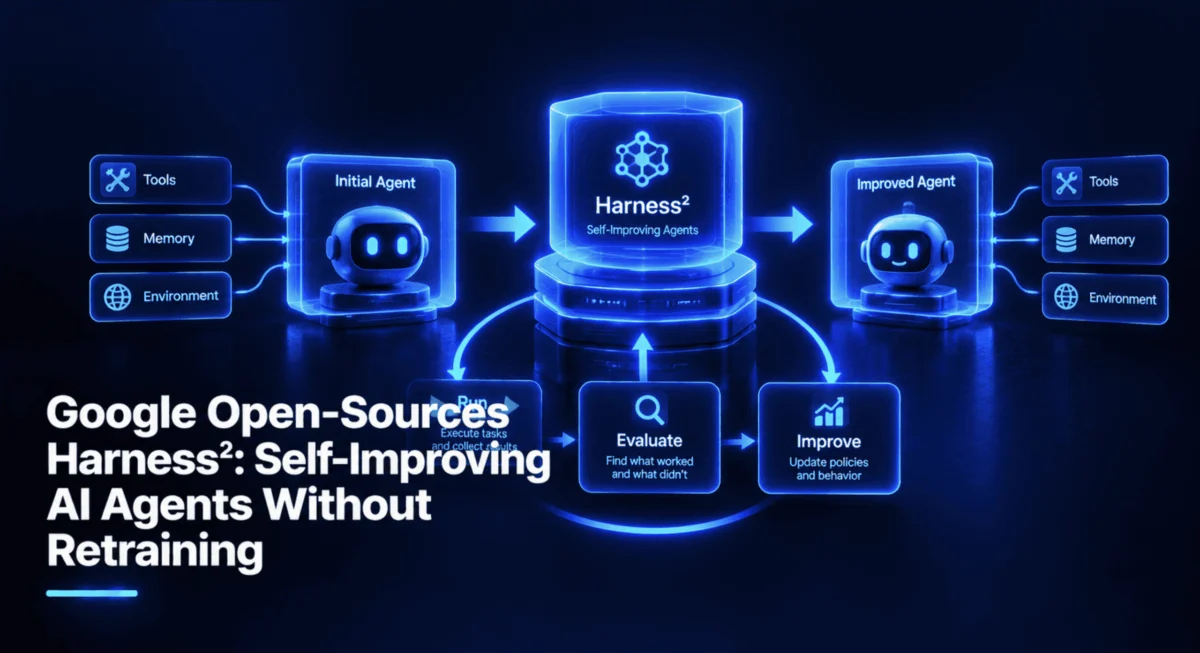
In a significant move for the field of artificial intelligence, Google Research has open-sourced Harness² (Harness-squared), a groundbreaking framework designed to enable AI agents to improve their performance autonomously without the need for costly and time-consuming model retraining. By shifting the focus from the static weights of a neural network to the dynamic environment surrounding it, Harness² introduces a recursive, self-improving architecture that could fundamentally change how we deploy AI agents in unpredictable, "open-world" environments.
The Core Concept: Redefining the Agent’s "Harness"
Traditionally, improving an AI agent’s performance has been an exercise in fine-tuning or Reinforcement Learning from Human Feedback (RLHF), both of which require significant computational resources, specialized datasets, and access to model weights. Google’s Harness² flips this paradigm on its head.
In this context, a "harness" is defined as the entire ecosystem supporting an AI model: its system prompts, available tools, memory structures, specific skills, and orchestration scripts. Harnessing—the process of optimizing these components—is typically a manual, iterative burden placed on human engineers. When an agent fails, a human must step in to refine the prompt, add a tool, or debug the logic. This is sustainable for static tasks but fails in the "open world," where agents encounter scenarios that developers could not have possibly anticipated.
Harness² automates this optimization. By keeping the underlying model weights fixed, the framework treats the agent’s surroundings as a modular system that can be edited. It focuses on eight critical components:
- System Prompts: The foundational directives that guide behavior.
- Guardrails: Safety protocols that constrain output.
- Memory: Long-term storage for continuity across sessions.
- Skills: Reusable, task-specific instructions.
- Tool Guidance: Heuristics on how to effectively utilize external APIs or code.
- Scripts: Helper functions executed by the agent.
- Subagents: Delegation protocols for complex task decomposition.
- Plugins: Middleware that intercepts and shapes the tool-loop.
A Chronology of Recursion: How Harness² Learns
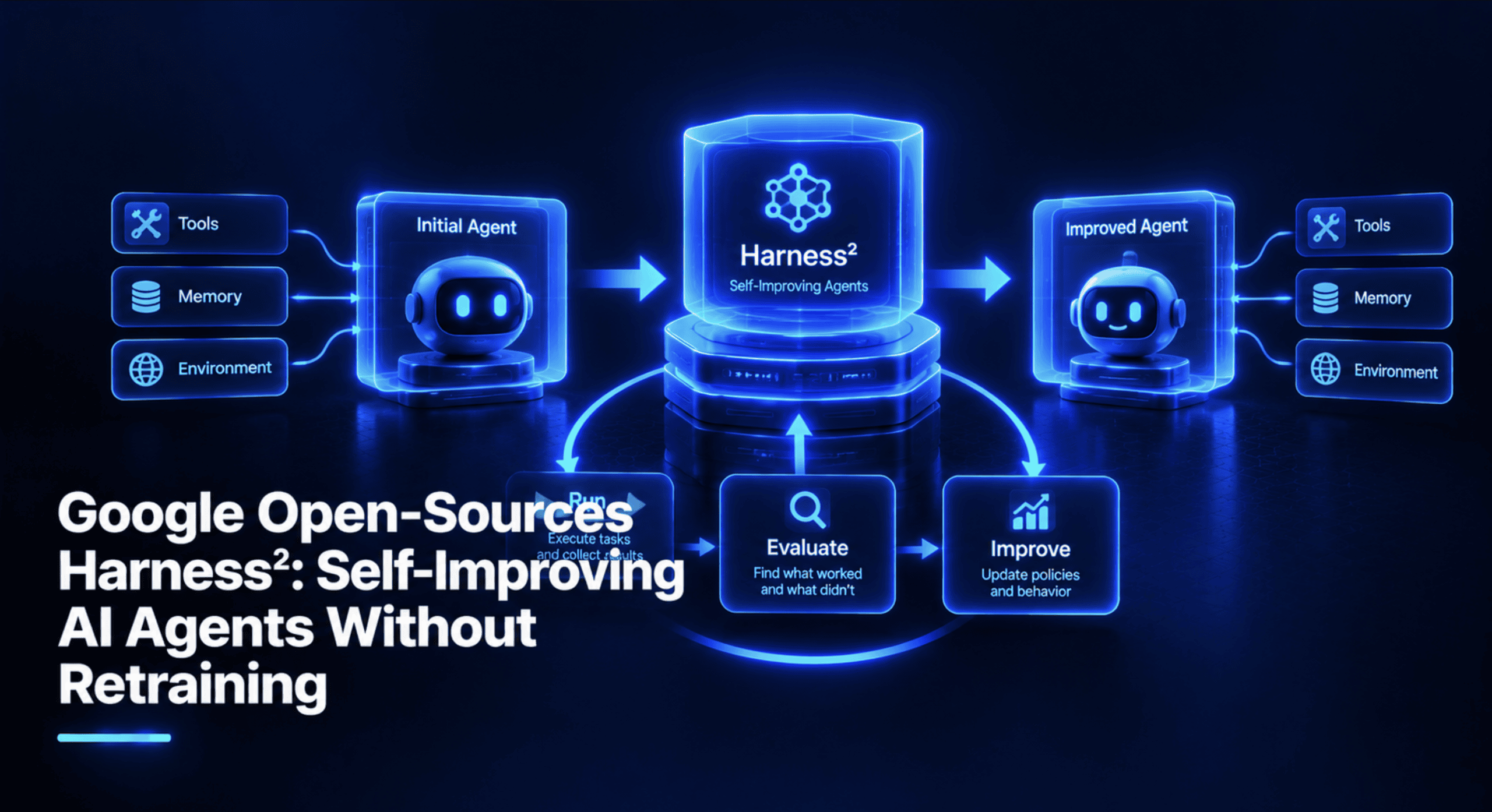
The name "Harness²" is derived from its dual-layered recursive structure. The framework operates on two distinct loops, ensuring that improvements are not only immediate but cumulative.
Loop 1: Task-Level Recursion (Propose–Probe–Compose)
At the task level, the agent enters a cycle of refinement. It does not rely on ground-truth feedback (which is often unavailable in real-world scenarios). Instead, it learns through "behavioral contrasts." By running the agent multiple times and comparing the differences in execution, the framework identifies what worked and what failed. It then proposes changes to the harness, probes those changes against the task, and composes the final, optimized version.
Loop 2: Harnessing-Level Recursion
The second loop is the "Experience Reflector." After a task is completed, the system saves the successful harness and extracts "evidence-supported lessons." These lessons are stored in a persistent improvement library. When the agent faces a future task, it consults this library, meaning that every task performed serves as training data for the framework itself. The system gets better at improving agents, just as the agent gets better at the tasks.
Supporting Data: Benchmark Results
Google’s internal testing of Harness² provides a compelling look at the potential gains. Using GLM-5 and Gemini 3.5 Flash across three major benchmarks, the results suggest that even a single iteration of the Harness² loop (k=1) yields measurable performance improvements.
- WorkBuddy-Bench: Focusing on office, web, and coding tasks, the framework saw gains of up to 11.5 points.
- LAB (Legal Automation Benchmark): Drawing from Harvey’s harvey-labs, this benchmark saw a 11.8 percentage point increase in partial pass rates.
- JobBench: In general professional work tasks, the framework achieved a 4.5-point increase.
While these are "up to" figures, the consistency across domains indicates that the framework’s ability to "patch" its own behavior is a viable alternative to training-heavy methodologies.
Implementation: How to Deploy and Test
For developers eager to explore this, Google has made the framework accessible. The installation process leverages uv, a modern Python package manager, ensuring a streamlined experience.
The Setup Workflow
- Installation: Using
uv, developers can install the framework in an editable environment, allowing for rapid iteration and code modifications. - The Demo: Google provides a "no-API-key" demo. This is a crucial feature, as it allows developers to test the logic of the recursive loops using deterministic script editors rather than relying on an expensive LLM for every single iteration.
- Real-World Benchmarking: For those ready to move beyond the demo, the framework supports integration with Vertex AI. By configuring a
.envfile with Google Cloud project credentials, users can run full benchmarks like LAB.
The process of running a benchmark is highly structured:
- Setup:
harness2-setup labdownloads the necessary environment. - Verification:
harness2-checkensures that all dependencies and cloud credentials are correctly configured. - Refinement: The core loop runs the refinement process, where the "improver" model generates edits and the "executor" model applies them.
- Reporting: The final step involves the
harness2-judge, which evaluates the refined harness against the original to quantify the improvement.
Implications for the AI Ecosystem
The release of Harness² carries several profound implications for the industry.
1. The Democratization of Agent Improvement
Most organizations today interact with LLMs via APIs. They have no access to weights, meaning traditional fine-tuning is impossible. Harness² provides a path for these teams to achieve "fine-tuned-like" performance through external configuration. This lowers the barrier to entry for building high-performance, specialized agents.
2. Transparency and Observability
Because Harness² stores improvements as plain text files (scripts, prompts, and memory logs), the agent’s evolution is entirely auditable. Unlike a "black-box" fine-tuned model, where it is difficult to isolate why a model performs better, a Harness² agent provides a clear "paper trail" of every lesson learned and every script modified. This is a massive win for enterprise compliance and safety teams.
3. The Future of "Library-Based" Intelligence
The most significant long-term implication is the transition from "model-based" intelligence to "library-based" intelligence. If agents can build libraries of lessons that are transferable across tasks, we may be moving toward a future where we don’t just "train" a model once—we "raise" an agent over weeks or months of work, allowing it to accrue a massive, bespoke library of skills that make it uniquely effective for its specific domain.
Challenges and Future Outlook
Despite the excitement, the framework is in its infancy. Several open questions remain:
- Transferability: How well do lessons learned in a legal context (LAB) translate to, say, software engineering or supply chain management?
- Cost Efficiency: While it avoids training costs, the recursive nature of the framework—executing dozens of rollouts per task—consumes significant inference tokens. Determining the "crossover point" where this approach becomes cheaper than fine-tuning is essential.
- Safety: If an agent is allowed to rewrite its own scripts and prompts autonomously, it creates a new surface area for "agentic drift" or unintended behavior. The community will need to develop robust verification layers to ensure these self-edits stay within safe operational bounds.
Conclusion
Harness² represents a pragmatic, elegant approach to the challenge of agent autonomy. By acknowledging that the intelligence of an agent is not just in its "brain" (the weights) but in its "tools and instructions" (the harness), Google has provided a toolkit that allows developers to iterate faster and smarter. As the code is now available under the Apache 2.0 license, the next chapter of this story will be written by the community—testing its limits, optimizing its costs, and discovering just how far an agent can go when it is given the tools to teach itself.
For those looking to get started, the GitHub repository serves as the primary gateway to this new methodology, offering the documentation and tooling necessary to begin building the next generation of self-improving agents.