In the modern corporate landscape, the annual budgeting process is often viewed with dread—a chaotic scramble of version-controlled Excel files, manual data entry, and late-night reconciliations. For many organizations, the transition from legacy spreadsheets to specialized planning software is not merely a technical upgrade; it is a fundamental shift in how the business understands its future.
However, justifying the investment in dedicated planning platforms requires more than a simple comparison of license costs. According to findings from The Planning Survey 26 by BARC, the true value of these tools lies not in short-term cost-cutting, but in the qualitative transformation of transparency, planning quality, and strategic agility. To secure executive buy-in, organizations must move beyond the "Excel vs. Software" debate and build a rigorous, multi-dimensional business case.
Main Facts: The Value Gap Between Excel and Specialized Tools
The disparity in user satisfaction between those using specialized software and those relying on Excel is striking. Data from The Planning Survey 26 indicates that 87% of specialized planning software users would recommend their solution to a peer company, compared to only 41% of Excel users.
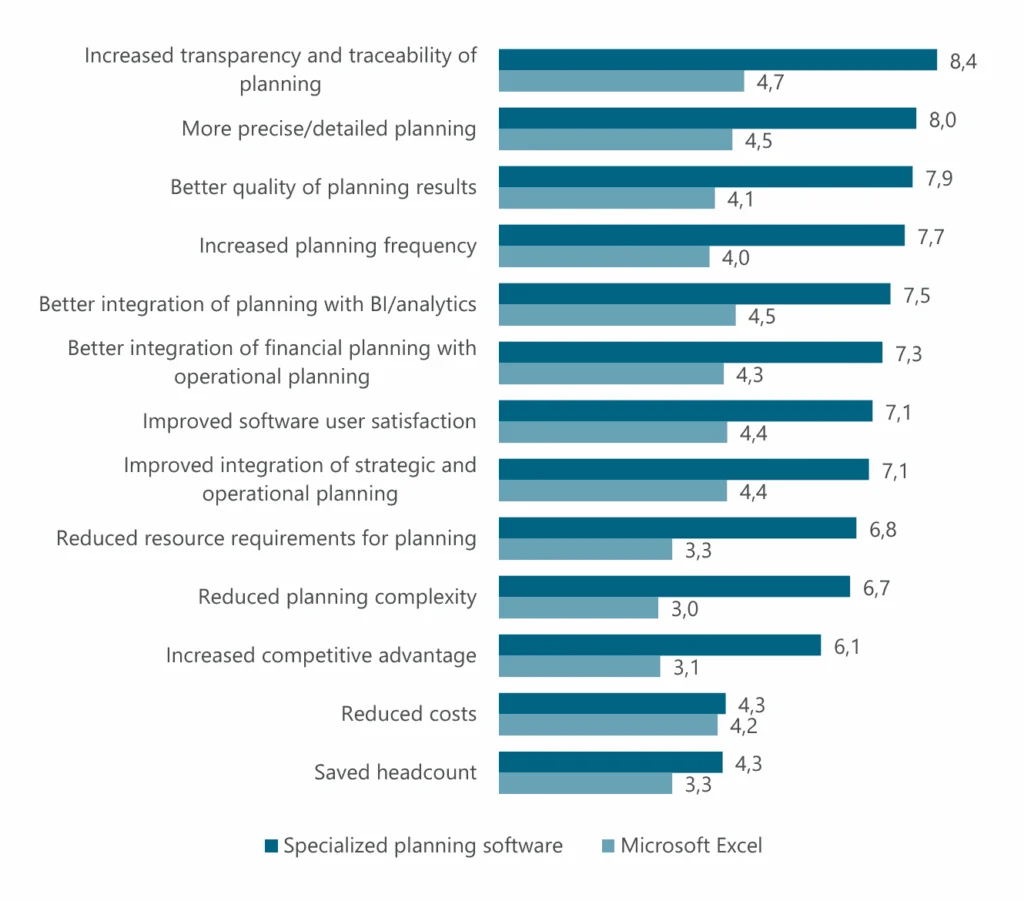
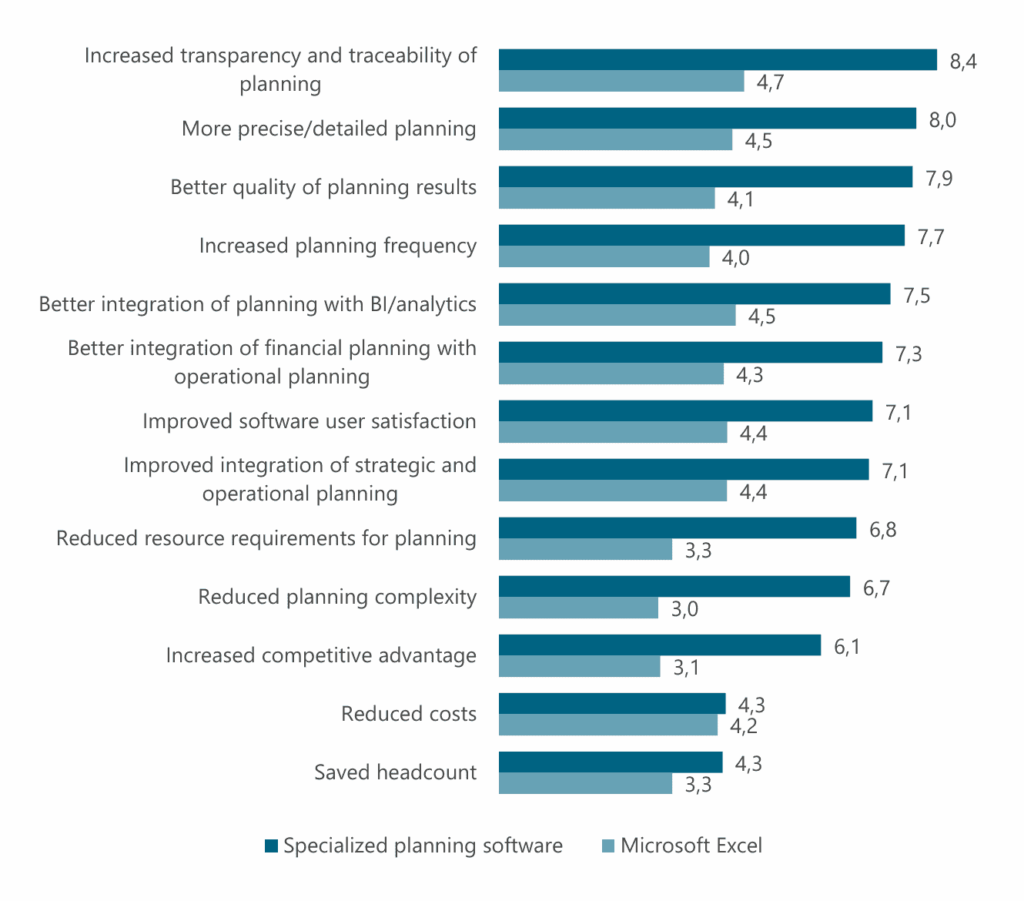
This gap is not merely a matter of preference; it is a reflection of functional utility. The Business Benefits Index (BBI) consistently ranks specialized software significantly higher in core areas:
- Transparency and Traceability: A score of 8.4 for specialized software versus 4.7 for Excel.
- Quality of Planning Results: 7.7 for software compared to 4.1 for spreadsheets.
- Planning Frequency: 7.5 for software compared to 4.0 for spreadsheets.
Crucially, the study reveals that cost reduction and headcount savings are the lowest-ranked benefits. This serves as a vital reality check for CFOs and project leads: if the business case is built solely on the promise of "fewer staff hours" or "lower software overhead," it will likely fail to capture the real, strategic value of the investment.
Chronology of the Business Case: From Vision to Execution
A robust business case is not a static document created to rubber-stamp a purchase; it is a roadmap that spans the entire lifecycle of the software adoption process.
- The Diagnostic Phase: Before engaging vendors, the organization must map its current planning pain points. Are forecasts stagnant? Is there a lack of accountability for budget variances? This phase defines the "why."
- The Valuation Phase: This involves quantifying the five key benefit areas (detailed below) into measurable KPIs. This is where assumptions are stress-tested against different scenarios.
- The Selection Phase: The business case must serve as the primary framework for vendor evaluation. 76% of successful organizations run a formal competitive evaluation, ensuring the chosen software aligns with the specific functional gaps identified earlier.
- The Post-Implementation Audit: The business case is not archived upon project go-live. It serves as the benchmark to measure success, comparing the actual ROI against the initial projections.
Five Pillars of Value: Structuring Your Business Case
To move from intuition to a data-backed proposal, the business case should be structured around five specific benefit areas. Each area requires a set of KPIs that make the qualitative benefits of "better planning" tangible.
1. Minimizing Process Friction
Planning is often plagued by "administrative drag"—the time spent manually loading data, fixing broken links in spreadsheets, and reconciling disparate versions. By centralizing assumptions and automating data workflows, organizations can reclaim significant labor hours. The objective here is not necessarily to reduce headcount, but to pivot that labor toward high-value activities like scenario analysis and management advisory.
2. Elevating Quality, Transparency, and Speed
Management decisions are only as good as the underlying data. An integrated planning solution allows for clear audit trails, where every assumption behind a forecast is visible and linked to actual results. KPIs for this pillar include the "time to forecast" (how quickly can the finance team adjust to a market shift?) and the consistency of management reports across different departments.
3. Achieving Scalability and Integration
As businesses grow, the complexity of their planning needs scales exponentially. A system that works for a single entity often crumbles under the weight of multiple currencies, legal entities, and complex allocations. The business case must account for "architecture overhead." A scalable platform allows the company to absorb new data sources and requirements without needing to rebuild the entire logic model from scratch.
4. Risk Mitigation and Governance
Manual, spreadsheet-based planning is a significant operational risk. Without clear version control or audit logs, companies face the danger of incorrect figures, delayed decision-making, and an over-reliance on "spreadsheet heroes"—employees whose specific knowledge is the only thing holding the process together. Risk assessment should be conservative, assigning a weight to the likelihood of these failures and the cost of remediation.
5. Enhancing Strategic Agility
This is the "advanced" pillar. It includes rolling forecasts, simulation capabilities, and AI-assisted modeling. However, the business case must be honest here: these are only benefits if the organization has the underlying data maturity to support them. If the data foundations are not stable, these features will remain unused. The business case should categorize these as a subsequent stage of maturity rather than a Day 1 benefit.
Supporting Data and Evidence: The "Reality Check"
The evidence from The Planning Survey 26 provides a crucial baseline for internal benchmarking. When comparing the scores of specialized tools versus Excel, the data shows that the primary advantage is not the speed of the software, but the "truth" of the numbers it produces.
Decision-makers often fall into the trap of assuming that "faster" is the same as "better." The data suggests otherwise. While users of specialized software do report faster forecasts, the highest scoring criteria are consistently those related to reliability and transparency. This is a critical insight for stakeholders who prioritize risk management and compliance. By utilizing a central data model, companies eliminate the "silo effect," where Finance, Sales, and Operations work from different sets of numbers.
Official Perspectives: Aligning Finance, IT, and Management
A successful business case necessitates cross-departmental alignment. Finance, IT, and executive leadership each have different stakes in the project:
- Finance focuses on data integrity, auditability, and the ability to conduct "what-if" analyses.
- IT focuses on integration, total cost of ownership (TCO), and security.
- Management focuses on the speed of insights and the accuracy of the final output.
The business case acts as the "contract" between these departments. It must explicitly state what the software provides versus what the organization must build itself. For example, while a tool may have an AI-forecasting engine, the organization must provide the clean, historical data to feed it. Defining these roles early prevents the common failure point where a project is blamed for "lack of functionality" when the issue is actually an organizational process gap.
Implications: Building a Resilient Investment Strategy
The ultimate implication of this research is that the "soft" benefits are the hard ones to ignore. Organizations that view planning software as an expense to be minimized will struggle to justify the investment. Conversely, those that frame it as an infrastructure project—a foundation for more agile and transparent decision-making—find that the return on investment is measured in market responsiveness rather than just saved licensing fees.
To ensure success, companies must:
- Develop three-tier projections: Create conservative, realistic, and ambitious scenarios. This allows leadership to understand which variables (e.g., user adoption rates, data integration effort) have the highest impact on the outcome.
- Calculate the Total Cost of Ownership (TCO): Do not stop at license fees. Include implementation, maintenance, training, and the ongoing cost of internal resources needed to manage the model.
- Standardize the Selection Process: Use the business case as the evaluation rubric. If a vendor cannot demonstrate how they solve the specific pain points listed in your case, they are not the right partner, regardless of their price or feature list.
In conclusion, the transition from spreadsheets to specialized software is an evolution in corporate intelligence. By moving the focus from short-term cost savings to long-term strategic benefits, firms can build a case that is not only defensible to the board but also serves as a catalyst for a more transparent, high-performance culture. As The Planning Survey 26 demonstrates, the gap between those who rely on the past (Excel) and those who are planning for the future (Specialized Software) is widening. The business case is the bridge that allows an organization to cross that divide.