In the rapidly evolving landscape of generative AI, the bottleneck for deployment is rarely the model’s "intelligence"—it is the sheer physical limitation of the hardware. As Large Language Models (LLMs) like GPT-4, Llama 3, and Claude move from research prototypes to enterprise-grade production, the challenge of serving them efficiently has become the primary hurdle for AI engineers.
To understand the problem, consider a simple analogy: transportation. If four people need to travel to the same destination, they could each hire an individual taxi. This is inefficient, costly, and congests the road. Alternatively, they could board a single bus. The bus utilizes the same fuel and driver resources but transports four times the capacity. In the realm of AI, this concept is known as batching.
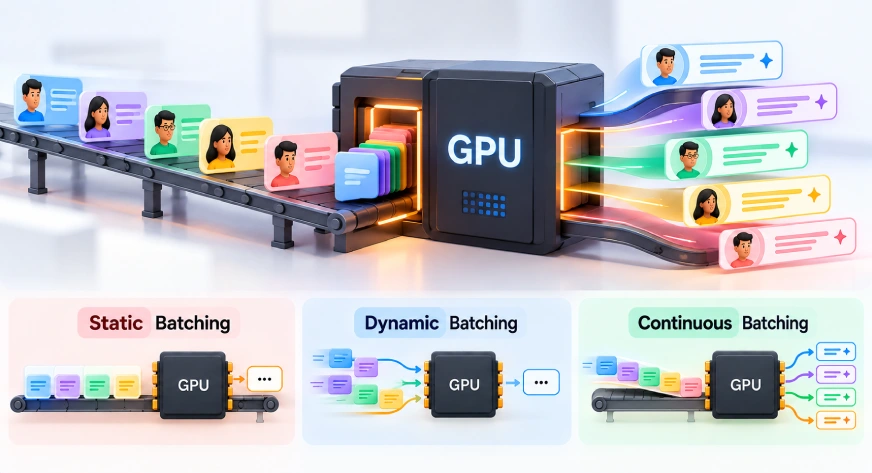
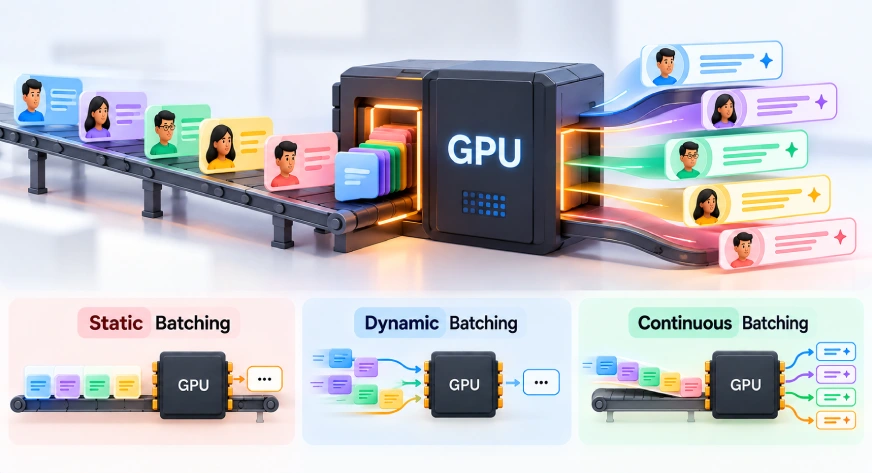
Batching is the mechanism by which a server groups multiple user requests together so the GPU can process them in parallel. Without it, modern AI services would be economically non-viable and impossibly slow. However, the way we batch matters. It determines the difference between a seamless user experience and a system that grinds to a halt under load.
The Technical Foundation: Why Batching is Non-Negotiable
At its core, batching is the process of running multiple inputs through a model in a single "forward pass." Instead of feeding the GPU a single tensor of shape [1, sequence_length], we feed it a tensor of shape [batch_size, sequence_length].
The Memory-Bound Reality
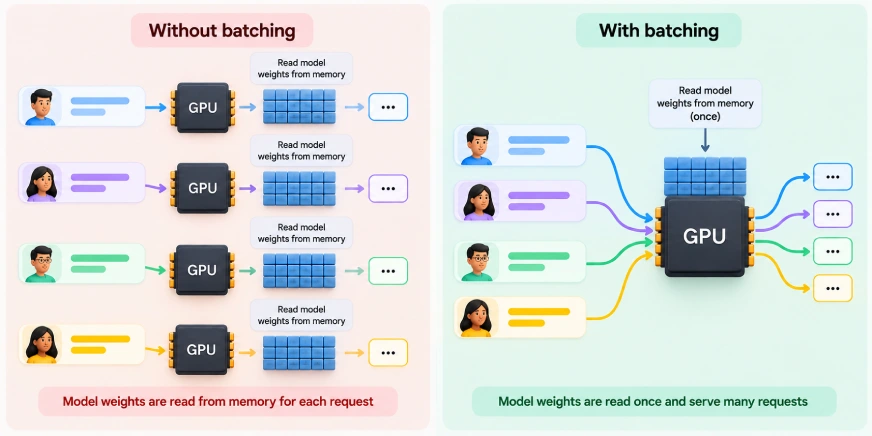
The urgent need for batching arises from the unique hardware profile of LLMs. During the generation phase (decoding), the GPU is rarely limited by its ability to perform mathematical operations (FLOPs). Instead, it is limited by its memory bandwidth—the speed at which it can move model weights from VRAM to the compute cores.
In a scenario with a batch size of one, the GPU spends over 99% of its time simply loading model weights to generate a single token. This is an enormous waste of computational potential. By batching 32 or 64 sequences together, the GPU loads those same weights once and uses them to generate 32 or 64 tokens simultaneously. The cost per token drops precipitously, and throughput skyrockets without the need for additional hardware investment.

However, there is a constraint: the KV Cache. Every sequence in a batch maintains its own "Key-Value" cache in GPU memory to keep track of previous tokens. As the sequence length grows, so does the memory footprint, creating a hard limit on how many requests can be handled simultaneously.
Chronology of Batching Evolution
The journey toward efficient inference has progressed through three distinct stages, each solving the limitations of the last.
1. Static Batching: The Era of Head-of-Line Blocking
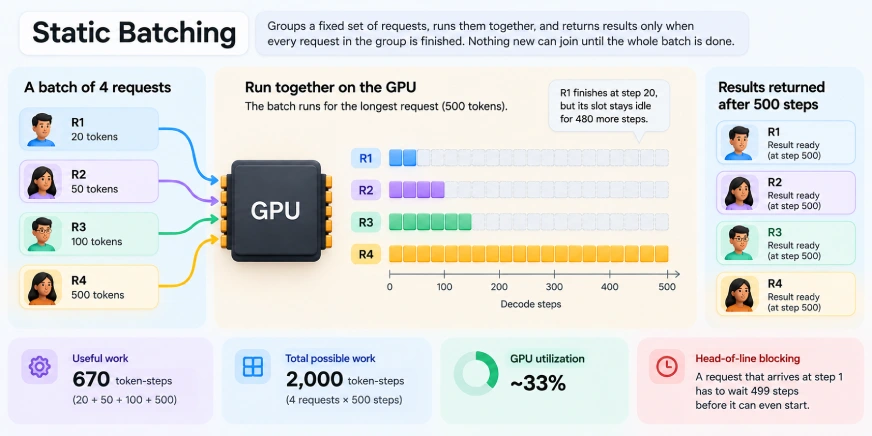
Static batching was the industry standard during the early days of deep learning. In this model, the server groups a fixed number of requests, processes them as a single block, and refuses to return any results until every request in that block is complete.
This approach is highly inefficient for LLMs because human-generated text varies wildly in length. If a batch contains one request that finishes in 20 tokens and another that requires 500, the shorter request must wait for the entire batch to clear. This is known as "head-of-line blocking." The GPU is forced to pad the shorter sequences with zeros, resulting in wasted cycles and high latency for the user.
2. Dynamic Batching: Improving Throughput
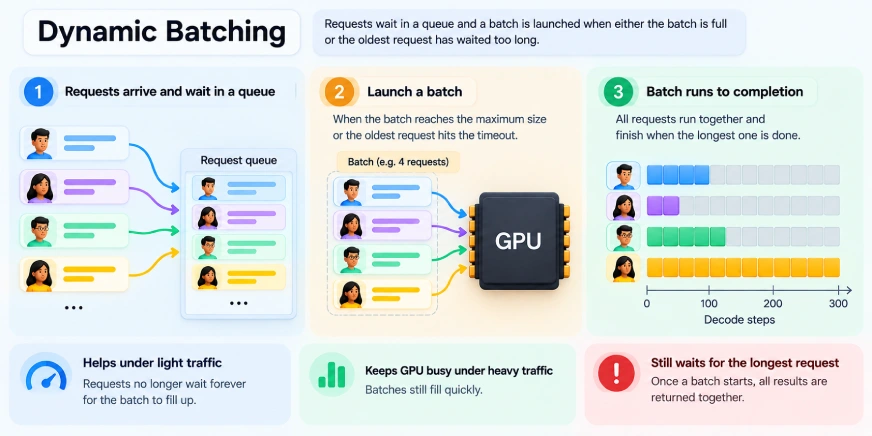
Dynamic batching introduced a more flexible approach to request management. Rather than waiting for a fixed number of requests, the server launches a batch as soon as either a "preferred" number of requests is reached or a maximum "wait time" expires.
This solved the issue of under-utilization during light traffic. However, it still suffered from the "straggler problem." Once a batch was launched, it remained locked until the longest request finished. It was an improvement for fixed-length models like BERT or ResNet, but for generative LLMs, it remained sub-optimal.

3. Continuous Batching: The Modern Gold Standard
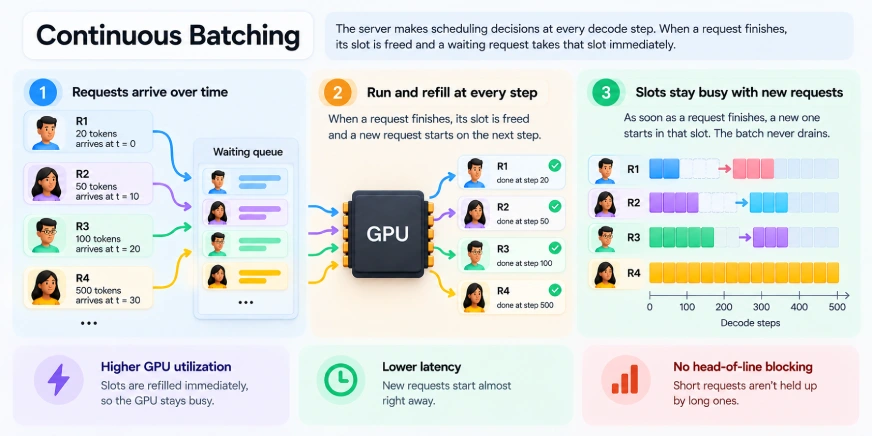
The game-changer arrived with the introduction of "Continuous Batching" (or iteration-level scheduling), famously popularized by the Orca research paper. In this paradigm, scheduling decisions are made at every single token generation step, not once per batch.
When a specific sequence finishes its generation, the system immediately returns the result and slots a new, pending request into the now-empty space. This ensures the GPU is almost always running at near-peak utilization. It effectively eliminates the idle time caused by stragglers and significantly reduces the average time-to-first-token.
Supporting Data: A Comparative Analysis
To quantify the efficiency of these approaches, we can simulate the performance of 12 distinct requests with varying lengths. The results highlight why modern serving engines (vLLM, TGI, TensorRT-LLM) have standardized on continuous batching.
| Metric | Static Batching | Dynamic Batching | Continuous Batching |
|---|---|---|---|
| Total Steps | 560 | 665 | 330 |
| Slot Utilization | 47% | 39% | 80% |
| Avg. Latency | 402ms | 418ms | 118ms |
Data Note: The simulation assumes a fixed GPU capacity of 4 slots and varying sequence lengths. Continuous batching achieves nearly double the throughput and significantly lower latency by recycling slots immediately.
Implications for Industry and Developers
The shift toward continuous batching has profound implications for how companies build AI applications.
1. The Death of "Hand-Rolled" Serving
Historically, many companies attempted to build their own inference loops using standard deep learning frameworks. The data makes it clear: this is a strategic error. Unless a team has specialized expertise in low-level kernel optimization and memory management, they will never achieve the efficiency of dedicated serving engines.
2. The Move Toward Specialized Engines
The industry has effectively consolidated around high-performance engines like vLLM, TGI (Text Generation Inference), and TensorRT-LLM. These tools handle the complexity of "PagedAttention" and continuous batching, allowing developers to focus on higher-level product features rather than memory fragmentation issues.
3. Cost-per-Token Optimization
For startups and enterprises alike, the "cost per token" is the most important metric for scaling. By utilizing continuous batching, companies can serve significantly more concurrent users on the same GPU cluster. This is not merely a technical optimization; it is a fundamental business necessity for AI companies looking to achieve profitability.
Conclusion: The Path Forward
The evolution of batching represents a maturation of the AI field. We have moved from the "naive" stage of processing requests one by one to the "industrial" stage, where every millisecond of GPU compute is accounted for.
Static batching serves a niche purpose in offline, uniform batch processing. Dynamic batching remains a reliable tool for fixed-cost models like embeddings or vision classifiers. But for the world of Generative AI, continuous batching is the undisputed king.
For engineers and data scientists, the message is clear: stop building custom batching loops. Instead, adopt industry-standard serving engines that implement continuous batching, and spend your engineering cycles on what actually adds value—tuning your prompt templates, optimizing your KV cache memory allocation, and monitoring your latency budgets. As we push the boundaries of what LLMs can do, the efficiency of our infrastructure will be the defining factor in how much of that potential we can actually afford to deliver to our users.