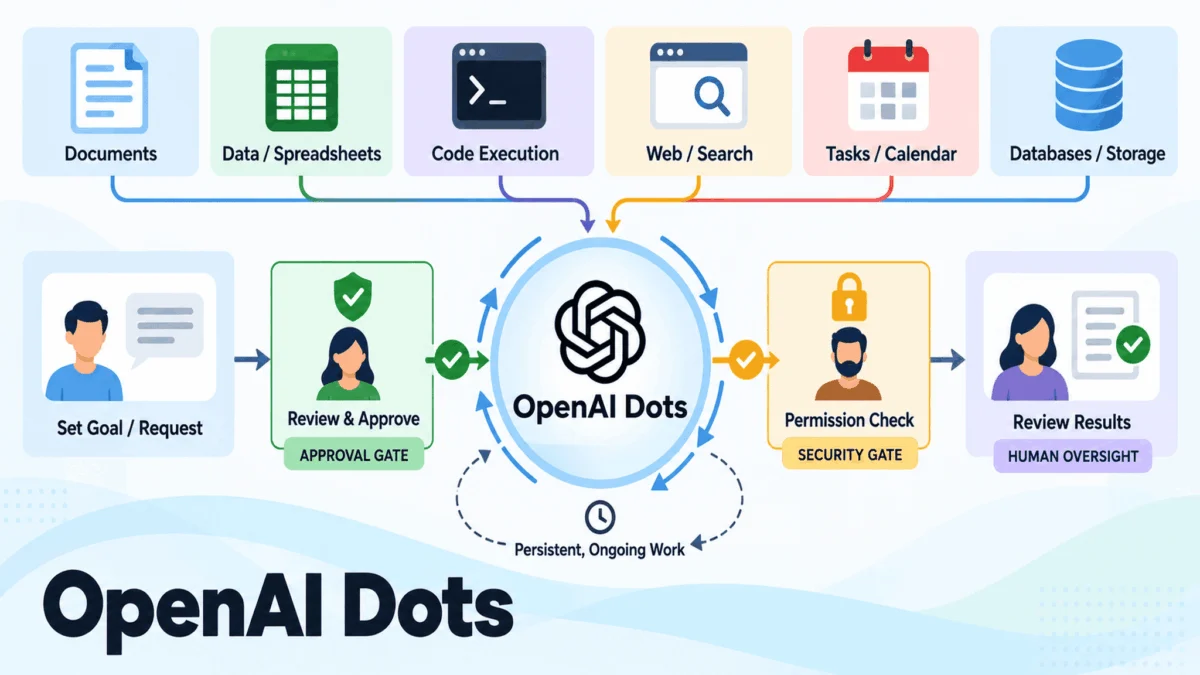
On September 29, 2026, OpenAI unveiled "Dots" at its DevDay conference—a product that marks a fundamental pivot in how we interact with artificial intelligence. While the industry has spent years chasing the dream of an "AI coworker," OpenAI’s latest release represents the most concrete, functional iteration of that vision to date. Dots are not merely chatbots; they are always-on, autonomous agents capable of operating independently on cloud infrastructure, integrating with over 4,000 third-party applications, and continuing their tasks long after a user has logged off.
For the data science and machine learning community, Dots is not just another feature update. It is a paradigm shift. However, as with any high-impact technology, the leap from prototype to production is fraught with technical, ethical, and operational complexities. This analysis explores what Dots is, why it represents a departure from previous agentic attempts, and the critical considerations practitioners must weigh before delegating their workflows to the cloud.
What Dots Actually Is: Beyond the Chatbot
The core architectural shift introduced by Dots is the transition from reactive to proactive intelligence.
Standard large language models (LLMs) operate within the constraints of a session: they await a prompt, process it, provide a response, and then go dormant. The conversation is transactional. A "Dot," by contrast, is persistent. Powered by the new GPT-6 Astra model, these agents reside on dedicated cloud computers. When a user assigns a standing goal to a Dot, it does not wait for further input. It actively monitors connected applications, checks for updates, and initiates actions—such as drafting invoices, scoping software fixes, or managing data pipelines—without needing constant human intervention.
The Delegation Model
During his keynote, Sam Altman emphasized that the goal of Dots is to emulate the relationship between a manager and a high-agency chief of staff. The agent is designed to learn user preferences over time. Unlike a standard chatbot that might require the same instructions every session, a Dot retains "memory" of previous corrections and workflow idiosyncrasies. If a user corrects a Dot’s formatting on an invoice today, the agent applies that logic to all future invoices, effectively building a repository of institutional knowledge specific to the user’s preferences.
A Brief Chronology: From LLMs to Autonomous Agents
The road to Dots was paved by years of iterative experimentation within the AI sector. To understand why Dots feels different, we must look at the progression:
- 2023: The Era of Chat-Based AI: Models like ChatGPT dominated the landscape, focusing on high-quality text generation and basic code assistance.
- 2024: The Tool-Use Breakthrough: OpenAI and competitors introduced "Function Calling," allowing models to trigger external tools (like search engines or calculators). However, these were limited by "brittleness"—if a multi-step task hit a minor error, the process would stall.
- 2025: Early Agentic Frameworks: Industry players attempted to create agents that could run loops. These were often computationally expensive, prone to "hallucinated loops," and struggled with context retention over long time horizons.
- September 2026: The Launch of Dots: OpenAI solved the persistence problem by decoupling the agent from the chat window. By moving the agent to a persistent cloud environment, they created a system that can sleep, wake, and iterate based on background triggers.
Why Dots Represents a Technical Leap
If you have utilized previous agentic capabilities and found them lacking, you are not alone. Previous systems were often "session-level," meaning they were prone to drift when tasked with complex, multi-stage workflows.
GPT-6 Astra and Multi-Step Reliability
The differentiator here is the underlying model: GPT-6 Astra. Astra was engineered specifically for "agentic flow." Where older models might lose the thread of a task when hitting a hurdle, Astra is designed for sustained, tool-using logic. It can interpret friction—such as an API error or a missing data point—and attempt to resolve it or ask for clarification, rather than simply failing or providing a generic apology.
Context Persistence
The most significant departure from the past is the concept of a "standing goal." By allowing the agent to exist outside of the chat interface, OpenAI has enabled "asynchronous collaboration." A user can set a goal to "monitor all incoming customer feedback and flag bugs in Jira" before heading to bed. The next morning, the agent presents a consolidated report. This moves the user from being a "driver" (who must guide every steering movement) to an "architect" (who defines the goals and reviews the output).
Supporting Data and Practical Constraints
While the potential is vast, the rollout is subject to significant limitations that professionals must account for in their risk assessments.
Accessibility and Pricing
As of the launch, Dots is restricted to a narrow cohort. It is available only to:
- ChatGPT Pro subscribers ($100/month).
- Business Premium users.
- Geographic Restrictions: Users in the European Economic Area (EEA), Switzerland, and the United Kingdom are currently excluded, likely due to the ongoing navigation of GDPR and the EU AI Act.
Privacy and Memory Governance
The most glaring concern for data scientists is the "black box" nature of Dot memory. Currently, users have limited visibility into how memories are stored and, crucially, no granular way to delete or edit individual memories. If a Dot learns from sensitive client data, there is no "clear cache" button for that specific information. For practitioners dealing with proprietary models or client-side work, this is a major security red flag.
Liability and Compliance
OpenAI has yet to publish specific uptime guarantees or enterprise-grade compliance documentation for the Dots infrastructure. For organizations with strict SOC2 or HIPAA requirements, the inability to audit the agent’s decision-making process—or to guarantee the security of the data it processes—makes immediate enterprise adoption difficult.
Implications for Data Science Workflows
For the data scientist, the arrival of Dots necessitates a shift in professional focus. The value proposition is clear: compressing hours of low-level administrative work into minutes of high-level supervision.
The Opportunity: Automating the Mundane
Data science is often plagued by "hidden" time-sinks:
- Documentation: Keeping technical documentation in sync with changing code specs.
- Status Reporting: Manually pulling data from Slack, emails, and JIRA to update stakeholders.
- Monitoring: Checking job outputs and basic data quality drift.
Dots can take these tasks off the plate, allowing the data scientist to focus on high-level strategy, model architecture, and exploratory analysis.
The Risk: Oversight Erosion
The primary danger lies in the "set it and forget it" mindset. If a practitioner assumes the agent is infallible, the cost of an error—such as an incorrectly scoped pull request or an misinterpreted data summary—could be massive. The same properties that make Dots powerful—its autonomy and persistence—are the same reasons it requires more, not less, oversight.
Final Thoughts: The Clarity Mandate
The introduction of Dots is a catalyst for a long-overdue conversation about what we actually do all day. To leverage an agent effectively, a practitioner must possess a high level of clarity about their own workflow. You cannot delegate a task you cannot define.
For those who are prepared to treat these agents as junior staff—requiring clear briefs, strict permission boundaries, and regular review checkpoints—Dots offers an unprecedented opportunity for productivity. For those who view it as a "magic button" to solve messy, ill-defined problems, the experience will likely prove expensive and frustrating.
Ultimately, the agent is only as capable as the brief provided by the human. We are entering an era where the most valuable skill for a data scientist may no longer be the ability to code the solution, but the ability to architect the process and define the boundaries within which the AI operates.
Vinod Chugani is an AI and data science educator specializing in agentic workflows. His work focuses on bridging the gap between emerging AI technologies and the practical, day-to-day realities of professional data science.