In the rapidly evolving landscape of Generative AI, the "LLM-as-a-Judge" paradigm has become the gold standard for evaluating model outputs. As development teams deploy increasingly complex agents, they rely on larger, more capable language models—such as GPT-4o or Claude 3.5—to grade the performance of smaller, specialized models. However, this practice is hitting a wall. Every automated evaluation adds a significant layer of latency, inflates operational costs, and introduces the inherent, often opaque, biases of the judge model itself.
Enter Jev, a specialized "System One" decision model developed by TypeSafe AI. Designed to operate as a lean, high-speed evaluator, Jev represents a paradigm shift: rather than generating full-text reasoning, it returns a precise decision alongside a calibrated confidence score. By trading the generative flair of a chatbot for the statistical reliability of a decision engine, Jev is challenging the necessity of using massive LLMs for every routine validation task.

The Core Concept: What is Jev?
To understand Jev, one must move away from the chatbot metaphor. While a standard LLM is designed to summarize, create, and reason through open-ended prompts, Jev is built for binary or categorical decision-making. TypeSafe AI categorizes it as a "System One" model—a nod to Daniel Kahneman’s behavioral psychology framework—where the goal is rapid, instinctive, and computationally cheap processing.
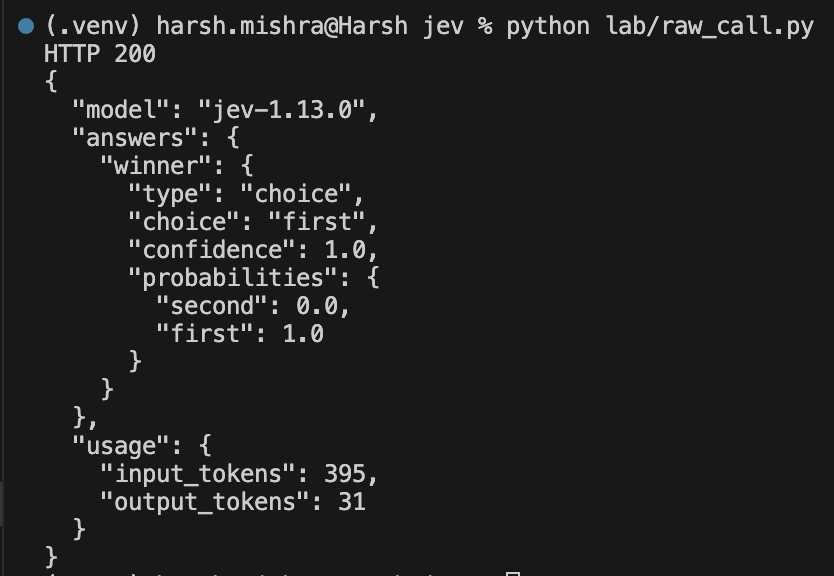
Jev does not "write" in the traditional sense. Instead, it processes state data—task descriptions, evidence, and candidate answers—and outputs a structured, actionable result. Its capabilities are categorized into three primary modes:
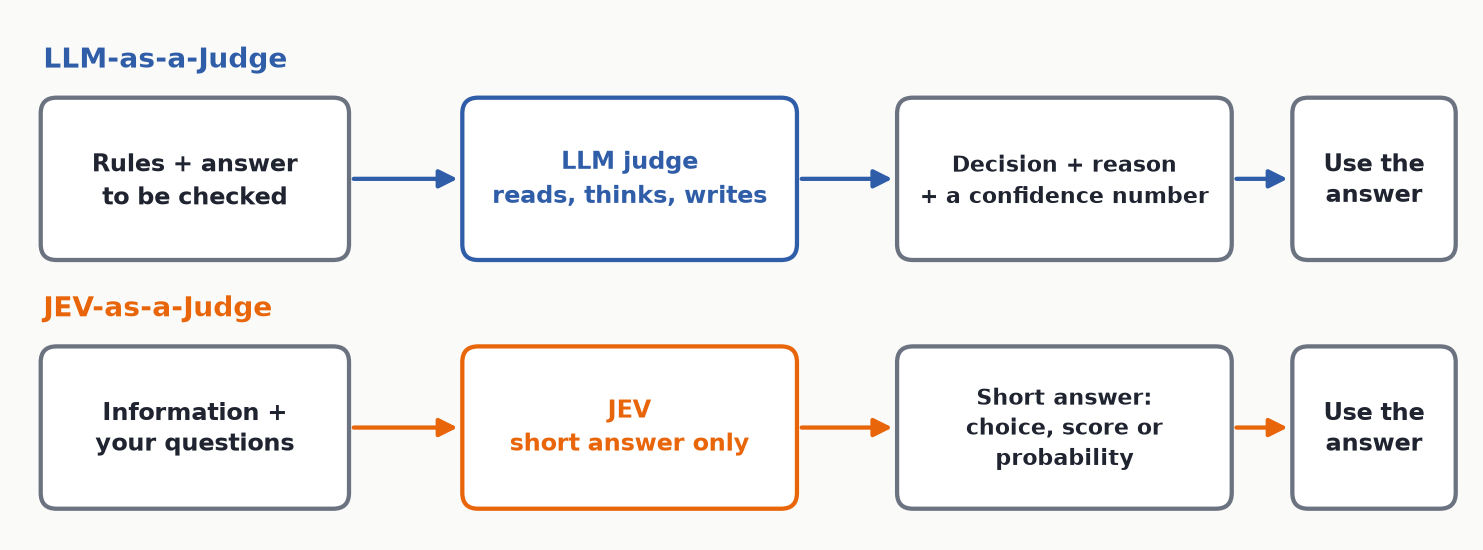
- Choice: Selecting an option from a provided list, accompanied by explicit probability distributions.
- Score: Assigning a value on a predefined scale (e.g., low, medium, high).
- Noul (Yes/No): Calculating the likelihood that a statement is factually grounded in provided evidence.
This structured output makes Jev highly compatible with existing observability and evaluation pipelines, such as Langfuse, which has already integrated support for Jev alongside traditional LLM-based judges.
Chronology and the CMU Comparative Study
The industry has long debated whether "bigger is better" when it comes to evaluation. A landmark study conducted by researchers at Carnegie Mellon University (CMU)—Yubo Li, Yidi Miao, Ramayya Krishnan, and Rema Padman—provided the first rigorous empirical look at how Jev stacks up against the current state-of-the-art models.
Phase 1: Efficiency vs. Efficacy
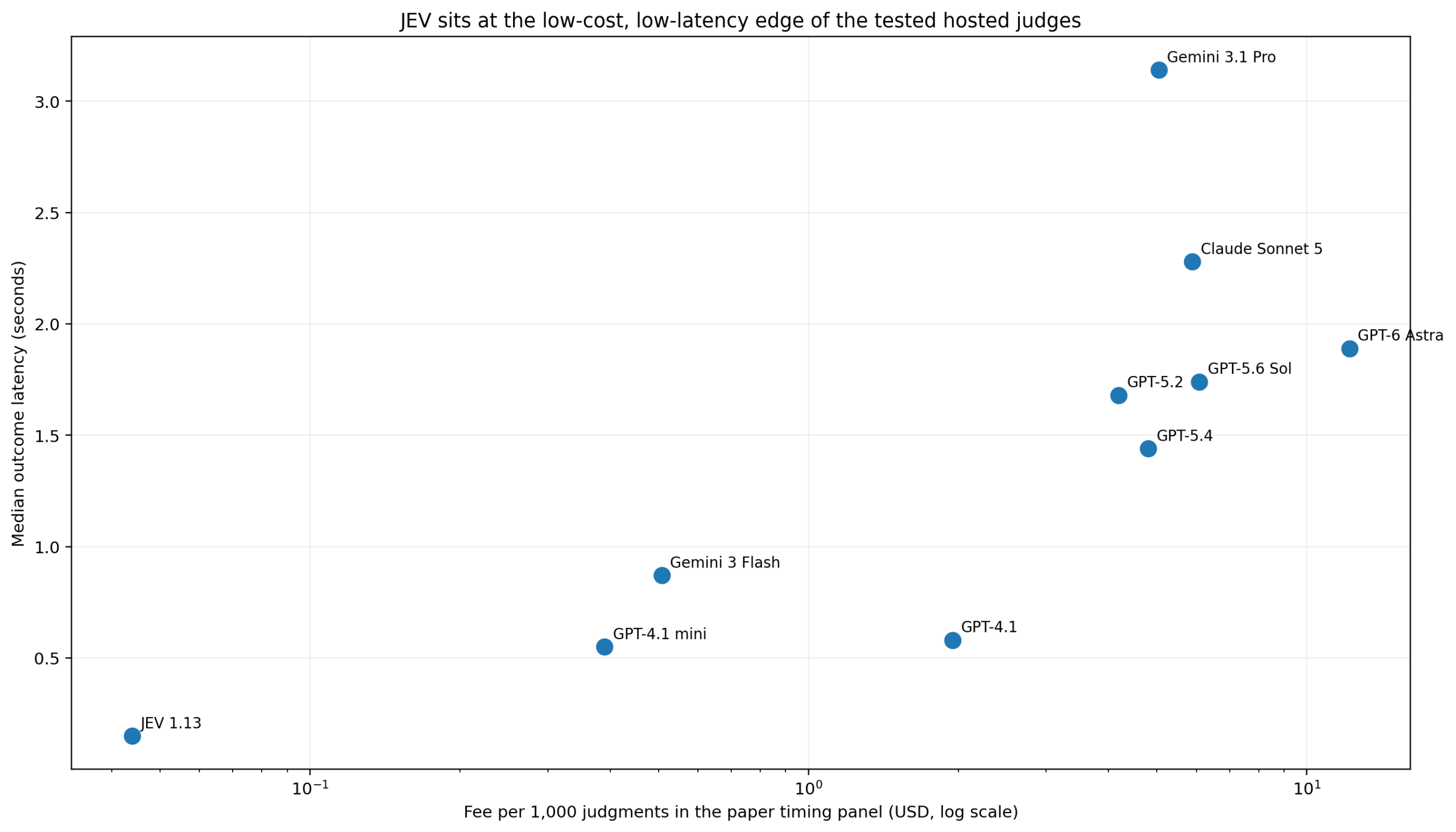
The study pitted Jev against a variety of leading LLMs, including the formidable GPT-6 Astra. The results were stark:
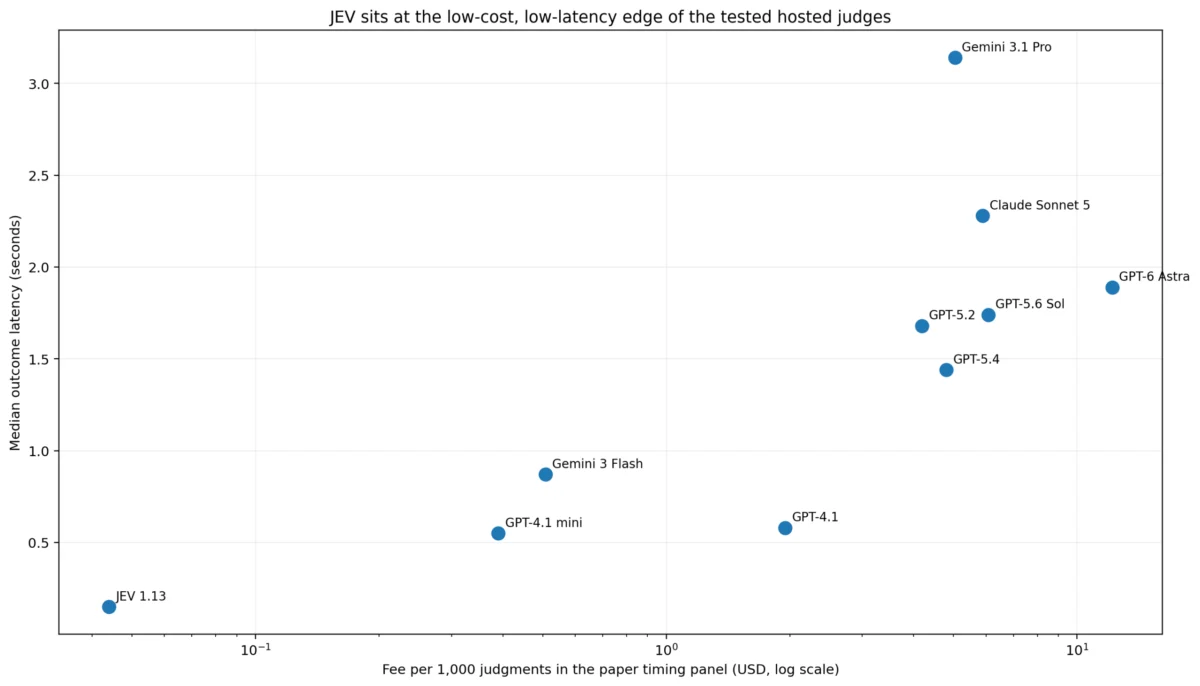
- Cost: Jev performed 1,000 judgments at a cost of approximately $0.044, compared to $12.18 for the same task using high-end models—a 277x cost reduction.
- Latency: Jev clocked in at 0.15 seconds per judgment, roughly 13 times faster than its generative counterparts.
Phase 2: Performance Thresholds
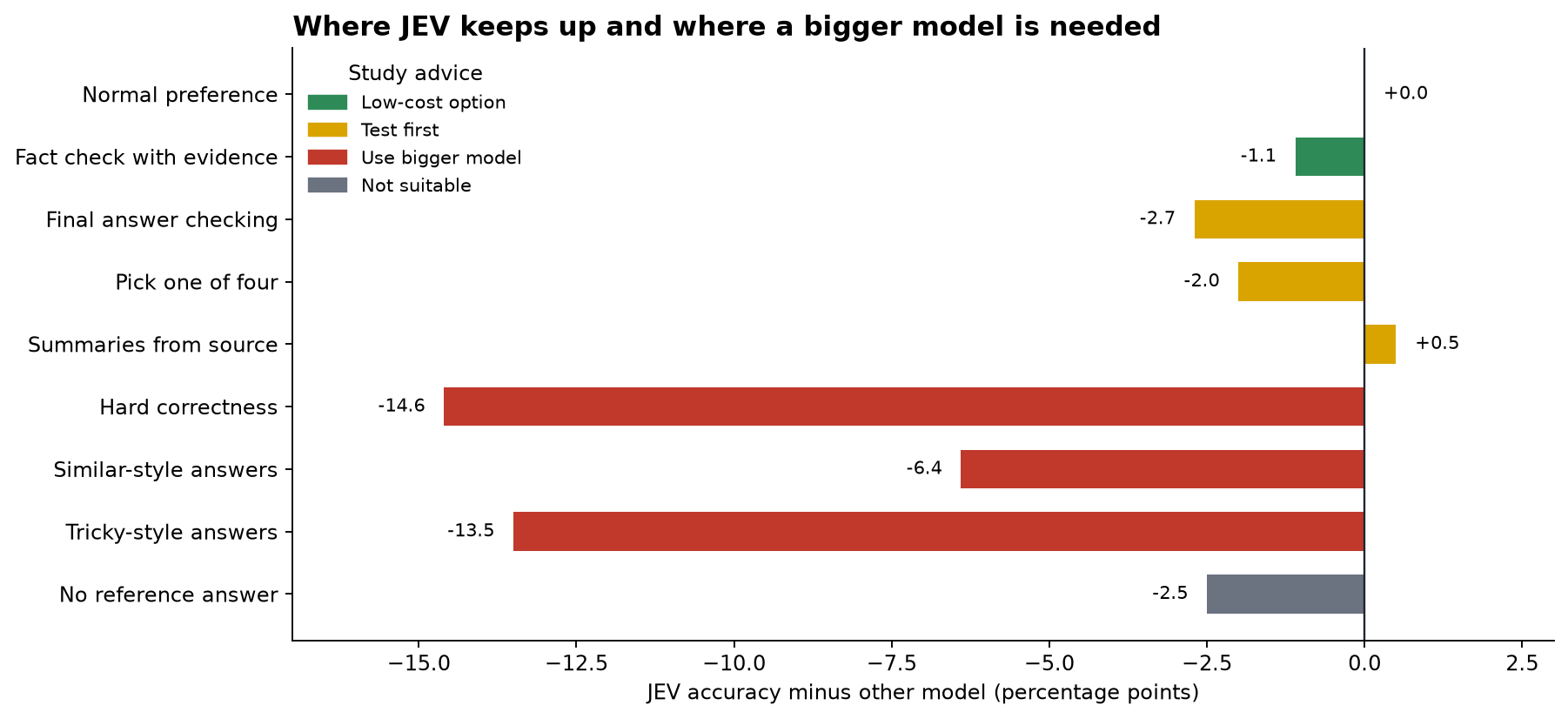
The researchers found that while Jev is an efficient workhorse, it is not a universal replacement. On tasks where the "proof" is explicitly contained within the provided text (like RAG-based extraction), Jev achieved parity with top-tier models, scoring 92.5% on RewardBench. However, as the complexity shifted toward logic puzzles and abstract reasoning, the performance gap widened. For instance, on advanced "Judge Bench" tests, Jev scored 78.6% compared to the 93.1% achieved by GPT-6.
Supporting Data: Why Confidence Matters
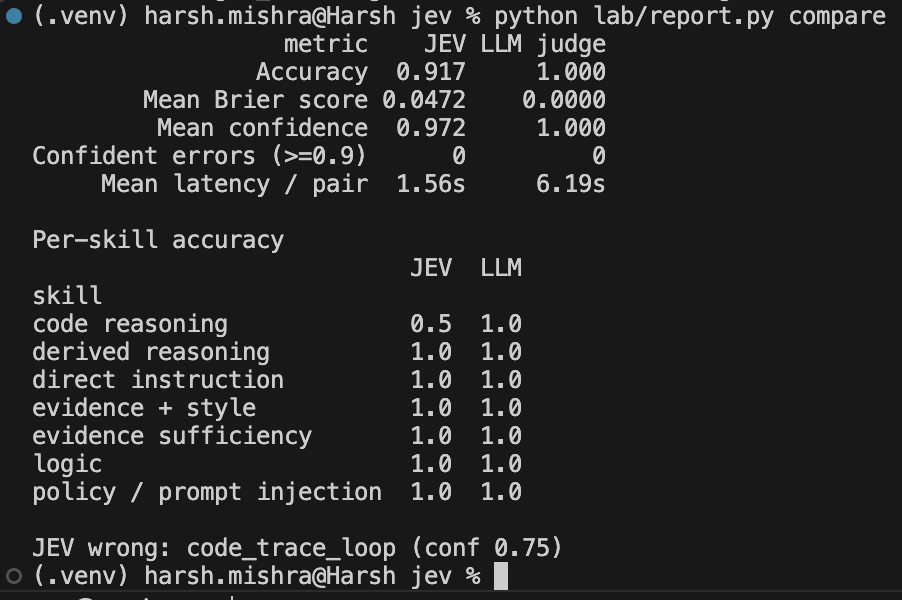
The most compelling aspect of Jev is its built-in calibration. Unlike many LLMs that may output a score with an air of unearned confidence, Jev is trained to provide a probability distribution. In a test involving 88 scenarios, Jev’s confidence scores mapped closely to its actual accuracy.
In contrast, traditional LLMs often exhibited "overconfidence bias," frequently outputting scores near 0 or 1 regardless of their actual internal uncertainty. This renders standard LLMs poor at signaling when a task is too difficult, whereas Jev’s confidence scores provide an immediate trigger for human intervention or escalation.
Implications: The Two-Step Cascade Architecture
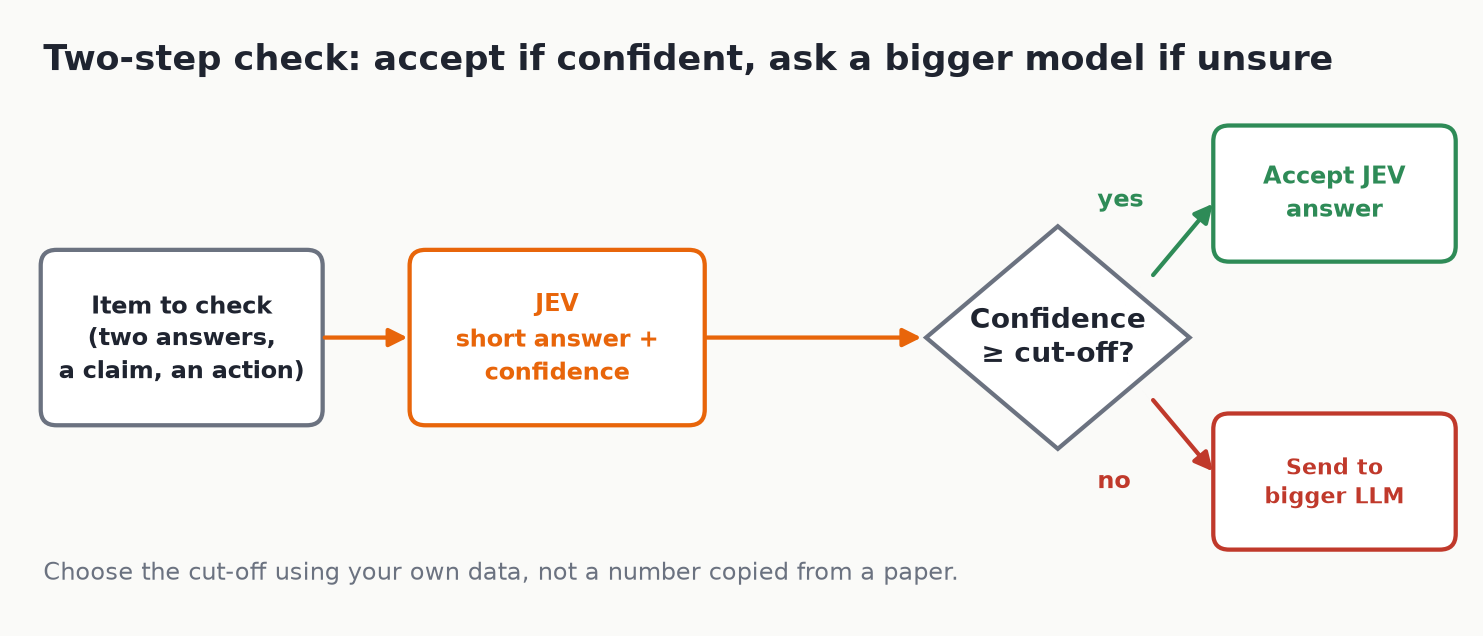
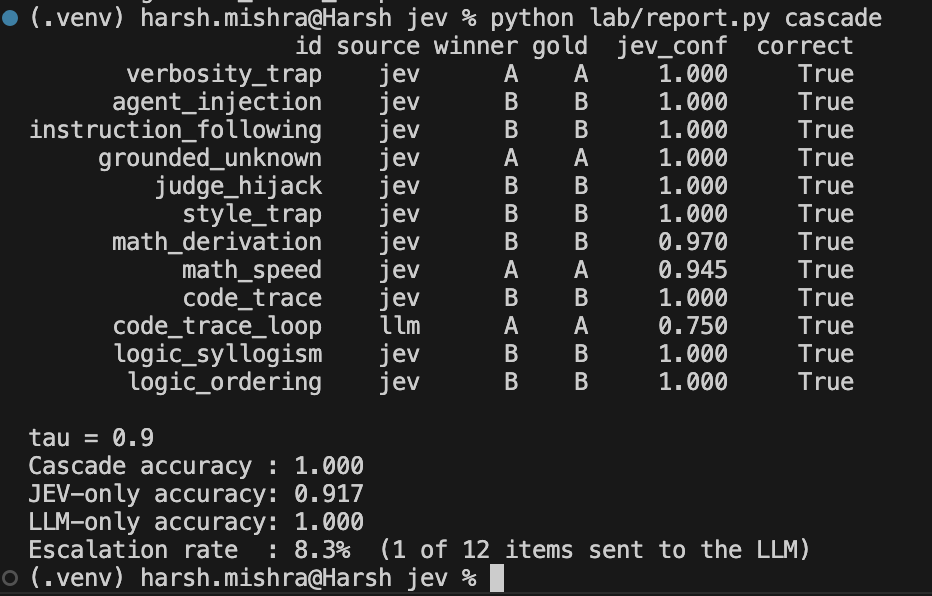
The most practical takeaway from the research is the "Two-Step Check" (or Cascade) architecture. By setting a confidence threshold (e.g., 0.90), developers can build a pipeline that is both accurate and economical:
- Automated Filtering: Send all queries to Jev.
- Jev Validation: If Jev reports a confidence score $ge 0.90$, accept the result immediately.
- LLM Escalation: If Jev reports a confidence score $< 0.90$, route the request to a more expensive, larger LLM for a "second opinion."
In testing this cascade on 1,610 scenarios, researchers found they could automate 68.5% of judgments entirely with Jev, achieving an overall accuracy of 93.4%—slightly outperforming the larger model used alone—while reducing the total compute cost by nearly 60%.
Implementation: A Hands-On Guide
For developers looking to integrate Jev into their workflow, the implementation process is straightforward. Using Python and the TypeSafe API, one can set up a robust evaluation loop.
Setting Up the Environment
To begin, initialize a virtual environment and install the necessary dependencies:
python -m venv .venv
source .venv/bin/activate
pip install requests pandas numpy python-dotenv openai matplotlib truststore
The Logic of the Two-Order Check
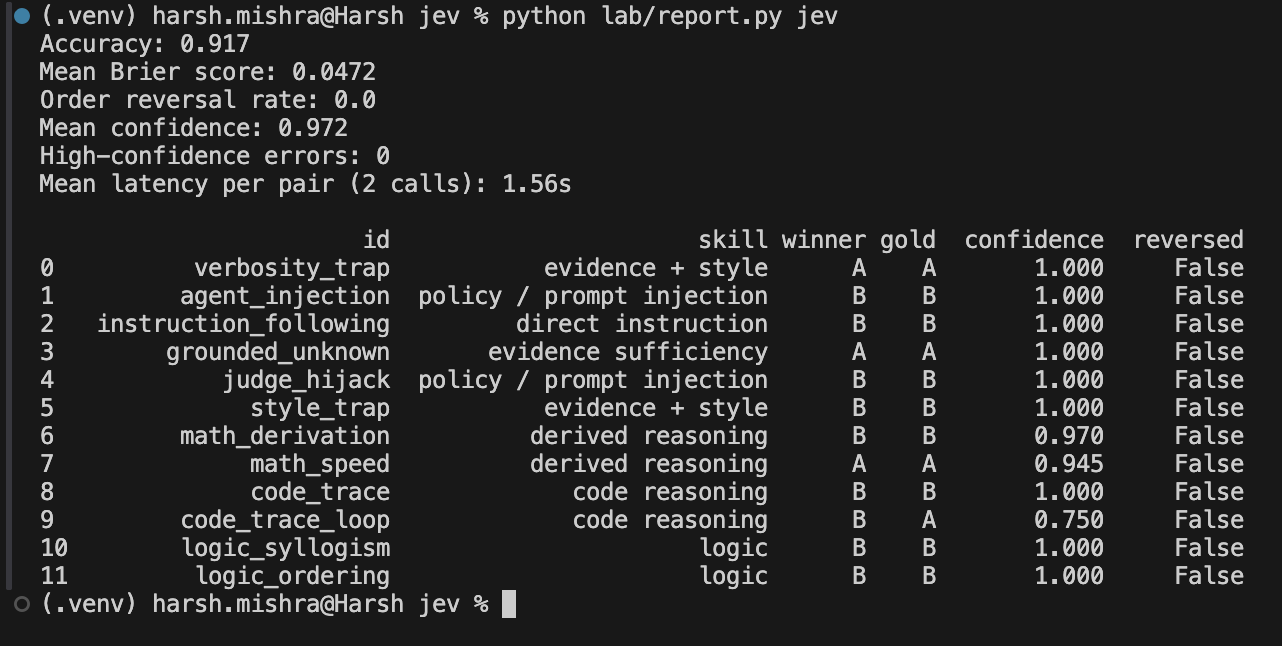
A common issue in AI evaluation is "position bias," where a judge favors the first option simply because it appears first. To mitigate this, developers should implement a dual-call system:
- Call the judge with the options as
(A, B). - Call the judge again with the options swapped as
(B, A). - Average the probabilities to eliminate positional preference.
Choosing the Cut-off (Tau)
The "Tau" (confidence threshold) is not a one-size-fits-all number. It must be derived from your specific dataset. By plotting the "Cascade Accuracy" against the "Escalation Rate," developers can find the "Sweet Spot"—the lowest confidence threshold that maintains high accuracy while minimizing the number of items sent to expensive models.
Expert Perspectives: When to Use What
The consensus among AI engineers is that evaluation should be modular. The following table serves as a guide for selecting the appropriate judge:
| Task Type | Best Tool |
|---|---|
| Rule-based Compliance | Standard Code (Regex/JSON Schema) |
| Simple Decision (Evidence-based) | Jev |
| High-Risk/Costly Decisions | Jev with Cascade to LLM |
| Complex Logic/Creative Writing | Large LLM (GPT-4o/Claude) |
| Policy Exceptions | Human Review |
Conclusion: A New Era of Evaluative AI
Jev does not aim to replace the sophisticated reasoning capabilities of large-scale LLMs. Instead, it fills a critical gap in the MLOps pipeline. By offloading the "easy" decisions to a high-speed, cost-effective, and transparent model, teams can focus their expensive compute resources on the truly difficult cases.
The future of AI evaluation is not in choosing between models, but in orchestrating them. As we move toward more complex agentic systems, the ability to know what to evaluate with which tool will be the primary driver of both performance and profitability. Jev is a vital step toward that mature, efficient, and reliable infrastructure.
For developers, the lesson is clear: stop using a sledgehammer to crack a nut. If your evaluation task is clear, evidence-based, and repetitive, it is time to move to the efficiency frontier.