In the modern enterprise, the distance between a high-performing AI prototype and a scalable, production-ready product has become the defining frontier of the tech industry. As organizations race to integrate Large Language Models (LLMs) and predictive architectures into their core workflows, a new professional archetype has emerged: the AI Product Manager (PM).
Unlike their predecessors who managed deterministic software—where input A consistently yields output B—the AI PM must navigate a landscape of probabilistic outcomes, hallucinations, and fluid system behaviors. This role requires a unique synthesis of technical fluency, economic modeling, and regulatory stewardship. As we look toward 2026, the mandate for these professionals is clear: bridge the gap between speculative research and user trust.
The Paradigm Shift: From Deterministic to Probabilistic Thinking
The transition to an AI-first product strategy begins with a fundamental psychological shift. Traditional software development is built on the bedrock of certainty. In contrast, AI systems operate within a spectrum of probability. For the AI PM, this is not a defect to be mitigated, but the core terrain to be managed.
Technical Fluency as a Foundation
AI PMs are not required to train models from scratch, but they must possess a deep understanding of architectural trade-offs. Whether deciding between a fine-tuned small language model, a retrieval-augmented generation (RAG) pipeline, or a multi-agent system, the PM must be capable of challenging engineering assumptions.
Key technical tensions define the daily life of an AI PM:
- Latency vs. Accuracy: The trade-off between how quickly a user receives an answer and the depth of the model’s reasoning.
- Cost vs. Context: Managing token consumption and context-window sizing to optimize for both user experience and gross margins.
- The "Time-to-First-Token" (TTFT): Understanding how infrastructure choices impact the perceived responsiveness of an AI-driven interface.
The Four-Phase Roadmap to AI Product Leadership
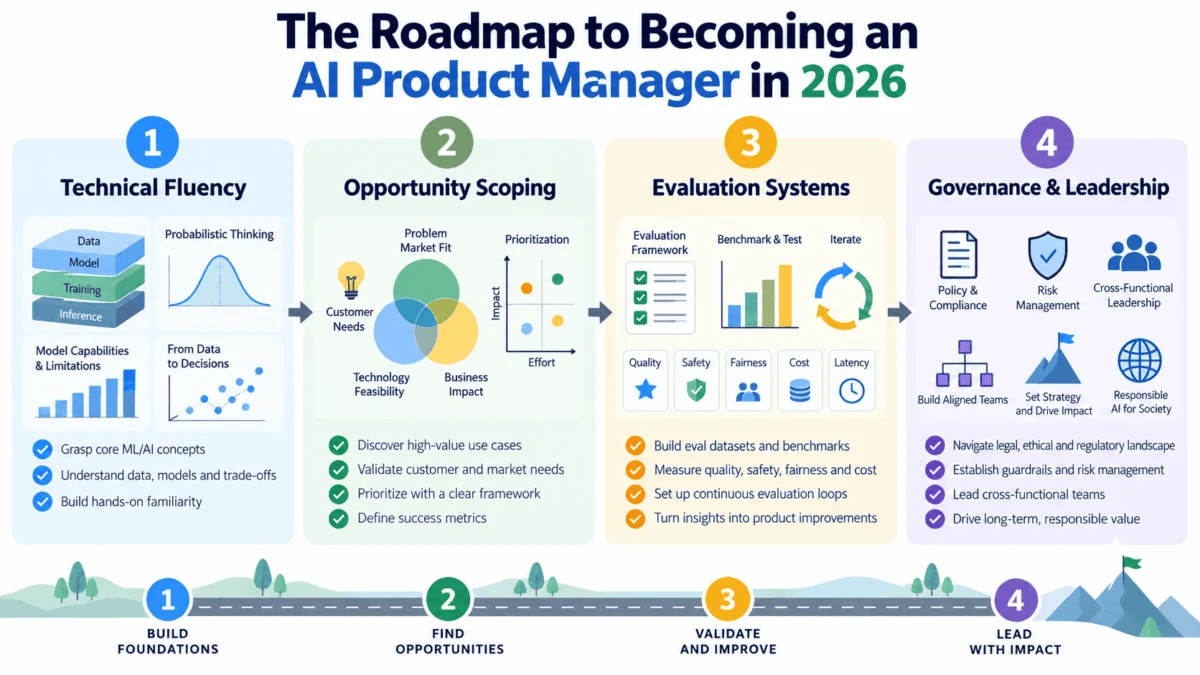
Becoming a proficient AI PM requires a structured, multi-disciplinary approach. The following roadmap outlines the evolution from foundational technical intuition to organizational governance.
Phase 1: Developing Technical Fluency
At the entry level, the focus is on architectural intuition. Aspiring PMs should engage with resources like Jay Alammar’s Hands-On Large Language Models or the fast.ai Practical Deep Learning curriculum. The goal is to develop a "mental map" of the stack—understanding how embeddings, vector databases, and API-based model calls interact.
- Portfolio Exercise: Construct a comparison matrix for a specific business problem (e.g., automated customer support). Evaluate three different architectural approaches—such as prompt-engineered RAG versus fine-tuned models—and document the trade-offs in terms of expected latency, cost, and accuracy.
Phase 2: Opportunity Discovery and Feasibility Scoping
Not every problem is an AI problem. The "AI Product Canvas" is an essential framework for mapping tasks based on the value delivered if successful versus the risk incurred if the system fails.
The most critical decision at this stage is the Build vs. Buy vs. Assemble dilemma. This is as much a financial calculation as a technical one. PMs must master the unit economics of compute:
- Token Consumption Modeling: Can the business afford the cost of inference at scale?
- GPU vs. API Costs: At what volume does hosting proprietary hardware become more cost-effective than using enterprise-grade API endpoints?
- Vector Database Overhead: How does retrieval depth affect the cost-per-query?
Phase 3: Evaluation, UX, and Iteration
This phase represents the most significant departure from traditional product management. Because AI outputs are non-deterministic, binary "pass/fail" testing is insufficient.
AI PMs must adopt Eval-Driven Development. This involves building automated evaluation pipelines—using tools like RAGAS or PromptFoo—to measure performance against ground-truth datasets. Furthermore, the UX must be designed for "graceful degradation." How does the interface inform the user that a response is an estimate? How are human-in-the-loop (HITL) checkpoints implemented to ensure quality control?
- Red-Teaming: A non-negotiable step. Before a feature hits the public, it must undergo adversarial testing, including prompt injection attempts and boundary probing, to ensure safety and alignment.
Phase 4: Governance, Compliance, and Leadership
As AI products scale, the PM evolves into an organizational diplomat. Regulatory literacy is no longer optional; the EU AI Act and emerging U.S. executive orders have introduced strict requirements regarding transparency, data lineage, and bias mitigation.
The AI PM acts as the primary translator between three distinct groups:
- Research Engineers: Who prioritize model performance and benchmarks.
- Legal/Compliance Teams: Who prioritize liability and data privacy.
- Executives: Who prioritize market share, revenue, and risk appetite.
Supporting Data and Industry Context
The rise of the AI PM is mirrored by the surging demand for technical literacy in the workforce. According to recent industry reports, companies that hire dedicated "AI Product Leads" see a 30% faster time-to-market for LLM-integrated features compared to companies that rely solely on generalist PMs.
Furthermore, the "Unit Economics of AI" has become a boardroom priority. With inference costs fluctuating as models become more efficient (e.g., the move toward smaller, distilled models), the ability to project compute costs 12–18 months into the future is now a core competitive advantage.
Official Perspectives: The Role of Ethics and Regulation
Regulatory bodies and industry experts emphasize that the AI PM is also a "Trust Officer." In sectors like healthcare and finance, the stakes of an AI "hallucination" are existential.
"The role of the PM is to be the final line of defense against black-box decision-making," notes Vinod Chugani, an expert in AI education. "You cannot simply ship a model and hope for the best. You must document the lineage of your data, the provenance of your model weights, and the safety guardrails that prevent the system from operating outside of authorized parameters."
Implications for the Future of Product Development
The implications for the product management profession are profound. The era of the "feature-shipping" PM is waning, replaced by the "system-steward" PM.
- Continuous Learning: The technical landscape shifts every few months. PMs must remain agile, treating their own knowledge base as a "live" product that requires constant updates.
- Intellectual Honesty: The most successful AI PMs are those who admit when a model is not ready. They resist the pressure to "AI-wash" their products, opting for human-in-the-loop systems when the cost of failure is high.
- Cross-Functional Orchestration: As companies move toward agentic workflows—where AI systems perform tasks autonomously—the PM’s role in defining the "boundaries of agency" will become the most important lever for growth.
Final Thoughts: Shaping the Field
The AI PM role is still being defined, which provides an unprecedented opportunity for practitioners to set the standard for the next decade of technology. By mastering the probabilistic mindset, rigorous evaluation, and complex governance, today’s AI PMs are doing more than managing backlogs; they are defining the architecture of trust in the digital age.
Whether you are a seasoned PM looking to pivot or an engineer moving into product, the path forward is clear: focus on the trade-offs, scope with rigor, and prioritize the long-term sustainability of your systems over the short-term excitement of the demo. The future of AI is not just in the models we build, but in the products we carefully design to serve the world.