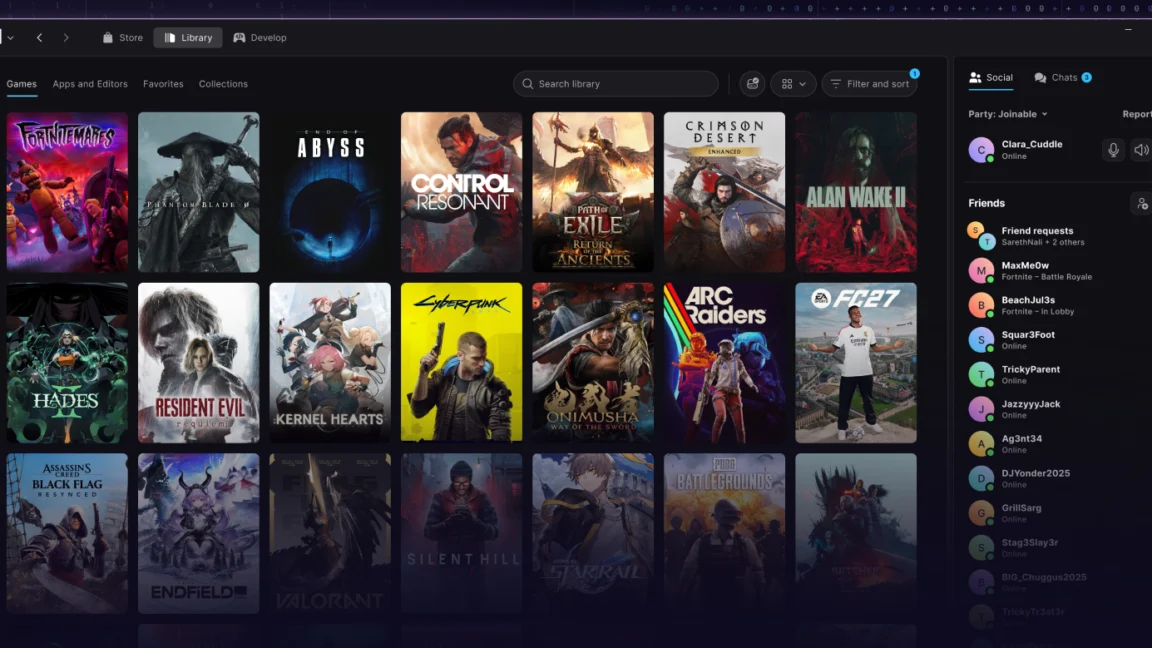
Nearly eight years after Epic Games first challenged the long-standing hegemony of Valve’s Steam with the launch of the Epic Games Store (EGS), the Fortnite developer has pivoted to an aggressive new strategy in its ongoing platform war. By deploying a “vibe coded” iteration of its desktop client, Epic is signaling a fundamental shift in how large-scale software infrastructure is developed, maintained, and optimized.
The move marks a departure from traditional legacy-heavy software engineering, utilizing Artificial Intelligence as the primary engine for a top-to-bottom rewrite of its launcher. While the branding—famously dubbed “vibe coding”—has drawn equal parts skepticism and curiosity from the tech community, the practical results suggest a new chapter in the competition between the two industry titans.
The Genesis of the Pivot: A Chronological Look at Epic’s Platform Strategy
To understand the weight of this new announcement, one must look at the timeline of Epic’s disruptive entrance into the digital storefront market.
2018: The Initial Disruption
In December 2018, Epic Games launched its store with a revolutionary value proposition: a significantly higher revenue share for developers (88% to the dev, 12% to Epic) compared to the industry-standard 70/30 split enforced by Steam. This was an ideological and financial attack on Valve’s business model.
2019–2025: The "Store Wars" Era
Over the subsequent years, Epic solidified its position by securing high-profile exclusives, distributing free weekly games, and slowly expanding its feature set. However, the EGS launcher itself often faced criticism. Users frequently cited slow load times, bloated memory usage, and a lack of the "community-first" features that kept gamers anchored to Steam. The launcher was often viewed as a functional necessity rather than a polished experience.
2026: The AI-Centric Renaissance
In October 2026, Epic broke its silence on its technical stagnation. The company announced a public “Preview” build of a brand-new Epic Games Launcher. Unlike the incremental updates of the past, this was a ground-up rebuild. Epic claimed that rather than performing traditional manual refactoring, its engineers used AI-assisted workflows to reimagine the client’s architecture entirely.
What is “Vibe Coding”? The Technology Behind the Interface
The term “vibe coding,” while colloquial and seemingly tongue-in-cheek, masks a significant shift in the development lifecycle. During interviews with industry outlets like IGN and PC Gamer, Martin Keely, General Manager and VP of the Epic Games Store, clarified that the term refers to an AI-augmented development philosophy.
Moving Away from Legacy Debt
Keely noted that the team intentionally chose not to port the existing code base. "Programming is hard," the company stated in its official release, "so instead of doing that, we vibe coded a new Epic Games Launcher."
In technical terms, this meant:
- Architecture Refresh: The team migrated to a modern tech stack, discarding the legacy systems that had slowed the previous iteration.
- AI-Assisted Synthesis: AI was utilized to write, audit, and debug features based on existing functionality requirements. The AI acted as an architect that understood the "vibe" or user intent of a feature, translating that intent into optimized code.
- Efficiency of Scale: This approach allowed a significantly smaller engineering team to handle a project that, in traditional development cycles, would have required a massive department.
By prioritizing the behavior of the app over the literal translation of previous source code, Epic claims to have achieved a level of responsiveness that was previously impossible.
Supporting Data: Performance Metrics and Benchmarks
The primary justification for this radical development shift is performance. Epic’s marketing team has centered their narrative on a single metric: speed. In its social media communications, the company boldly asserted, "We vibe coded the Epic Games Launcher to be faster than the other guy."
Cold Start and Responsiveness
Testing conducted by various outlets, including Ars Technica, reveals that the new launcher succeeds in its primary objective. In cold-start scenarios—where the application is launched from a dormant state—the new EGS client significantly outpaces the current build of Steam. By stripping away redundant background processes that had accumulated over years of "feature creep," the new client reaches the store page in a fraction of the previous time.
The Margin of Difference
However, data shows a nuanced reality. While the startup speed is objectively faster, other interactions—such as the transition from the system tray to the library—show marginal gains. Some benchmarks indicate a speed increase of roughly 0.06 seconds. While this improvement is mathematically measurable, it remains largely imperceptible to the average user. The significance, therefore, lies not in the 0.06-second gain, but in the efficiency of the underlying code that made such a reduction possible.
Official Responses and Industry Reception
The industry response to the "vibe coding" moniker has been polarized. Some developers view it as a brilliant marketing tactic to make AI-assisted development feel approachable and modern. Others view it as a dismissive take on the complexity of software engineering.
Martin Keely’s defense of the strategy was focused on the end-user. He emphasized that the primary benefit of this AI-driven rewrite is cross-platform parity. "It made us more efficient and allowed a small team to rewrite the code base… [we can] support Windows and Mac, and we’re going to have a Linux version as well," Keely noted.
This focus on Linux is particularly notable. Steam has long been the champion of Linux gaming via the Steam Deck and Proton. By prioritizing a Linux version through its AI-accelerated dev cycle, Epic is signaling that it intends to compete for the handheld and open-source gaming market in a way it has not previously prioritized.
Implications: The Future of Software Engineering
The implications of Epic’s move extend far beyond the gaming industry. If a massive, resource-heavy application like a digital storefront can be successfully rebuilt using AI-augmented workflows, it serves as a proof-of-concept for the broader software sector.
1. The Death of Legacy Bloat
For years, software applications have suffered from "code rot"—the accumulation of legacy code that makes programs slower and more difficult to update. Epic’s move suggests that we are entering an era where it is cheaper and faster to "AI-rewrite" an application from scratch rather than maintain an aging codebase.
2. The Rise of the "Small Team"
If AI can enable a small team of engineers to perform the work of a large, traditional software department, the barrier to entry for platform development is lowered. This could lead to a more competitive landscape, as smaller entities gain the ability to build sophisticated, high-performance apps without the need for massive overhead.
3. The "Vibe" Over the "Code"
The term "vibe coding" points to a philosophical shift in how we perceive software. If the user experience is optimal, does the underlying code matter? While traditionalists argue that clean, manually written code is essential for security and stability, the "vibe" approach prioritizes performance, responsiveness, and speed to market. Epic is gambling that in a consumer-facing market, the "vibe"—or the feeling of the software—is the only metric that drives retention.
Conclusion: A New Frontier for Digital Storefronts
Epic Games has successfully turned a technical necessity—updating its aging launcher—into a bold, provocative marketing campaign. By leaning into the controversial "vibe coding" terminology, they have effectively captured the industry’s attention and shifted the focus of the "Store Wars" from exclusive game titles to the performance of the software itself.
While the performance gains on minor UI interactions may be subtle, the underlying achievement is not: Epic has demonstrated a sustainable, AI-assisted path to maintaining complex software. As the EGS continues to roll out its new launcher, the pressure is now on Valve to demonstrate whether its own legacy architecture can keep pace, or if the "vibe" of the future belongs to those who embrace the AI-driven rewrite.
For the gamer, the outlook is positive. Whether one prefers the community features of Steam or the competitive pricing of Epic, the competition has officially moved into the realm of technical optimization. And in that race, the user stands to benefit from faster, cleaner, and more responsive platforms across every operating system, from Windows to Linux.