As the 2026 midterm elections approach, the American electorate appears to be viewing the path to legislative control through a deeply polarized lens. A new survey from the Pew Research Center, conducted between September 28 and October 4, 2026, reveals that while a clear majority of the public anticipates a Democratic victory in the House of Representatives, the outlook for the Senate remains a statistical dead heat.
These "citizen forecasts"—a snapshot of public expectation rather than a definitive prediction of electoral outcomes—underscores the extent to which partisan identity shapes how voters perceive the political landscape. With 5,062 U.S. adults surveyed, the findings highlight a electorate that is increasingly mirroring the competitive nature of modern American politics, where hope for one’s own party success often clouds objective analysis of the national political environment.
The State of the Forecast: House vs. Senate
The data suggests a significant divergence in how the public perceives the two chambers of Congress. According to the study, 55% of U.S. adults expect the Democratic Party to secure a majority in the House of Representatives, compared to 40% who believe Republicans will retain control. This 15-point gap indicates a prevailing sentiment that the lower chamber is currently tilting toward the Democratic camp.
However, the outlook for the Senate is markedly different. The public is essentially split, with 48% of respondents predicting that Republicans will maintain their Senate majority, while 46% believe Democrats will successfully flip control of the upper chamber. This near-even split reflects the high-stakes, state-by-state nature of Senate contests, where the electoral map often dictates the outcome more decisively than national trends.
A Chronology of Partisan Expectation
To understand the current sentiment, one must look at the evolution of political polling. While the Pew Research Center has tracked public expectations regarding congressional elections as far back as 2016, the 2026 cycle has shown a distinct hardening of partisan lines.
Throughout the late summer and early autumn of 2026, political analysts noted that the economy, coupled with shifting local demographics, began to dominate the narrative. In late September, as the survey window opened, the discourse centered on whether the legislative agenda of the current Congress would provide enough tailwinds for the party in power or if the natural "midterm backlash" would favor the opposition.
The survey results from the first week of October confirm that these national narratives are being filtered through an intense partisan prism. By mid-October, as the campaign cycle entered its final, most aggressive phase, the divide in expectations reached a peak, with respondents effectively "voting" for their preferred party’s success in their survey answers.
Deep-Dive: Supporting Data and Demographic Trends
The power of the survey lies in its granular look at how partisan affiliation drives these predictions. When the data is disaggregated by political leanings, the "own-party bias" becomes strikingly evident.
The Partisan Mirror
Among those who identify as Democrats or lean toward the Democratic Party, 80% believe their party will capture the House, and 71% believe they will take the Senate. Conversely, among Republicans and Republican leaners, 68% expect their party to hold the House, and 75% are confident in a Republican-held Senate.
This reflects a phenomenon often seen in political psychology: voters are not just expressing a preference; they are projecting their desired outcome as a likely reality. This suggests that the "wisdom of the crowd" is heavily influenced by the media bubbles and political silos in which voters reside.
The "Sweep" Expectation
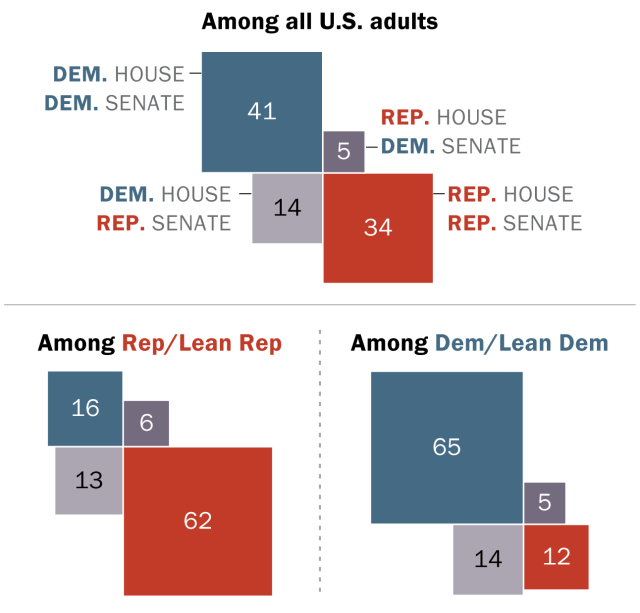
The survey also investigated the likelihood of a "sweep"—where a party captures both the House and the Senate. The results were telling:
- Democratic Confidence: Roughly 65% of Democrats and Democratic-leaning independents expect their party to win both chambers.
- Republican Confidence: Approximately 62% of Republicans and Republican-leaning independents believe the GOP will successfully retain both chambers.
These figures illustrate that, regardless of the objective political climate, a significant majority of the American public expects their side to be the ultimate winner. This creates a psychological environment where an electoral loss for either side is likely to be viewed by their base as a shock, potentially deepening feelings of disenfranchisement or skepticism toward the democratic process.
The Role of the "Citizen Pundit"
While political scientists and pollsters typically caution against using public opinion as a tool for electoral forecasting, these "citizen forecasts" provide a unique barometer for the public’s confidence in the system.
It is a well-established practice in political sociology that asking individuals for their "forecast" is actually a proxy for measuring their engagement level and their degree of optimism. When an American says, "I think my party will win," they are often expressing a belief in the viability of their party’s platform and the perceived failure of the opposition’s record. As noted in the survey methodology, these expectations often align with the broader consensus of political observers, yet they are perpetually colored by the voter’s own political worldview.
Implications for the 120th Congress
The implications of this public sentiment are profound. If the final results of the election deviate sharply from these expectations, it could lead to significant social and political friction.
- Legislative Gridlock: The fact that the public is so divided on the Senate, yet leans Democratic on the House, suggests that the incoming 120th Congress may be characterized by intense legislative friction. If control is split between the chambers, the ability of the government to pass essential budget resolutions or address national crises will be severely hampered.
- Trust in Institutions: When a large segment of the population expects their party to "sweep" and that expectation fails to materialize, it can fuel narratives regarding the legitimacy of the election. The high levels of partisan confidence identified by Pew suggest that the 2026 post-election period may see renewed debates over the efficacy and fairness of the electoral process.
- Mobilization: The high confidence levels within both parties likely serve as a powerful tool for mobilization. Campaigns use these "we are winning" or "the race is too close" narratives to encourage voter turnout. The fact that partisans on both sides are so bullish on their prospects suggests that turnout in the 2026 midterms could be exceptionally high.
Methodology and Transparency
Pew Research Center’s commitment to transparency remains a cornerstone of this analysis. The survey, which utilized the American Trends Panel, ensured a representative sample of the full U.S. adult population. By conducting the survey in early October, the Center captured the "late-stage" mindset of the American voter.
The inclusion of detailed survey questions and top-line responses provides a roadmap for future researchers to examine how the 2026 cycle compared to previous eras of political intensity. As Steven Shepard, the Associate Director of Politics at Pew, noted in the study’s release, the goal is to help the public and decision-makers understand the complex interplay between voter sentiment and political reality.
Conclusion: A Nation Divided by Perception
As the country moves toward the final days of the 2026 election, the data suggests that America is a nation divided not only by its political preferences but by its very expectations of the future. The disconnect between the public’s prediction of a Democratic House and the tight, uncertain race for the Senate underscores the fragility of the current political moment.
Ultimately, the 2026 midterms will be a test of whether the American public’s partisan-driven expectations can survive the reality of the ballot box. Whether the results align with the 55% who expect a Democratic House or the 48% who expect a Republican Senate, one thing is certain: the outcome will have a profound impact on the legislative agenda for the next two years, and the journey to that outcome will be defined by the deeply ingrained beliefs of the American voter.
The political environment is, as always, fluid. But for now, the data from the Pew Research Center offers a clear, sobering picture of a nation that is deeply invested in the outcome, yet viewing the path forward through vastly different windows of expectation.