The Briefing: A New Era of Media Accountability
As the American media landscape undergoes a seismic shift, the relationship between the executive branch and the press has reached a new, volatile inflection point. This week, the White House issued a stern ultimatum to Politico, demanding the retraction or correction of recent reports concerning Chief of Staff Susie Wiles. The incident, which highlights a broader trend of escalating friction between the Trump administration and traditional news outlets, serves as a focal point for a larger, national debate regarding the limits of journalistic freedom, the definition of accountability, and the public’s perception of truth in an increasingly digitized era.
This week’s briefing explores the collision between political power and the press, the shifting mechanisms through which Americans consume information, and the rise of alternative media influencers who are rapidly challenging the hegemony of traditional journalism.
The Conflict: White House vs. Politico
The current standoff centers on a report published last week by Politico, which suggested that President Donald Trump was contemplating a replacement for Chief of Staff Susie Wiles. The White House, characterizing the report as "fake news," responded with a formal letter from White House Counsel Will Scharf.
In a stark communication, Scharf asserted that "freedom of the press is not a professional exemption from accountability." This legalistic warning—which threatened potential consequences including litigation—marks a significant escalation in how the administration handles negative or speculative reporting.
A Pattern of Confrontation
The demand for a retraction is not an isolated event; it is the latest in a series of punitive actions taken by the White House against major news organizations. Last month, three prominent media outlets were banned from White House grounds, a move that has already sparked legal pushback from various press freedom organizations. The administration’s posture suggests a concerted strategy to redefine the boundaries of the adversarial relationship between the executive branch and the press, moving from public criticism to active intervention in editorial content.
Chronology of Tensions: October 2026
- Early October: Several major news organizations are barred from White House access, citing conflicts over coverage and credentials. This prompts immediate legal challenges from media consortiums defending First Amendment rights.
- Mid-October: Reports emerge regarding internal personnel shifts within the West Wing, specifically concerning the tenure of Chief of Staff Susie Wiles.
- October 20th: Politico publishes an article detailing potential plans by President Trump to replace Wiles.
- October 21st: The White House issues a formal letter via Counsel Will Scharf, demanding a retraction or correction, framing the report as a violation of professional standards.
- October 22nd: Public debate intensifies as stakeholders, including researchers at the Pew Research Center, release data regarding the public’s tolerance for government intervention in news reporting.
Supporting Data: Public Opinion on Press Limits
While the administration’s rhetoric toward the press is aggressive, it operates within a complex landscape of public opinion. According to a recent survey conducted by the Pew Research Center as part of the Pew-Knight Initiative, Americans hold nuanced, and at times contradictory, views regarding the role of the government in regulating media.
The Threshold of Government Intervention
When asked whether the U.S. government should be authorized to force a news organization to retract or remove a story, the public response is highly conditional:
- False Information: Approximately 51% of U.S. adults believe that the government should be able to intervene if a story contains demonstrably false information. This indicates a significant segment of the population that prioritizes accuracy over absolute editorial autonomy.
- Political Bias: In stark contrast, only 14% of Americans believe the government should have the authority to suppress a story if it clearly favors one political side.
- Critical Reporting: Perhaps most tellingly, only 10% of respondents support government-mandated removal of stories that are simply critical of the administration.
These figures illustrate that while the public is wary of misinformation, there remains a strong, underlying defense of a press that is free to criticize those in power and maintain its own editorial perspective.
The Digital Shift: How Americans Consume News
The dispute between the White House and the press occurs at a time when the infrastructure of news consumption is undergoing its most rapid transformation in a century. Traditional newspapers and broadcast networks are no longer the sole gatekeepers of information.
The Rise of the Algorithm and the Influencer
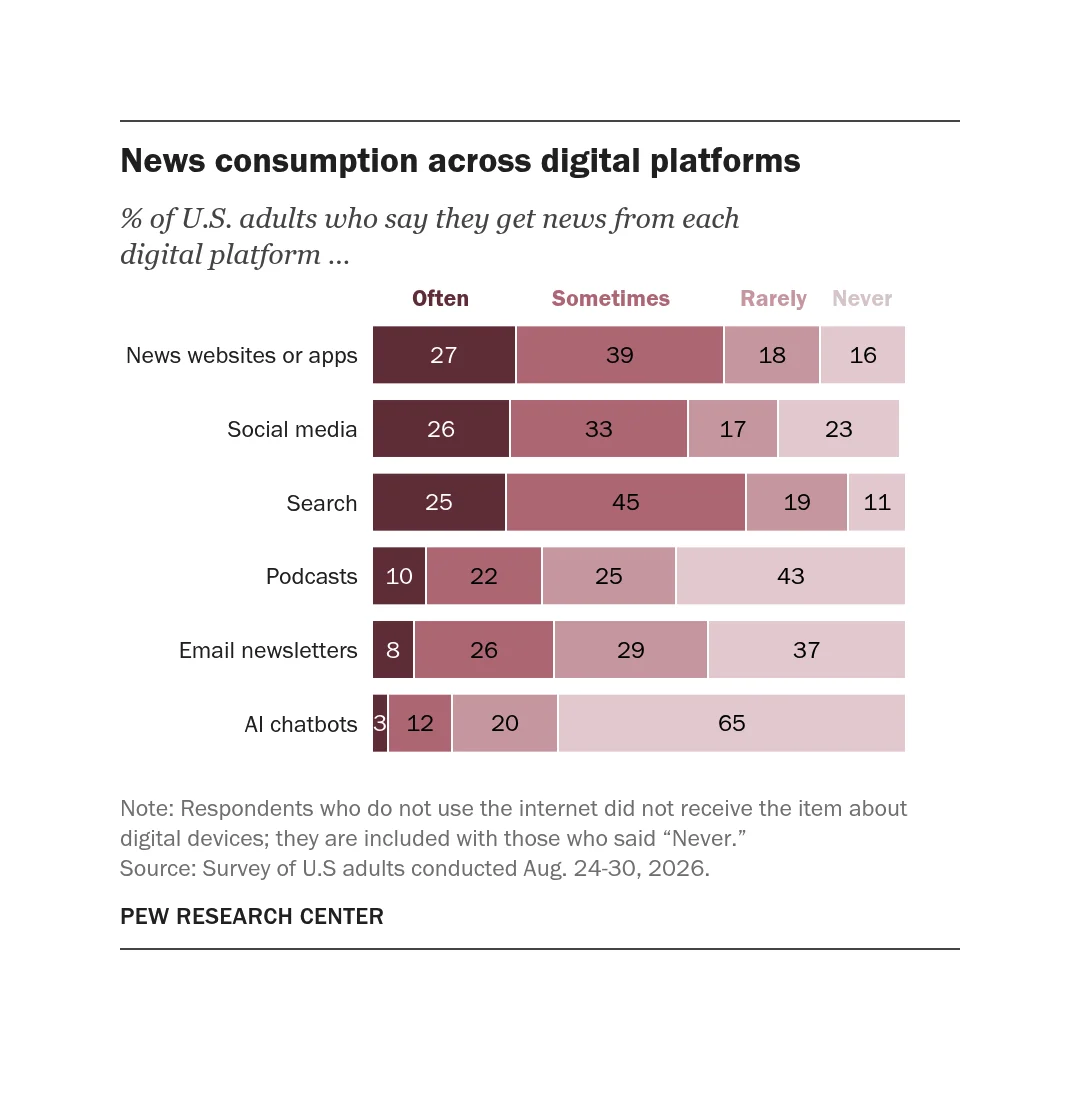
New data from an August 2026 Pew Research survey highlights a clear migration toward digital pathways. Americans are increasingly bypassing traditional news websites in favor of search engines, social media platforms, and, increasingly, AI-driven chatbots.
Key Trends in News Consumption:

- Search Engines: 25% of adults say they "often" get their news from search engines, with 45% stating they do so "sometimes."
- Social Media: 26% of adults rely on social media as a frequent news source.
- AI Chatbots: While still a smaller slice of the total, the usage of AI chatbots for news has jumped from 9% in 2025 to 15% in 2026, signaling a major behavioral shift in how the next generation verifies facts.
- News Influencers: A notable 21% of U.S. adults regularly receive their news from independent social media influencers. This trend is even more pronounced among younger demographics, with 38% of adults under 30 identifying as regular consumers of influencer-led news.
The Convergence: C-SPAN and the Creator Economy
The shifting landscape is perhaps best exemplified by the recent decision by C-SPAN to integrate YouTube creators into its election night coverage. By featuring livestreams from outlets like The Young Turks and The PBD Podcast on its auxiliary channels, C-SPAN is acknowledging a new reality: the future of political discourse is a hybrid of traditional institutional reporting and independent, personality-driven commentary.
Implications of Hybrid Media
This strategy is not without controversy. Many of these influencers bring explicit political perspectives to their coverage—a departure from the traditional "nonpartisan" model long upheld by C-SPAN’s flagship programming. However, the data suggests this is exactly what the audience is gravitating toward. By embracing these voices, traditional media outlets are attempting to stay relevant in a fragmented market where the "neutral" reporter is being replaced by the "authentic" influencer.
Implications: The Future of Accountability
The friction between the White House and Politico is more than a professional spat; it is a preview of the challenges facing the press in the latter half of the 2020s.
1. The Weaponization of "Accountability"
When the government defines its own criticism as "falsehoods" requiring state-level intervention, the result is a chilling effect on investigative journalism. If news organizations are forced to choose between the risk of litigation and the risk of offending those in power, the investigative rigor that holds administrations accountable is inevitably compromised.
2. The Fragmentation of Truth
As Americans migrate to niche influencers and social media platforms for their news, the existence of a "shared reality" becomes increasingly fragile. When 15% of the population relies on AI chatbots for information, the potential for algorithmic bias or automated misinformation becomes a public policy concern that exceeds the scope of traditional libel law.
3. The Resilience of the First Amendment
Despite the aggressive tactics employed by the current administration, the legal system remains the final arbiter of press freedom. The ongoing lawsuits regarding the White House media ban will serve as a definitive test of how the judiciary interprets the First Amendment in the age of digital, influencer-led, and rapidly polarizing media.
Looking Ahead
As we move toward the next electoral cycle, the interaction between the White House and the press will likely remain contentious. For the average citizen, the challenge will be to navigate an environment where "news" is increasingly defined by its platform of delivery rather than its source of origin.
While the White House seeks to assert control through the threat of retraction, the broader trends suggest that the power to control the narrative is slipping from the hands of institutions and into the hands of a decentralized, digital, and highly personalized media ecosystem. Whether this shift empowers the electorate or further fractures the democratic process remains the central question of our time.
The Briefing will continue to monitor these developments, providing the data and context necessary to understand the rapidly changing world of information and power. For those seeking to stay informed, the importance of diversifying one’s news diet and understanding the platforms that deliver that news has never been more critical.
The Briefing is compiled by the Pew Research Center staff. For further analysis on the intersection of media and politics, please visit the Pew Research Center’s journalism project archives.