Editor’s note: This is a contributed commentary. It comes amid the Federal Motor Carrier Safety Administration’s (FMCSA) ongoing revocation of registered Electronic Logging Devices (ELDs) due to hours-of-service (HOS) log manipulation. FreightWaves welcomes responses from other parties regarding this critical industry issue.
The modern freight ecosystem is built upon a foundation of digital connectivity. At the center of this web lies the Electronic Logging Device (ELD), a technology that has evolved from a simple regulatory mandate into the backbone of supply chain visibility. For brokers, ELD connections are essential for verifying carrier activity, ensuring vehicle-carrier association, and confirming the physical presence of the right assets for a load. For carriers, these integrations are the primary vehicle for demonstrating capacity and unlocking access to high-value freight.
However, as the industry leans into automation and real-time data, a pressing question has emerged: Can we trust the integrity of the providers facilitating these connections?
The Fallacy of the "Universal Endorsement"
There is a dangerous misconception currently circulating in the logistics sector: that a technical integration between a platform and an ELD provider acts as a blanket endorsement of that provider’s business practices. In reality, a technical handshake is merely a conduit for data—it is not an audit of a company’s ethics, financial stability, or compliance history.
Integrations must be governed by rigorous, evolving standards. When those standards fail, accountability must follow. Relying solely on FMCSA registration is no longer sufficient; while registration provides a baseline, it is merely the starting point for due diligence.
At Highway, we have spent nearly five years navigating this landscape, working with hundreds of ELD providers. We maintain our own internal requirements for integration, separate from government mandates. We have, on multiple occasions, terminated integrations with providers that remained on the FMCSA’s “registered” list because they failed to meet our specific standards for data reliability. Furthermore, we actively monitor the market for “reincarnated” providers—companies that reappear under new branding after a previous entity has been revoked. In the eyes of the industry, a new label does not erase a history of fraudulent behavior or systemic non-compliance.
The Nuance of Risk Management
The industry must avoid the trap of collective guilt. It is a mistake to assume that every carrier using a problematic ELD provider is complicit in fraudulent activity. A single, large-scale provider may serve thousands of legitimate, honest businesses.
When a provider is flagged, brokers require a clear, granular view of risk. The goal is not to shut down legitimate carriers but to implement controls around the specific transactions that present a threat. When an integration must be severed, the priority is to provide legitimate carriers with sufficient notice and a clear, workable path to migrate to a new provider. Effective enforcement must protect the network without collateral damage to the honest actors who keep the economy moving.
Clarifying the Role of Telemetry in Cargo Security
It is critical to be precise about what ELD data can—and cannot—establish. Highway does not receive a driver’s hours-of-service (HOS) records through these integrations, nor do we perform the safety audits mandated by the FMCSA. While reports of manipulated logs warrant intense scrutiny, ELD telemetry is only one of many inputs in a broader, holistic assessment of carrier identity and cargo risk.
To rely on ELD data as the sole arbiter of a hiring decision is a tactical error. In our five years of operation, we have yet to identify a successful cargo theft where the failure was solely due to reliance on manipulated ELD data. This is not to say that ELD manipulation is harmless—it is a significant regulatory and ethical breach—but it is a distinction that must be made. The industry must distinguish between HOS enforcement and the specific, high-stakes question of whether a cargo-hiring decision was compromised by falsified data. Both require accurate evidence, but they call for different mitigation strategies.
Building a Layered Defense: The Certified Partner Network
Accountability in the freight sector is being redefined through initiatives like the Highway Certified Partner Network. By creating a tiered system of commitment, we are asking providers to opt into a higher standard of data integrity and reliable delivery.
This program allows brokers and carriers to see exactly which providers are willing to back their data with formal commitments. While participation in the certification is voluntary, meeting our baseline technical and compliance requirements for integration remains mandatory.
Crucially, this is not an ELD-exclusive issue. We initiated this accountability framework with insurance agents, and we are now extending it to every entity that contributes data to a freight transaction. If you are part of the hiring decision, you must be part of the accountability framework.
The Test of the Balance Sheet: The Performance Guarantee
The ultimate test of any standard is its performance during a failure. Talk is cheap, and in a market rife with skepticism, we believe in putting our own capital at risk. Through our Performance Guarantee, Highway provides up to $100,000 in coverage for qualifying loads.
Across roughly one million guaranteed loads, we have paid out only once. This success rate is not a result of luck; it is the result of a rigorous, enforceable assessment of the carrier and the load. We can offer this guarantee because we look beyond a single signal from a single provider. We assess the entire transaction.
The "Man in the Arena" and the Future of Freight
The current market environment is characterized by a chorus of pundits and competitors demanding instant, sweeping declarations. Many of these voices occupy the “stands,” calling for action without owning the consequences of those demands. They are free to ask, but they are not the parties to whom we are accountable.
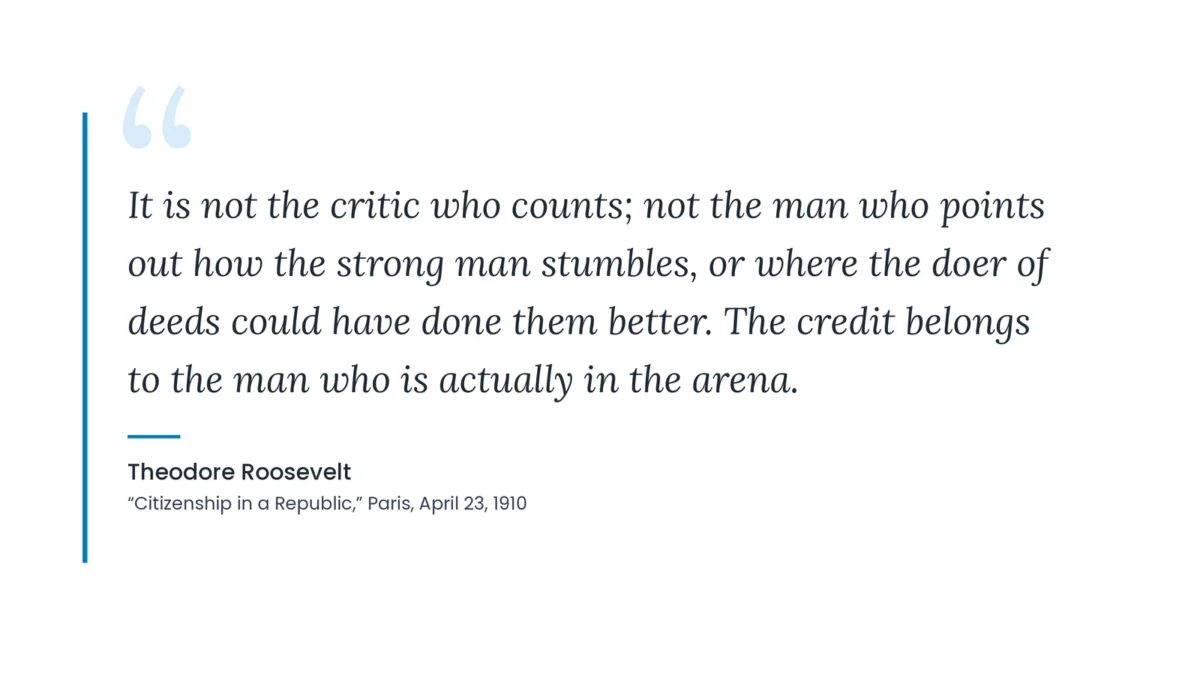
Our responsibility is to the brokers and carriers who trust us with the critical decisions that affect their livelihoods. As Theodore Roosevelt famously posited in his “Man in the Arena” speech, the credit belongs to the one who is actually in the arena, whose face is marred by dust and sweat.
In the freight industry, the “arena” is defined by a load at risk, a carrier fighting to stay in business, and a customer who needs someone to take responsibility for a decision. It is easy to demand change from afar. It is significantly harder to establish the facts, apply a standard fairly, and remain standing when things go wrong.
We have yet to see another carrier identity platform pair an enforceable, high-bar standard with a performance guarantee across this volume of freight. We welcome the competition; we welcome anyone willing to raise the bar. Until then, we will remain in the arena, doing the work, correcting our course when the evidence demands it, and standing behind the loads our customers entrust to us.
Implications for the Industry
The ongoing FMCSA crackdowns on ELD fraud are a necessary step toward cleaning up the industry, but they are only a beginning. The implications of this shift are threefold:
- Shift from Passive to Active Vetting: Brokers can no longer rely on “plug-and-play” data sources. The era of passive vetting is over. Platforms must now act as active stewards of the data they ingest.
- Increased Focus on Data provenance: As we move forward, the industry will likely see a flight to quality. Carriers who use transparent, high-integrity ELD providers will become the preferred partners for shippers and brokers, while those associated with "black box" providers will face increasing friction.
- The Rise of Financial Accountability: The success of performance guarantees suggests that the market is beginning to value liability-backed data over simple data aggregation. If a provider cannot stand behind the veracity of their information with a financial commitment, the market may eventually deem that information worthless.
The freight market needs an ELD ecosystem where a provider’s commitments are visible, its data is verified, and failures carry tangible consequences. Brokers should be empowered to set the bar for their freight, and legitimate carriers should have a fair, transparent path to prove their worth. We are committed to enforcing that standard, one load at a time.
Michael Caney is the Chief Commercial Officer of Highway, a carrier identity and fraud-prevention platform. Highway’s products, including its Certified Partner Network and Performance Guarantee, are discussed in this article. The views expressed are the author’s own and do not necessarily reflect those of FreightWaves.