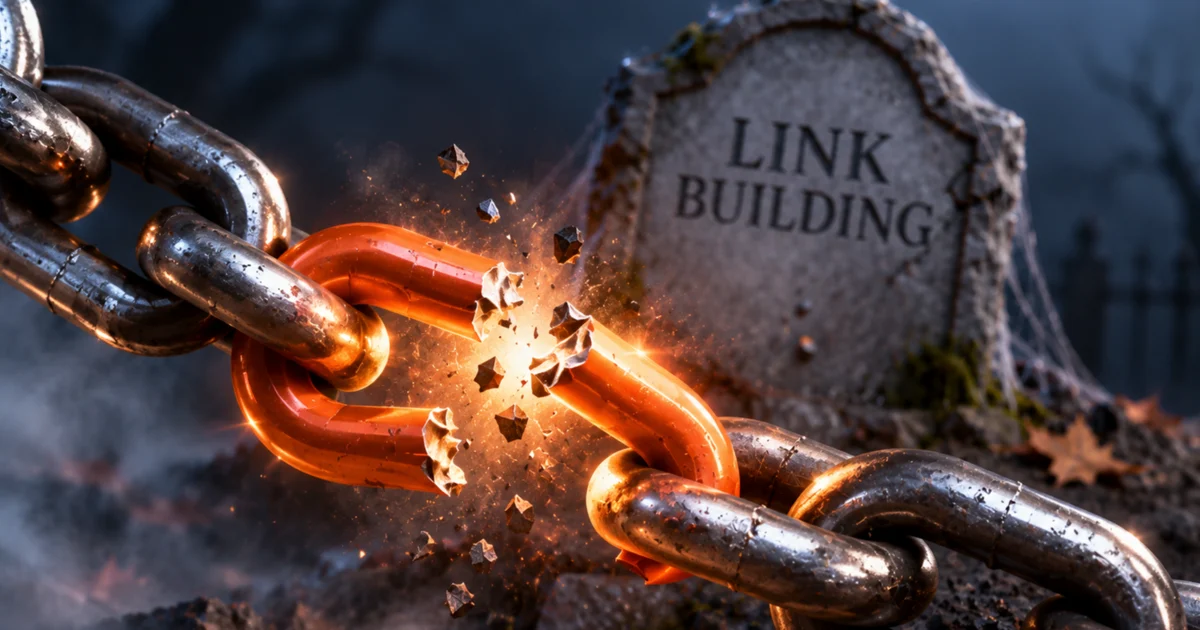
As the digital landscape pivots toward an AI-first paradigm, the SEO community is grappling with a fundamental question: Is link building dead, or has it simply entered its most complex evolution yet? With search engines like Google moving rapidly toward AI Overviews and sophisticated AI-driven search modes, the traditional "backlink-is-king" mantra is undergoing a rigorous transformation.
For marketers looking ahead to 2027, the challenge is not whether to build links, but how to evolve those efforts to satisfy both human users and the increasingly opaque algorithms of AI-driven discovery. To help clarify this shift, Search Engine Journal is hosting an exclusive webinar, The Link Building Graveyard: What to Bury & What Still Wins, featuring Michael Johnson, CEO of Resolve.
The State of Play: Why Links Remain Vital in the Age of AI
The narrative that AI renders backlinks obsolete is fundamentally flawed. While the mechanics of search are changing—shifting from a list of blue links to synthesized, generative answers—the underlying requirements for search engines remain consistent: discovery, relevance, and authority.
AI models do not exist in a vacuum. They are trained on and retrieve information from the open web. If your content is not discoverable, or if it lacks the authority signals that verify its credibility, it will never enter the training set or the retrieval pool from which AI Overviews are generated.
The Mechanism of Discovery
Google’s AI-powered search features rely on high-quality, authoritative web pages to synthesize accurate answers. Relevant, earned links serve as the "digital breadcrumbs" that help search crawlers find, index, and evaluate your content. By securing high-quality backlinks, you aren’t just boosting a vanity metric; you are providing the search engine with a roadmap to your brand’s expertise.
Supporting Data: The Correlation Between Rankings and Citations
The data supports the continued relevance of traditional SEO practices. A landmark study conducted in March 2026 by Ahrefs revealed a striking overlap between organic performance and AI presence. The study found that 37.1% of URLs cited in AI Overviews were already ranking in the top 10 organic search results for the same query.
This statistic is a wake-up call for SEO professionals: your organic visibility is the foundation upon which your AI visibility is built. While a single backlink no longer guarantees a direct citation in an AI response, the cumulative authority of your domain—built through a strategic backlink profile—remains a critical gatekeeper for inclusion in AI-generated answers.
Chronology of the Shift: From Spam to Authority
To understand where we are going in 2027, we must look at how we arrived here.
- 2022-2023: The Great Reckoning. The rise of generative AI began to threaten the utility of low-quality, automated link-building schemes. Google’s spam updates became more frequent and punitive.
- 2024-2025: The Rise of AI Overviews. Google began integrating SGE (Search Generative Experience) and later AI Overviews. The industry saw a temporary dip in referral traffic as "zero-click" searches became the norm.
- 2026: The Stabilization Phase. Marketers realized that AI models were hallucinating or providing thin answers when source data was low-quality. The emphasis shifted back to "E-E-A-T" (Experience, Expertise, Authoritativeness, and Trustworthiness).
- 2027: The Maturity of Off-Page SEO. As we enter 2027, the industry is settling into a new reality: links are for people, not just bots. If a link doesn’t provide a pathway for a human user to find your expertise, it is increasingly being seen as "dead weight."
What to Bury: Strategies That No Longer Serve Your Brand
In the 2027 digital ecosystem, several historical link-building tactics have become not only ineffective but potentially harmful to a domain’s reputation.
1. Mass-Produced Guest Posting
Gone are the days when churning out hundreds of low-quality guest posts on "link farms" or irrelevant blogs could move the needle. AI-detection tools and updated spam policies now identify these patterns with alarming speed. If the content is not unique and the hosting site doesn’t have a genuine audience, bury it.
2. Automated Directory Submissions
While directories once served a purpose in the early web, they are now viewed as clutter. Submitting your URL to thousands of automated, generic directories is a waste of resources that offers zero benefit to your authority and can signal a lack of brand quality to Google.
3. The "Volume-First" Mentality
Focusing on the number of links rather than the quality and context of those links is a legacy strategy. A single link from a high-authority industry journal that generates actual referral traffic is worth more than a thousand links from obscure, unvisited sites.
What Still Wins: Building a Sustainable 2027 Program
The future of off-page SEO lies in authenticity and utility. The following strategies are becoming the gold standard for high-visibility brands.
Original Research and Data Journalism
Nothing earns links more naturally than proprietary data. By conducting original surveys, analyzing industry trends, or creating interactive tools that solve specific user pain points, you position your brand as a primary source. Journalists, bloggers, and industry peers naturally gravitate toward data-backed content because it adds value to their own work.
Strategic Digital PR
The lines between PR and SEO have effectively vanished. Digital PR involves crafting compelling narratives that pitch your brand’s experts to reputable publications. When you provide genuine value to an editor—rather than just asking for a link—you earn placement on sites that possess high topical authority.
Answer-Driven Content Strategy
Your link-building efforts should be tethered to the questions your buyers are asking. If you have a guide or a tool that provides a definitive answer to a complex industry question, you have a "linkable asset." The goal is to ensure that when a user—or an AI—is looking for an answer, your content is the most credible source available.
Implications for Your SEO Team
The transition to a 2027-ready strategy requires a shift in how SEO teams are structured and measured.
- Metric Redefinition: Move away from "Domain Authority" as a singular goal. Start measuring "Referral Authority" and "Brand Mentions" in contexts where your target audience lives.
- Cross-Departmental Collaboration: Your SEO team must work closely with Content and PR teams. SEO can no longer be a siloed operation; it must inform the content production process from the ideation stage.
- The "Human-First" Pivot: If a piece of content is written solely for a bot, it will likely fail in the AI era. Focus on creating assets that satisfy the reader’s curiosity. If you solve the human problem, the AI recognition will follow.
Join the Conversation
As the industry continues to evolve, staying ahead of the curve is not just an advantage—it is a survival requirement. The upcoming webinar, The Link Building Graveyard: What to Bury & What Still Wins, is designed to provide you with a clear, actionable roadmap for your 2027 execution plan.
Michael Johnson will guide participants through:
- A "Keep vs. Cut" Audit: A framework to evaluate your current off-page campaigns.
- AI-Resilient Link Building: Tactics that work regardless of how the search interface changes.
- The Intersection of PR and SEO: How to leverage earned media to satisfy AI citations.
Event Details:
- Date: Wednesday, October 21, 2026
- Time: 2:00 p.m. ET
- Moderator: Loren Baker, Founder of Search Engine Journal
The digital landscape is not becoming less competitive; it is becoming more refined. By pruning the dead weight of outdated tactics and doubling down on high-authority, high-value outreach, your brand can secure its place in the next generation of search.
Can’t make the live session? Register today to receive the full recording and supplemental materials to help you plan your 2027 strategy at your own pace. Don’t let your SEO strategy become a relic of the past—evolve with the web.