Tirana, Albania – October 22, 2026 – In a dramatic turn of events within Albania’s judicial system, the Special Court (GJKKO) has ruled to proceed with the criminal trial of Ilir Meta, the leader of the Freedom Party and former President of Albania, and his estranged wife, Monika Kryemadhi, former Chairwoman of the Socialist Movement for Integration (LSI), without their legal representation. The unprecedented decision, made on Thursday, October 22nd, marks a significant escalation in a case that has captivated the nation and highlighted the complex interplay between legal proceedings and political maneuvering.
The court’s decision comes after repeated and ultimately unsuccessful attempts by the Special Court to secure legal representation for the defendants, who have been left without counsel due to a nationwide boycott of GJKKO sessions by defense attorneys. This boycott, initiated by a decision from the General Council of the Albanian Chamber of Advocates, is a protest against the new regulations imposed by the GJKKO, specifically the prohibition of mobile phone use within courtrooms.
The Impasse: Lawyers’ Boycott and the Court’s Response
The core of the current legal deadlock lies in the organized refusal of defense lawyers to participate in proceedings at the GJKKO. This collective action is a direct response to the new regulations, which advocates deem an infringement on their professional rights and the ability to effectively represent their clients. Despite the presence of two lawyers appointed to represent Meta and Kryemadhi, these legal professionals, bound by the Chamber’s directive, were present in the courtroom but explicitly refused to act on behalf of their clients, citing their adherence to the boycott.
This situation compelled the court to take extraordinary measures. A week prior to Thursday’s session, the court had appointed two lawyers from the Ministry of Justice’s Free Legal Aid office to represent the defendants. However, this attempt to circumvent the boycott also proved futile.
Presiding Judge Erjon Bani informed the court on Thursday that Marsela Zeneli, the lawyer assigned to represent Ilir Meta, had been notified but stated her inability to participate due to the ongoing boycott. Similarly, Anjeza Rusi, appointed to defend Monika Kryemadhi, had also been notified but did not appear. Judge Bani further clarified that Ms. Rusi had formally withdrawn her representation, arguing that the case did not qualify for services provided by the Free Legal Aid office, a claim that contradicts the established criteria for such assistance.
The online portal of the Directorate of Free Legal Aid outlines that this service is available to citizens facing economic hardship or belonging to specific vulnerable categories requiring legal assistance. These categories typically include victims of domestic violence, human trafficking, child abuse, and individuals residing in social care institutions. The rationale behind denying assistance to prominent political figures like Meta and Kryemadhi, who are not typically associated with these specific vulnerable groups, remains a point of contention and has been a source of public debate.
Absence of Key Prosecutors and Defense Arguments
Adding to the unusual nature of the proceedings, three key prosecutors from the Special Prosecution Office (SPAK) – Altin Dumani, Arben Kraja, and Sotir Kllapi – were also absent from the session. SPAK was represented by prosecutor Vladimir Mara, who observed that the trial could not proceed under the current circumstances of absent defense counsel and suggested the proceedings should be postponed. He also requested a suspension of the pre-trial detention periods for Meta.
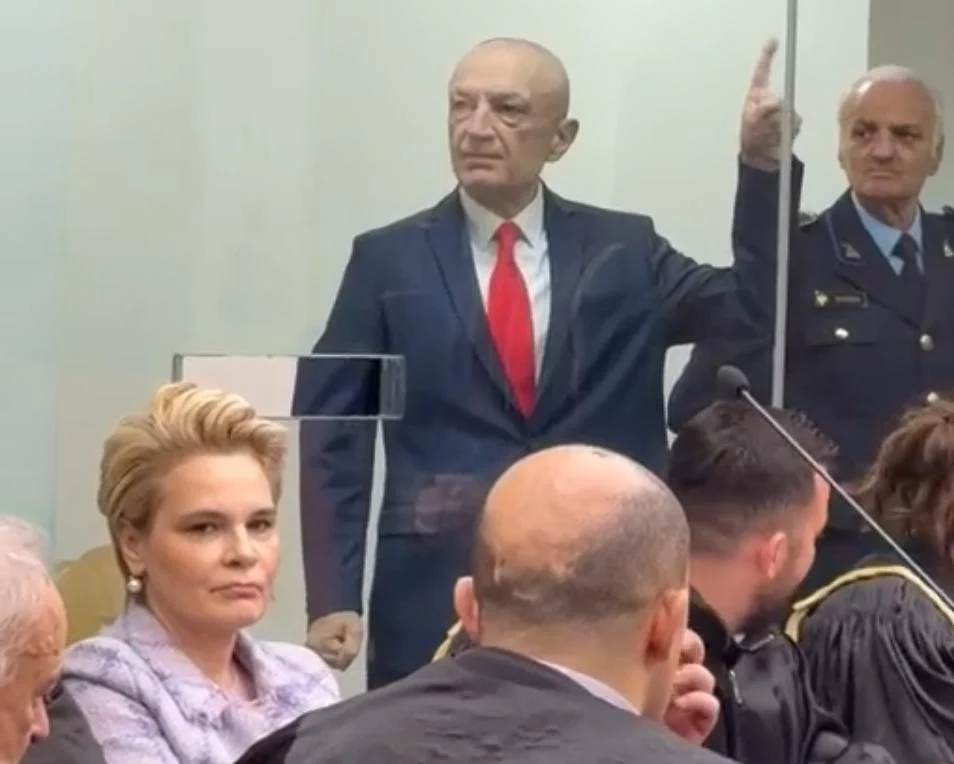
Ilir Meta, speaking from the dock, reiterated his readiness to proceed with the trial without legal representation, choosing to defend himself. He characterized the current situation as a deliberate tactic to delay the proceedings. Meta also revealed that he had been in contact with the head of the Chamber of Advocates, who he believed would have a solution by Thursday. He claimed that lawyer Maksim Haxhia had informed him of a meeting with the High Judicial Council on Thursday to address the developing situation. Meta strongly contested the request to suspend pre-trial detention, emphasizing that the prosecution was absent from this particular session.
Monika Kryemadhi echoed similar sentiments, asserting that the prosecutor representing SPAK in this session was unfamiliar with the case and that, even with legal representation present, the proceedings would likely have been adjourned.
Court’s Ruling and Imposition of Fines
Following deliberations in chambers, the court concluded that the absence of the four defense lawyers was unjustified. As a consequence, the court imposed fines: 20,000 Albanian Lek (ALL) for the privately chosen lawyers and 5,000 ALL for those appointed from the Free Legal Aid office.
Presiding Judge Erion Bani declared that the court had exhausted all legal avenues to secure representation for the defendants. Citing case law from the European Court of Human Rights, he stated that the trial would proceed without legal counsel, noting that this was also a request made by the defendants themselves at some point. This assertion, however, appears to be a nuanced interpretation of the defendants’ statements, as both Meta and Kryemadhi had indicated a willingness to defend themselves in the absence of counsel, rather than an outright request for the court to proceed without lawyers present.
The Path Forward: Adjournment and Underlying Charges
Despite the court’s decision to proceed, the next hearing has been adjourned to October 29th at 11:00 AM. This adjournment offers a brief reprieve, potentially allowing for further developments in the lawyers’ boycott or a change in the court’s approach.
The charges against Ilir Meta and Monika Kryemadhi are significant and stem from various alleged corruption and influence-peddling schemes. SPAK accuses Meta of involvement in the CEZ-DIA affair, a complex case involving the privatization of the electricity distribution company. Both defendants are also charged in relation to a lobbying contract for the LSI in the United States, alleged influence-peddling on behalf of businessmen Samir Mane and Adrian Shatku in exchange for favors, financial inability to purchase two apartments in the exclusive "Blloku" area, and undeclared expenses. The defendants have vehemently denied all charges, dismissing them as baseless and politically motivated fabrications by their opponents.
Broader Implications and Legal Precedents
The decision by the GJKKO to proceed without defense counsel sets a precarious precedent within the Albanian justice system. While the court argues it has exhausted all legal options and is acting in accordance with international human rights standards to ensure the trial progresses, critics raise concerns about the fairness and legitimacy of a trial conducted under such duress. The principle of the right to a fair trial, including the right to adequate legal defense, is a cornerstone of democratic legal systems.
The ongoing boycott by the Chamber of Advocates highlights a deep-seated conflict between the legal profession and the judiciary, particularly concerning the regulatory powers of specialized courts like the GJKKO. The prohibition of mobile phones, while ostensibly aimed at maintaining order and preventing interference, is viewed by some as an overly restrictive measure that hinders effective legal practice.
The case of Ilir Meta and Monika Kryemadhi is not merely a criminal trial; it is a high-stakes political drama unfolding within the halls of justice. The outcome will undoubtedly have far-reaching implications for the political landscape of Albania, the credibility of its judicial institutions, and the public’s trust in the rule of law. The coming weeks, leading up to the October 29th hearing, will be critical in determining whether a resolution to this legal impasse can be found, or if the trial will continue under these extraordinary and contentious circumstances. The international community will be watching closely as Albania navigates this challenging chapter in its pursuit of justice and accountability.