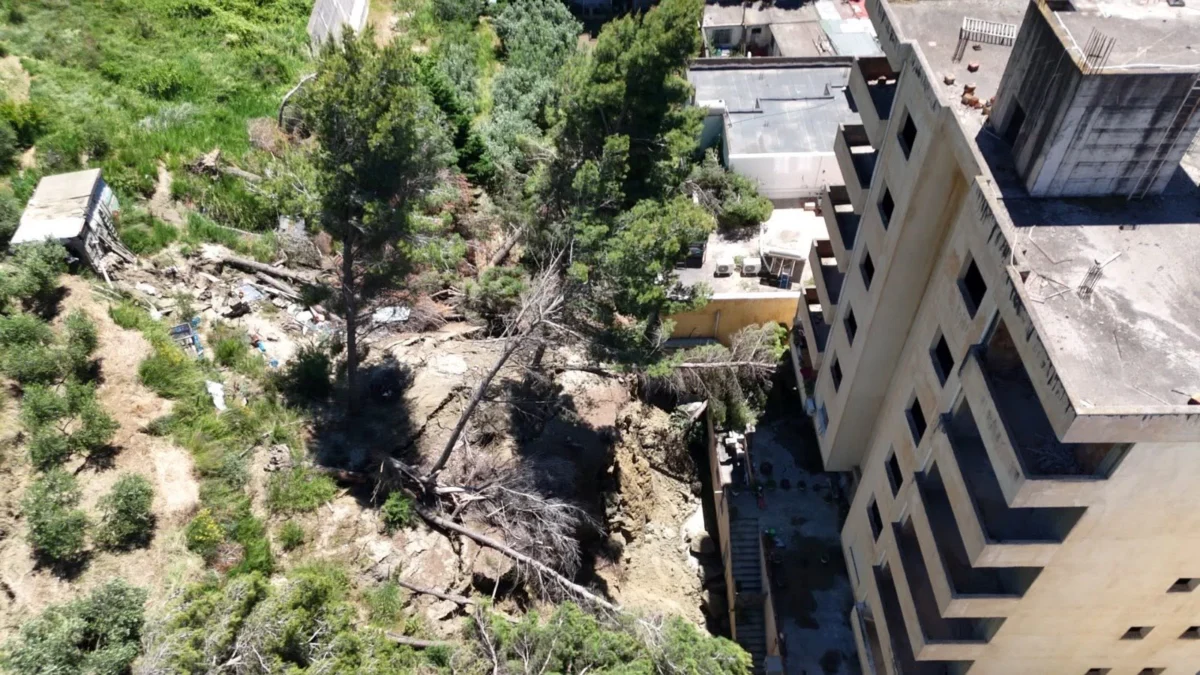
Durrës, Albania – June 2026 – After a prolonged four-month drought punctuated by soaring temperatures, the arrival of Friday’s rainfall brought a much-needed respite to the residents of Durrës. However, for a segment of the city’s population, particularly those living in apartment buildings along Currilave Road, the soothing sound of rain is a stark reminder of a persistent and growing danger: the looming threat of landslides from the hillside above their homes. The very geological formations that once offered a picturesque backdrop to this popular coastal area are now a source of profound anxiety, as evidence suggests that decades of development have exacerbated inherent instability, putting lives and property at risk.
The Precarious Balance: A History of Instability
The picturesque coastline of Durrës, particularly the Currilave hill area, has long been a cherished destination for locals and tourists alike. Its gentle slopes, once carpeted with lush greenery and dotted with pine trees, offered serene beaches and a tranquil escape. However, this idyllic image belies a complex geological reality. The hill itself is composed primarily of alternating layers of clay and sand, formations shaped over millions of years. This geological makeup, while contributing to the area’s natural beauty, also renders it inherently susceptible to erosion and landslides.
Clay, known for its propensity to swell when saturated with water and contract during dry spells, interacts with the sandy layers to create a volatile mix. This characteristic makes the slopes unstable, a fact that has been documented in geological studies for decades, predating the significant construction booms of recent decades. The natural processes of erosion and soil creep have always been present along this segment of the coast, but the scale and frequency of destructive events have intensified, painting a grim picture for the future.
A Troubling Chronology of Threats
The current anxieties are not without precedent. Just four months prior to the recent rainfall, a significant landslide occurred, tearing away a protective concrete wall and sending mud-laden debris tumbling down. Pine trees were uprooted, some toppling onto the first floors of the apartment buildings below. This dramatic event served as a potent visual manifestation of the underlying geological fragility.
Experts have long warned about the suitability of the construction in this area. Geologist Professor Adem Hyseni, who has been monitoring the Currilave zone since 1974, when he was involved in oil and gas exploration studies, has been a vocal advocate for caution. He explains that the alternating layers of clay and sand filter water at different rates, a process that erodes the structural integrity of the soil and facilitates massive landslides, particularly in this vulnerable region.
"This structure is highly endangered," Professor Hyseni stated, referencing seismic studies from the 1980s that identified similar risks in the territory extending northwards to Kallmi. He further expressed uncertainty regarding the extent of damage caused by the additional load from construction that has taken place since the early 2000s.
The transformation of Currilave over the past three decades is stark. What was once a predominantly natural and recreational area, characterized by small beaches and verdant slopes, has gradually evolved into an urbanized landscape. The construction of apartment buildings, hotels, restaurants, and service establishments has fundamentally altered the terrain and its inherent stability. The landslides in the Currilave hills have become a recurring phenomenon over the past decade, directly endangering the coastal road, businesses, and the apartment blocks built precariously on the slope.
Supporting Data: The Science Behind the Slips
The geological composition of the Currilave hill is central to understanding the persistent risk. The alternating clay and sand formations create a geological mosaic prone to instability. Clay’s hygroscopic nature means it absorbs significant amounts of water, leading to expansion. Conversely, during dry periods, it contracts. This cyclical expansion and contraction, combined with the porous nature of the sand layers, creates a perfect recipe for landslides. Water, acting as a lubricant between these layers, can initiate catastrophic slides, especially when exacerbated by heavy rainfall or seismic activity.
Professor Hyseni’s decades of research provide critical scientific backing to these concerns. His work in the 1970s and subsequent seismic studies in the 1980s highlighted the inherent instability of the region’s geological structure. The addition of significant construction loads in the post-2000 era, including multi-story apartment buildings, has undoubtedly placed additional stress on these already fragile slopes. The increased weight and altered drainage patterns resulting from extensive development can further destabilize the soil, making it more susceptible to collapse.
The incident four months ago, where a concrete retaining wall was dislodged and trees were uprooted, serves as a tangible piece of evidence. The debris impacting the first floors of buildings underscores the direct threat to residential structures. This is not a theoretical risk; it is a demonstrated danger with potentially devastating consequences.
Official Responses and Past Interventions
Recognizing the escalating threat, past efforts have been made to mitigate the risks. In 2014, the Ministry of Environment initiated a rehabilitation project that included the installation of protective nets, afforestation, and the construction of recreational infrastructure. However, this project reportedly did not yield the desired successful outcomes.
Following the recent landslide, the presence of municipal inspectors and civil emergency personnel was more visible, according to Neritan Vila, a resident of one of the affected apartment buildings. The municipality offered temporary shelter in rooms at the Ministry of Interior’s rest house as a precautionary measure due to the immediate danger. However, many residents found their own solutions and returned to their apartments relatively quickly. This suggests a complex interplay between perceived immediate safety and the desire to remain in their homes, often due to their prime location and value.
Vila noted that in the most endangered building, which houses 40 apartments, only about 15-16 families reside year-round. However, some families have purchased multiple apartments for other relatives, driven by the building’s desirable seaside location. This highlights the economic incentives that may outweigh the perceived safety risks for some, further complicating the situation.
In response to inquiries from BIRN, the municipality stated that alongside an engineering-seismological study, an expert assessment of the structural load-bearing capacity of existing buildings has been prepared. All relevant documentation has been forwarded to the appropriate institutions, including the Ministry of Agriculture, the Ministry of Defense, and Civil Emergencies. The municipality has formally requested these institutions to allocate the necessary investments for the restoration of normalcy in the area.
However, Professor Adem Hyseni remains skeptical about the long-term efficacy of such measures. He recounted the case of a bunker built on the crest of the hill in 1982. "That bunker slid down 40 years later from a height of 96 meters. Fortunately, due to an obstruction, it remained halfway down the slope; who knows what damage it would have caused if it had reached the bottom," he explained, illustrating the inherent power of natural forces and the unpredictable nature of landslides. His cautionary tale serves as a stark reminder that engineering solutions must contend with the immense forces of nature.
Implications for the Future: A Call for Proactive Solutions
The situation in Currilave presents a multifaceted challenge, encompassing geological instability, urban development, resident safety, and the responsibility of governing bodies. The immediate implications are clear: residents living below the unstable hillside are in a state of constant vulnerability. The recent rainfall, while a welcome relief from drought, has amplified their fears, bringing the dormant threat to the forefront of their minds.
The long-term implications are even more profound. The continued erosion and potential for larger-scale landslides threaten not only the safety of residents but also the viability of existing infrastructure, including the coastal road and businesses operating in the area. Furthermore, the incident raises critical questions about urban planning regulations, building permits, and the oversight of construction in geologically sensitive zones.
The municipality’s actions to compile studies and forward them to relevant ministries are a step in the right direction, but the urgency of the situation demands more than bureaucratic processes. The request for investment in restoring normalcy is crucial, but what does "normalcy" entail in such a precarious environment? It likely involves significant engineering interventions to stabilize the hillside, potentially including extensive retaining structures, drainage systems, and reforestation efforts.
Professor Hyseni’s pessimism, rooted in decades of observation and scientific understanding, underscores the gravity of the situation. The example of the fallen bunker serves as a potent warning that natural forces can overcome human interventions. This suggests that a comprehensive, multi-disciplinary approach is required, one that prioritizes safety and sustainability over short-term economic gains.
The residents of Currilave are caught between the allure of their seaside homes and the ever-present threat of the earth beneath them giving way. Their situation is a stark reminder that development must proceed with a profound respect for the natural environment and its inherent limitations. Without decisive and effective action, the beautiful coastline of Durrës could become a symbol of the devastating consequences of unchecked development in a geologically unstable region. The coming months and years will be critical in determining whether the residents of Currilave can find lasting peace or if they will continue to live under the shadow of impending disaster.