In the current labor market, the phrase "AI experience" has become a ubiquitous, yet profoundly ambiguous, staple of job descriptions. From the cubicles of boutique biotech startups to the high-frequency trading desks of global financial institutions, recruiters are appending this requirement to roles ranging from entry-level data analysts to senior research leads.
However, as AI and machine learning become the primary drivers of corporate digital transformation, this catch-all term has created a significant disconnect between job seekers and hiring managers. What one firm labels as "AI experience" might involve training deep neural networks from scratch, while another may simply require a proficiency in prompting Large Language Models (LLMs) to summarize quarterly reports. This article serves as a comprehensive guide to navigating this semantic minefield, helping professionals translate their existing statistical rigor into the language of the modern AI-driven enterprise.
The Anatomy of a Marketing Term: Why Definitions Remain Elusive
To understand why "AI experience" feels like a moving target, one must first recognize that it is a marketing term, not a standardized technical competency. Unlike specific requirements such as "proficiency in R," "experience with Bayesian inference," or "five years of SQL development," the term "AI experience" carries no shared industry definition.
The Ambiguity by Design
This ambiguity is rarely an accident. In a competitive landscape, hiring teams often include "AI experience" to signal that the company is at the vanguard of innovation. It serves as a filter—a way to attract candidates who are culturally aligned with technological adoption, even when the hiring team itself lacks a precise, unified vision of what the role’s technical output should look like.
For the job seeker, this necessitates a forensic approach to reading job postings. The description must be treated as a "statistical document" that requires decoding based on industry context, organizational size, and the stated seniority of the position.
The Four Categories of "AI Experience"
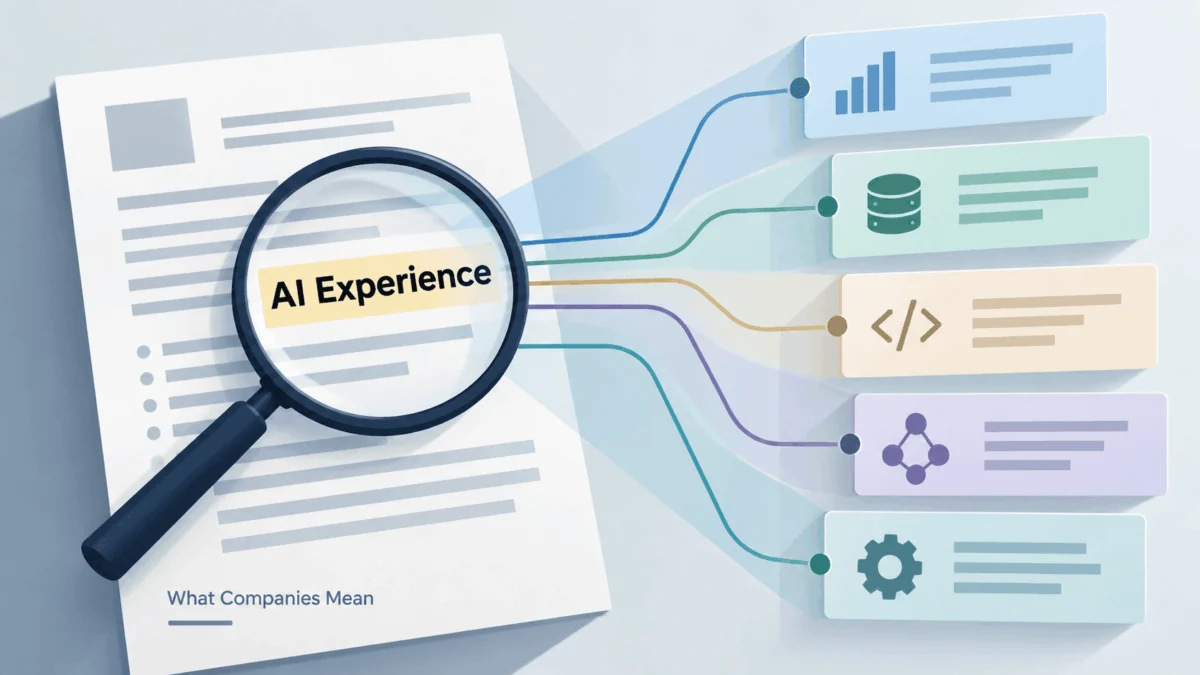
While the terminology remains broad, most "AI experience" requirements in current job postings collapse into four distinct, functional categories. Identifying which category a role occupies is the first step in tailoring your application:
- AI Tool Proficiency: This focuses on the ability to leverage existing AI-powered platforms (e.g., GitHub Copilot, ChatGPT, or industry-specific generative tools) to improve workflow efficiency. Here, the employer values your ability to integrate AI into existing business processes.
- Informed AI Collaboration: This requires the candidate to work alongside engineering teams, providing the domain expertise and model evaluation metrics necessary to ensure AI outputs are accurate and ethically sound.
- Applied Machine Learning: This is the most technical tier, where the employer expects the candidate to build, train, and deploy predictive models using libraries such as PyTorch, TensorFlow, or Scikit-Learn.
- Domain-Specific AI Strategy: This is a strategic role often found at the senior or management level, focusing on identifying where AI can solve specific business problems and where it remains a liability or an unnecessary overhead.
Bridging the Gap: Mapping Statistical Rigor to AI Competency
For many data professionals, the anxiety surrounding "AI experience" stems from a perceived deficit in modern tooling. However, the foundational truth remains: statistical training is the bedrock of virtually every "AI" application in business.
The perceived gap between a seasoned statistician and an "AI practitioner" is largely one of vocabulary and tooling, not underlying reasoning. When you encounter a requirement for AI experience, you do not need to overhaul your resume; you need to translate your existing impact into the new lexicon of the AI era.
The Translation Strategy
- From Regression to Supervised Learning: If your resume highlights building "predictive regression models for quarterly demand," you are already describing supervised learning. Reframe this to emphasize the model evaluation metrics—such as RMSE, MAE, or cross-validation strategies—which are the core of modern machine learning workflows.
- From Data Cleaning to Feature Engineering: Statistical data preparation is essentially feature engineering. Highlight the processes you used to handle missing values, outliers, and transformations, as these are the exact skills required for preparing high-quality data for neural networks.
Reading the Job Posting as a Data Scientist
Treating a job posting as a dataset is a powerful mental model. Acknowledging that "headline requirements" are aspirational—a list of ideal traits rather than a list of non-negotiable hurdles—allows candidates to look for the "signal" in the "noise."
Identifying the True Requirements
A useful shortcut for discerning the actual need is to analyze the "day-to-day responsibilities" section. If the posting emphasizes "model maintenance," "data pipeline management," and "A/B testing," the role is likely a traditional data science position masquerading under the AI banner. If the description emphasizes "LLM integration," "prompt engineering," or "automated content generation," you are looking at a newer, generative-focused role.
Pay attention to modifiers:
- "Preferred": This is a signal that you should apply even if your experience is tangential.
- "Required": If followed by specific tool sets, the role is likely highly technical (Category 3). If it is a standalone requirement without technical specifics, it usually refers to Category 1 or 2.
The Seniority Signal: A Table of Expectations
The interpretation of "AI experience" shifts dramatically depending on the seniority of the role. Understanding these expectations allows you to pivot your pitch during the interview process.
| Seniority Level | What They Actually Want | Practical Application |
|---|---|---|
| Junior | Adaptability | Comfort with new tools, willingness to learn internal proprietary systems, and no fear of AI-generated outputs. |
| Mid-Level | Informed Collaboration | Ability to work alongside engineering teams, contribute to model evaluation, and bridge the gap between technical data and business stakeholders. |
| Senior | Strategic Judgment | Knowing when AI is the wrong solution, communicating technical limitations to leadership, and mitigating the hidden costs of reckless AI deployment. |
Clearing Up Persistent Misconceptions
Despite the rapid evolution of the industry, several myths continue to hinder job seekers.
1. "I should list every AI tool I’ve ever touched."
Listing a laundry list of tools—from LangChain to various LLM APIs—often backfires. It suggests a lack of focus and technical depth. Hiring managers are far more impressed by candidates who can describe the problem they solved and the reasoning process they applied to reach a solution. The tools are merely the means to an end.
2. "I’m disqualified if I haven’t built a model from scratch."
Most business roles do not require you to write a transformer architecture from scratch. They need people who understand the limitations of data, the dangers of overfitting, and the importance of interpretability. These are core statistical competencies that many self-taught "AI practitioners" actually lack.
3. "I need a certification before I apply."
While credentials provide a basic baseline, they rarely serve as a differentiator in the interview room. Being able to explain when an AI system is likely to fail—and why—demonstrates a level of maturity and analytical depth that no online course can replicate.
Implications for the Future of Work
The rise of "AI experience" as a hiring requirement is an early indicator of a broader shift in the professional landscape. We are moving toward a period where "AI literacy" will become as fundamental as Microsoft Office proficiency was two decades ago.
For the modern professional, the path forward is not found in chasing the latest library or chasing certifications. It is found in mastering the fundamental logic of data, probability, and decision-making. By framing your existing statistical expertise through the lens of modern AI applications, you position yourself as a rare, high-value asset: someone who understands the "how" of the tools, but more importantly, the "why" behind the results.
As Vinod Chugani, a leading educator in this space, notes, the goal is to bridge the gap between emerging AI technologies and practical business outcomes. Whether you are an aspiring data analyst or a seasoned quantitative researcher, the key is to stop viewing "AI experience" as a hurdle to be cleared, and start viewing it as a new language in which to describe your existing, highly valuable expertise.
The job market is signaling a change; your task is to translate that signal into a clear, compelling narrative that proves you are the one who can guide the organization through the complexities of the AI-driven future.