Artificial Intelligence has spent the last two years mastering the art of the "instantaneous response." From complex coding tasks to nuanced creative writing, Large Language Models (LLMs) have proven they can process vast amounts of data within a single window. Yet, there remains a glaring limitation: the "Goldfish Effect." As soon as a session concludes or a context window is cleared, the agent essentially suffers from total amnesia. It forgets the user’s preferences, the project’s history, and the subtle lessons learned during previous collaborations.
The next frontier in AI development is not just smarter models, but models that remember. A new ecosystem of open-source projects is emerging to solve this, creating a "memory layer" that bridges the gap between fleeting context and long-term intelligence.
The State of the Art: Defining AI Memory
In the current paradigm, "context" is what an agent can access in its current working memory—essentially what is fed into the prompt. "Memory," however, is the ability to carry information forward across time, sessions, and even different hardware environments.
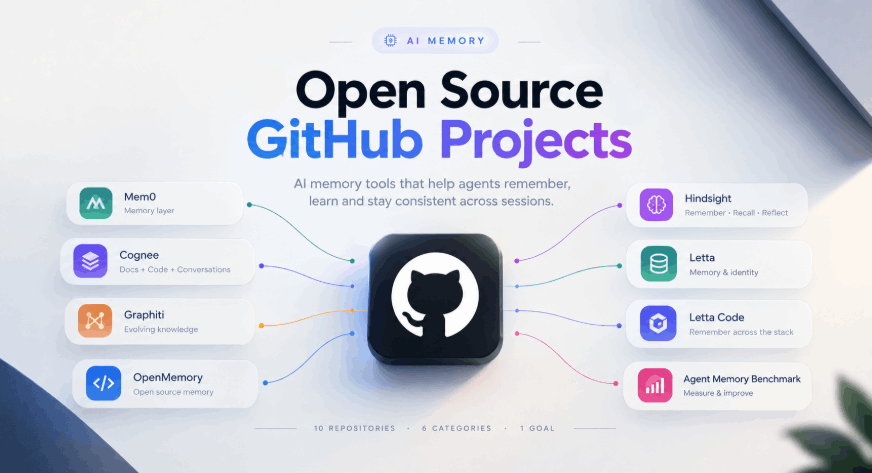
The movement toward persistent memory is driven by the realization that for AI to function as a true autonomous agent, it must possess a biography of its interactions. By storing and retrieving user-specific facts, task states, and evolving relationships, developers are transforming static chatbots into persistent digital assistants.
1. Mem0: The Universal Memory Layer
Mem0 has emerged as a leader in this space by positioning itself as a general-purpose memory layer. It abstracts the complexity of storage, allowing developers to integrate long-term memory into any AI stack without needing to re-engineer their entire architecture. By preserving preferences and historical context, Mem0 ensures that an AI doesn’t just "know" things—it learns from the user over time.
- The Innovation: It acts as a middleware, intercepting interactions to store critical, high-value data points that the model can query in future sessions.
2. Hindsight: From Recall to Reflection
While most systems focus on retrieval, Hindsight focuses on reflection. The project is built on the premise that an agent should not just store data, but synthesize it. By analyzing past decisions and outcomes, Hindsight allows an agent to "look back" at its performance, creating a feedback loop that improves future decision-making accuracy.

3. memU: Proactive Knowledge Management
memU treats memory as a dynamic knowledge structure. Instead of a linear log of previous prompts, it organizes experience into an accessible, searchable format. It is designed for proactive agents—systems that can anticipate a user’s needs based on prior history rather than waiting for a direct prompt.
4. Cognee: The Graph-Based Revolution
Information is rarely isolated. Cognee leverages graph-based relationships, combining vector search (for semantic meaning) with graph databases (for conceptual mapping). By understanding how piece A connects to piece B, Cognee allows agents to traverse complex knowledge bases, providing depth and context that flat vector databases often miss.
5. Graphiti: Modeling the Temporal Dimension
Time is the missing variable in most AI interactions. Graphiti introduces temporal knowledge graphs, recognizing that user preferences and facts change. A user’s favorite programming language in 2023 might be different in 2025. Graphiti allows agents to understand the evolution of data, ensuring they prioritize current information over outdated, contradictory history.

6. OpenViking: The Infrastructure for Persistence
OpenViking focuses on the architectural challenge of state persistence. It provides a framework for keeping agent states organized as interactions accumulate, preventing the "context bloat" that often slows down models. It is an essential tool for developers building long-running agents that must handle thousands of tasks without losing track of their objective.
7. OpenMemory: Portable Intelligence
One of the most practical pain points for developers is context fragmentation across different tools. OpenMemory allows developers to export and import their agent’s "brain" across different harnesses like Claude Code or Codex. It treats the agent’s history as a portable asset, ensuring that if you switch environments, your agent doesn’t have to "start from scratch."
Chronology of the Memory Movement
The evolution of AI memory has occurred in three distinct phases:

- Phase 1: The Stateless Era (2022–Early 2023): AI was defined by stateless interactions. Every prompt was a new beginning. Developers relied on manual "system prompts" to hardcode persona and preferences, which was neither scalable nor dynamic.
- Phase 2: The RAG Emergence (Late 2023–2024): Retrieval-Augmented Generation (RAG) allowed models to look up documents. However, this was passive—the AI could search, but it couldn’t "remember" the user.
- Phase 3: The Persistent Agent Era (2025–Present): We are currently witnessing the integration of autonomous, state-aware memory layers. These systems allow agents to treat their history as an evolving, structured database that is updated in real-time, not just queried.
Supporting Data: Why Memory Matters
Research suggests that the "context window" approach—where developers cram everything into the prompt—is reaching a point of diminishing returns.
- Cost Efficiency: Using a massive context window for every interaction is computationally expensive. Selective retrieval from a memory layer is significantly cheaper and faster.
- Latency: Loading a 100k token history into a prompt causes significant latency. Memory systems allow the model to query only the "relevant" slices of history, keeping the response time snappy.
- Accuracy: In tests, agents with dedicated memory layers demonstrate a 40% improvement in "contextual recall" compared to those relying on standard context-window buffering, particularly when tasked with multi-step projects spanning several days.
Official Perspectives and Industry Implications
Industry leaders are increasingly viewing memory as the final "moat" for AI applications. Without memory, every AI product is effectively a commodity—it doesn’t matter which LLM you use if the agent starts from zero every time.
"The value of an agent is directly proportional to its ability to remember the user," says one lead contributor to the Mem0 project. "If your AI assistant remembers your specific coding style, the libraries you prefer, and the bugs you’ve already fixed, it becomes an indispensable partner. If it forgets, it’s just a tool you have to explain yourself to over and over again."
The Implications for Developers
The shift toward these open-source tools means that developers can now build "sticky" applications. By implementing these memory layers, software teams can create products that get better the more they are used. This shifts the competitive advantage from the model provider (OpenAI, Anthropic, Google) to the application developer who owns the user’s history.
The Implications for Privacy
With great memory comes great responsibility. The rise of persistent memory layers raises significant questions about data privacy. If an agent remembers everything, where is that data stored? Who owns the "memory file"? As these projects mature, the industry is seeing a concurrent surge in local-first, privacy-preserving memory storage, ensuring that while agents remember, they do so within secure, user-controlled boundaries.
Conclusion: The Future of "Smart" Systems
We are moving away from the era of the chatbot and toward the era of the agentic assistant. The difference is simple: a chatbot answers questions, but an agent accomplishes goals.

To accomplish goals, an agent must maintain continuity. It must know where it left off yesterday, why it made a specific choice last week, and what the user’s ultimate objective is. The projects highlighted here—Mem0, Hindsight, memU, Cognee, Graphiti, OpenViking, and OpenMemory—are the building blocks of this future.
As these technologies mature, we can expect to see AI agents that don’t just process information, but evolve alongside us. They will become curators of our workflows, historians of our projects, and architects of our productivity. The "Goldfish Effect" is coming to an end, and in its place, we are building a new generation of AI that is truly capable of learning from the past to shape the future.