In the rapidly accelerating landscape of Large Language Models (LLMs), the "middle child" of a model family often dictates the actual pace of industry adoption. Anthropic has just unveiled Claude Sonnet 5.5, a release that redefines the balance between high-end reasoning and operational efficiency. While industry headlines often fixate on massive, parameter-heavy models, Sonnet 5.5 represents a strategic shift toward practical, agentic utility, offering free access to non-subscribers and significant architectural refinements for developers.
This article provides a comprehensive analysis of what changed, the benchmarks that define its performance, the critical cost controls developers must implement, and a hands-on exploration of its capabilities in real-world scenarios.
Main Facts: What is Sonnet 5.5?
Claude Sonnet 5.5 is the latest iteration of Anthropic’s mid-tier model. It is designed to be the "workhorse" of the Claude ecosystem—optimized for speed, cost-effectiveness, and high-stakes tool usage.
Unlike its larger sibling, Opus 5.5, which remains behind a paid enterprise-grade paywall, Sonnet 5.5 is now the default model for all users of the Claude web application. This move democratizes access to state-of-the-art AI, allowing free users to leverage a model that is significantly more capable than previous iterations.
Key Characteristics:
- Accessibility: Free to all users without a subscription (subject to usage limits that reset every five hours).
- Architectural Philosophy: While Anthropic keeps specific parameter counts and mixture-of-experts (MoE) configurations proprietary, the focus is on "reasoning budget," tool-calling reliability, and verification behavior.
- Context Window: Maintains a massive 1-million-token context window, with a 128k-token maximum output for standard requests.
- Operational Role: It is not intended to replace Opus 5.5 for open-ended, highly ambiguous research, but rather to excel in well-scoped, repeatable, and latency-sensitive environments.
Chronology: The Path to Sonnet 5.5
The release of Sonnet 5.5 is the culmination of a deliberate strategy by Anthropic to bridge the gap between "smart" and "useful."
- Foundation (Early 2026): Anthropic established the "Sonnet vs. Opus" paradigm, separating models by their focus on speed versus raw reasoning power.
- Iterative Refinement: Following the release of Sonnet 5, developers reported that while raw performance was high, the "agentic" capabilities—the ability to act, use tools, and verify output—needed stronger architectural support.
- The 5.5 Breakthrough: Anthropic integrated new training methods focused on "agentic coding" and "computer use." By significantly lowering the error rate in tool-calling environments, they created a model that spends less time "hallucinating" and more time executing logical sequences.
- Deployment: By making this the default for free users, Anthropic is effectively training a massive user base on a model that is inherently more reliable for automation, signaling a push toward a broader agentic future.
Supporting Data: Benchmarks and Performance
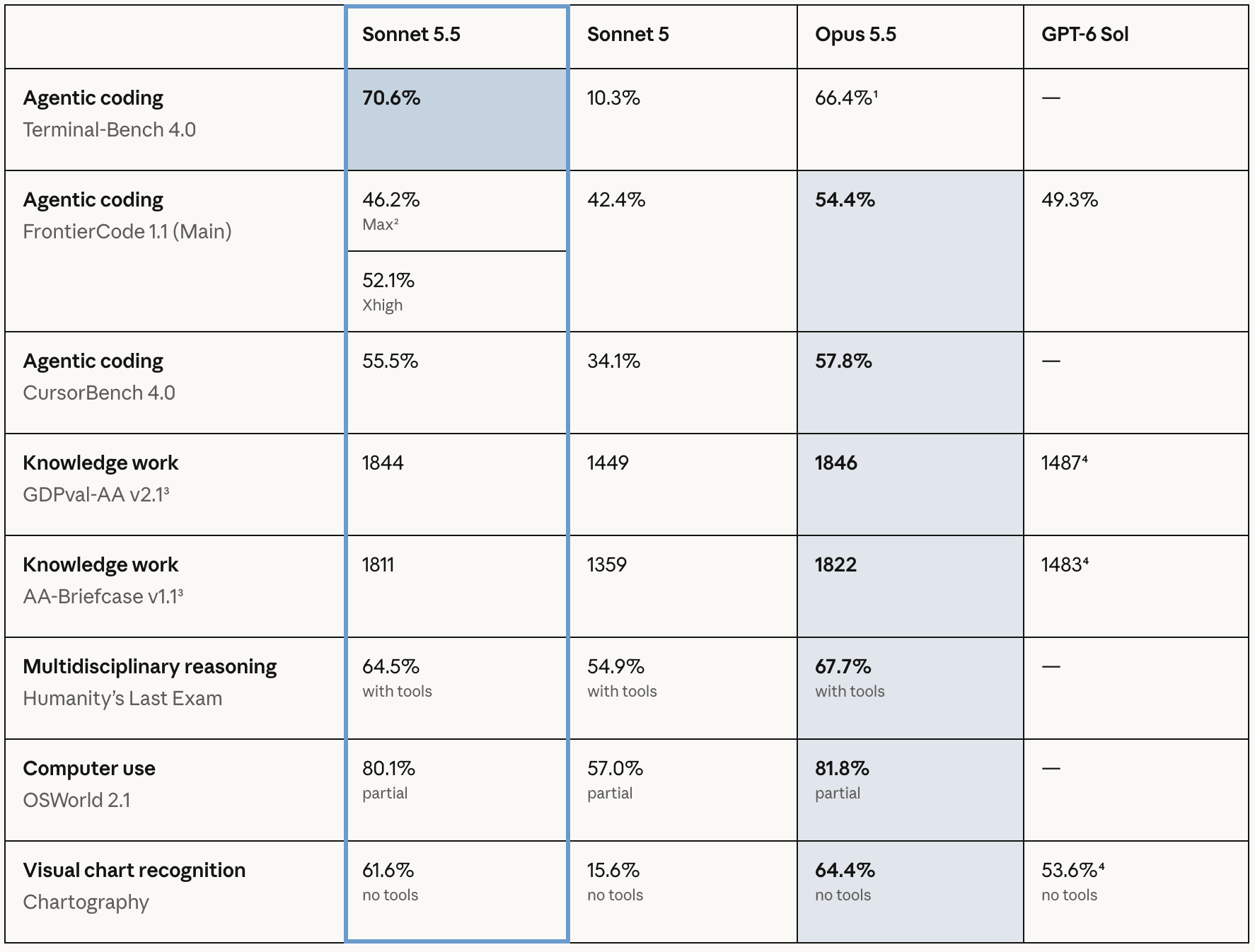
Benchmark results for Sonnet 5.5 demonstrate a clear pivot toward technical competence. The jump in agentic performance is not merely incremental; it is transformative.
Notable Benchmark Improvements:
- Terminal-Bench 4.0: Increased from 10.3% to a staggering 70.6%. This indicates a major leap in the model’s ability to navigate command-line environments and execute code in real-time.
- CursorBench 4.0: Rose from 34.1% to 55.5%. For software developers using IDE-integrated AI, this represents a significant reduction in the need for manual code correction.
- OSWorld 2.1: Improved from 57.0% to 80.1%, confirming the model’s proficiency in multi-step task completion across various software interfaces.
The "Overthinking" Caveat:
One of the most fascinating takeaways from Anthropic’s internal data is that more processing "effort" is not always better. On the FrontierCode benchmark, Sonnet 5.5 actually performed worse at "Max" effort than at "Xhigh." This suggests that in complex agentic systems, excessive self-review can lead to "paralysis by analysis," where the model introduces errors by second-guessing valid code or over-editing. This finding is a crucial lesson for developers: Tune your effort settings to match the task.
Official Responses and Strategic Positioning
Anthropic has been clear about the model’s market position. During the release, their engineering team emphasized that Sonnet 5.5 is a "fast, low-cost complement" to Opus 5.5.
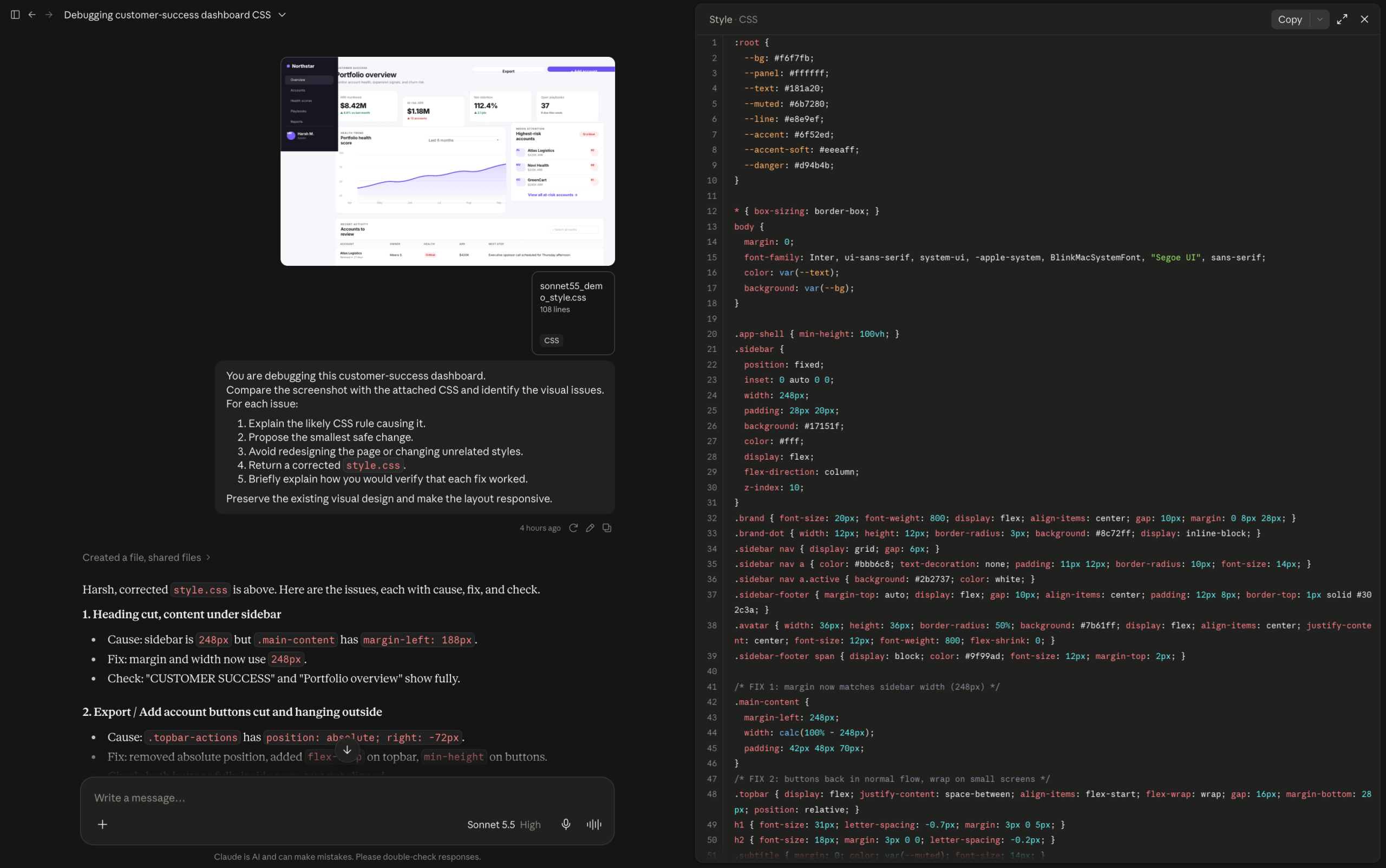
For the platform, Anthropic has set "High" as the default effort level. In the consumer-facing Claude app, "Medium" remains the default. This distinction is deliberate: the app requires snappy, responsive interaction for general queries, while the platform requires the rigor of the "High" setting for enterprise automation.

By keeping the per-token price identical to Sonnet 5 while improving performance, Anthropic has effectively lowered the cost per task. Because Sonnet 5.5 requires fewer tokens and fewer tool calls to reach a conclusion, real-world expenditure for enterprise users is expected to drop by up to 30%.
Implications: The Rise of the Visual Agent
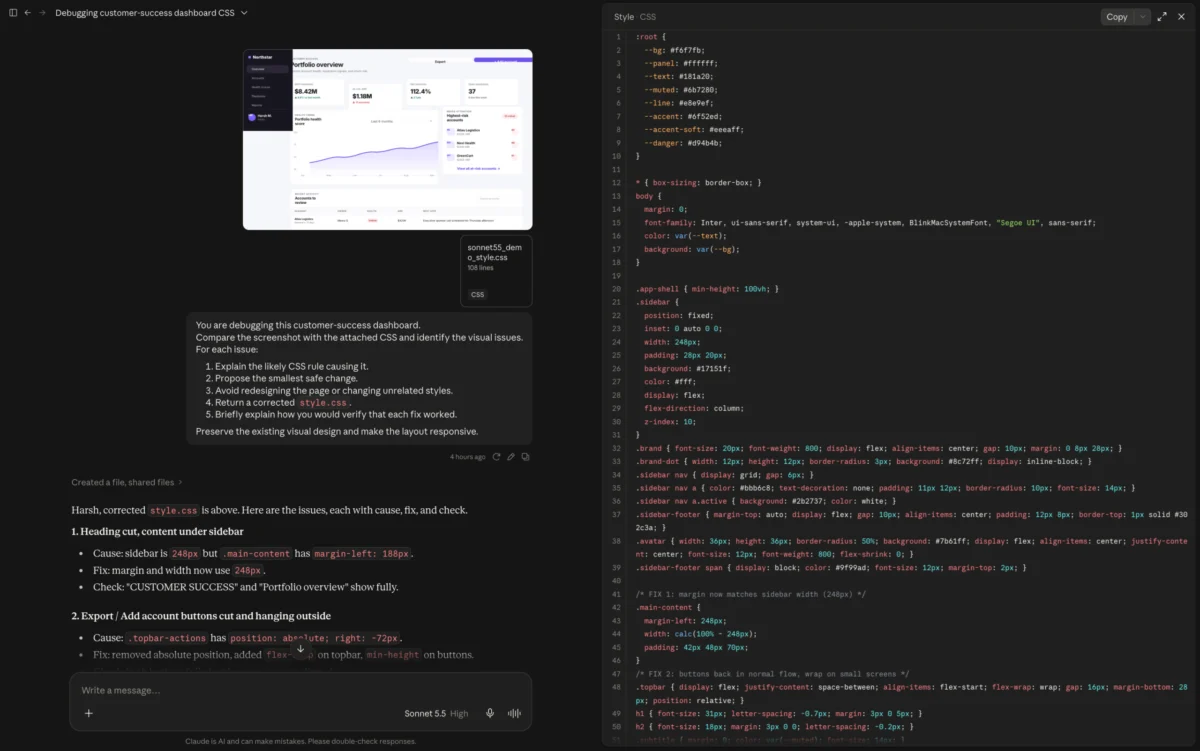
The most compelling application of Sonnet 5.5 is its ability to synthesize visual information with code-level reasoning. In our testing, we challenged the model with a "Visual Bug-Fixing Copilot" task.
The Test:
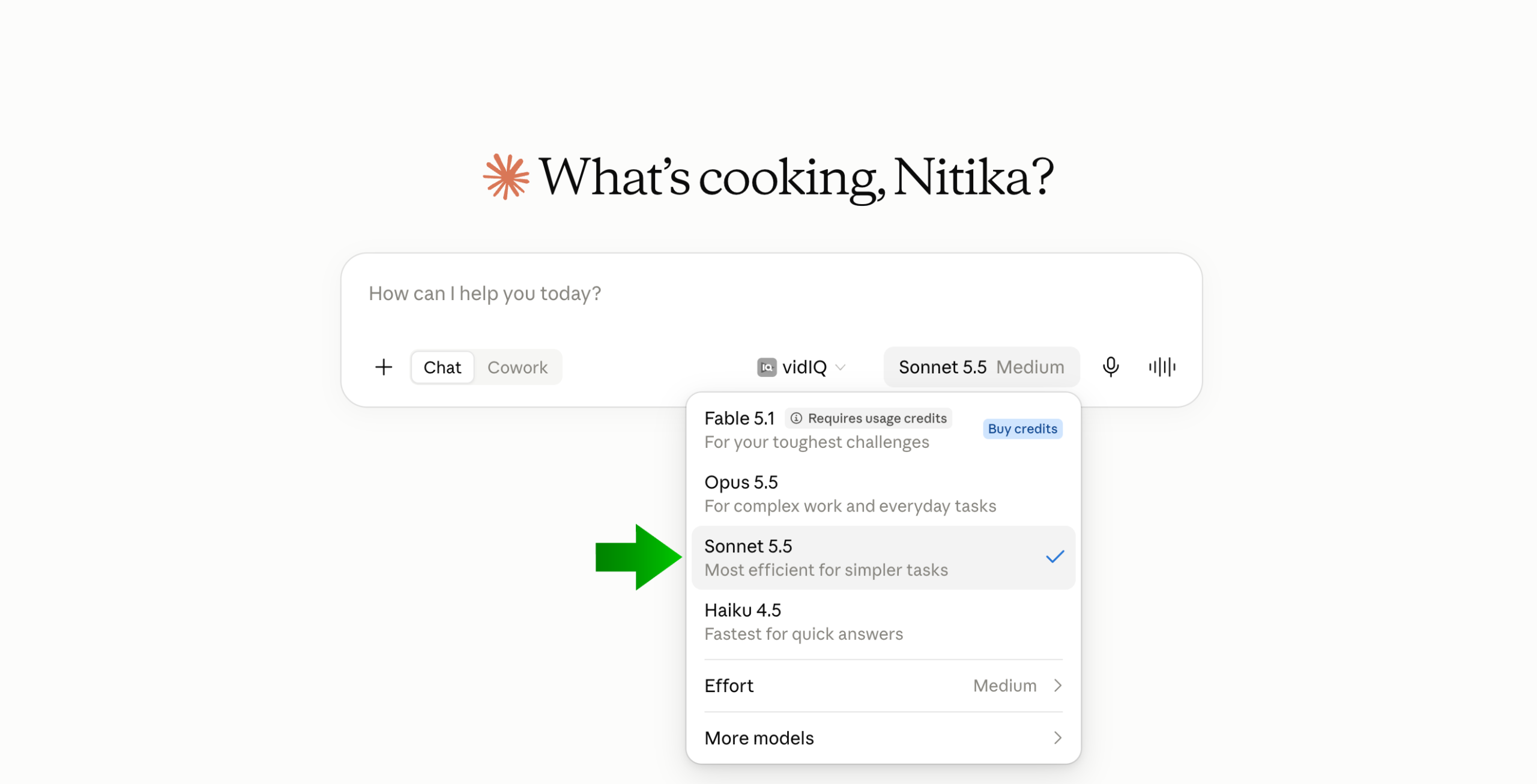
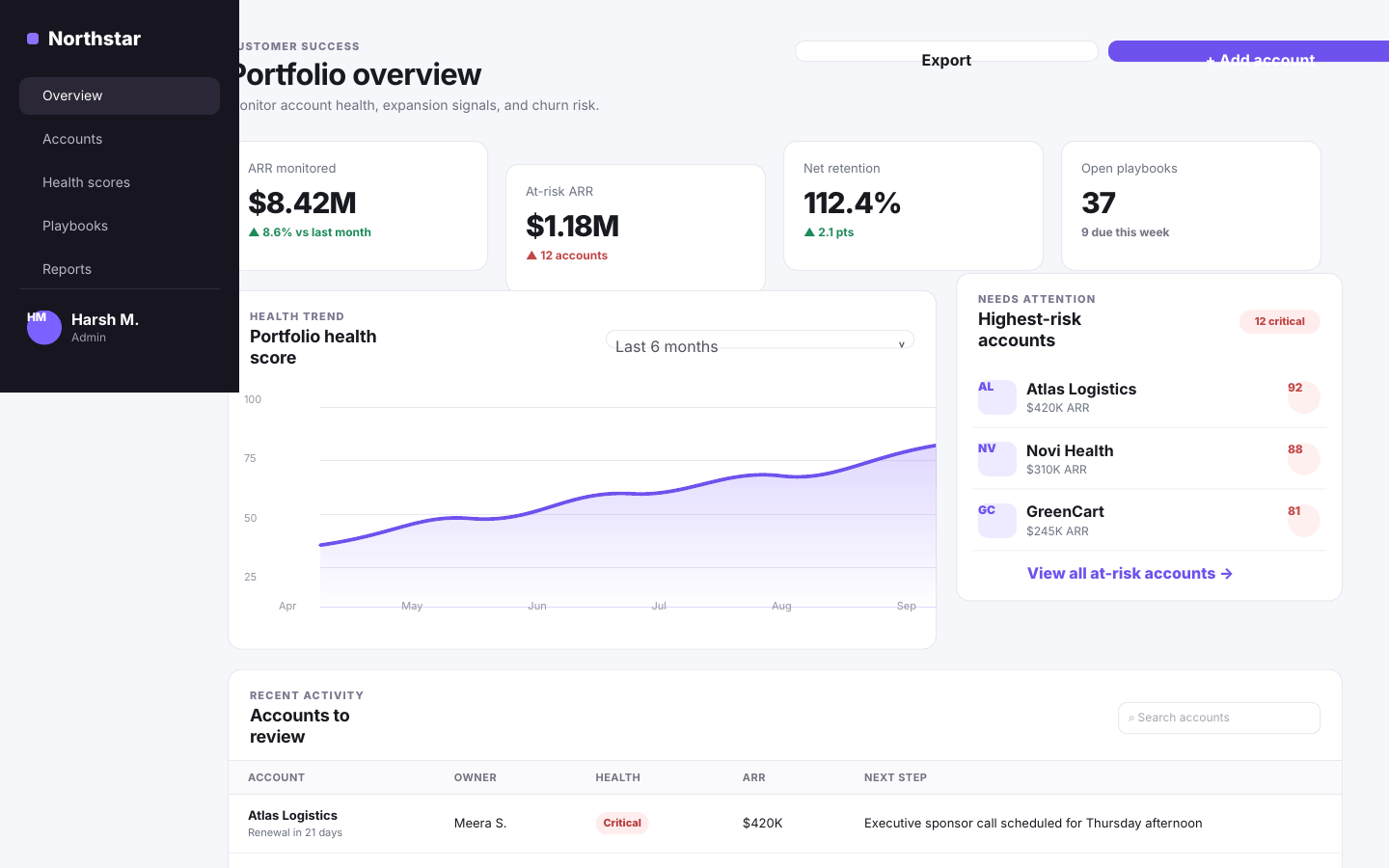
We provided a screenshot of a broken customer-success dashboard alongside its corresponding styles.css file.
The Prompt:
"You are debugging this dashboard. Compare the screenshot with the attached CSS and identify visual issues. For each issue, provide the corrected CSS and explain the fix. Preserve the design intent."
The Result:
Sonnet 5.5 processed the input in under 10 seconds. It did not just identify the syntax errors; it identified layout issues (e.g., misaligned flexbox containers) that were invisible to the code alone but obvious in the screenshot. It suggested precise, minimal edits rather than rewriting the entire stylesheet.
Implication for Industry:
This capability changes the nature of QA (Quality Assurance). We are moving toward a world where "frontend" debugging is automated. Developers no longer need to manually inspect elements for every CSS mismatch; the model can "see" the UI and "know" the code, acting as a bridge between design and implementation.
The Technical Developer’s Checklist: Cost and Efficiency
For technical leaders, deploying Sonnet 5.5 requires a shift in how they view "reasoning budget."
- Effort Control: Do not default to "Max." Use "Medium" for routine tasks to maximize speed and minimize costs. Save "High" for complex, multi-step agentic workflows.
- Prompt Caching: Leverage cache-write capabilities effectively. With a cost of $2.50 per MTok for 5-minute caches, you can significantly reduce expenses for recurring tasks that rely on large, static system prompts.
- Tool-Calling Optimization: Because Sonnet 5.5 is more efficient at tool-calling, ensure your API schemas are clean. The model is now capable of interpreting complex tool lists; reducing redundancy in your prompt will yield lower token usage.
- Verification Architecture: Do not rely on the model to "self-heal" indefinitely. Build your own verification loops where the model’s output is tested against a sandbox environment. If the test fails, only then trigger a "re-think" with a higher effort level.
Conclusion: A New Standard for Efficiency
Claude Sonnet 5.5 is more than just a model update; it is a declaration of maturity in the AI field. By focusing on practical, reliable agentic performance rather than chasing ever-higher parameter counts, Anthropic has provided a tool that fits perfectly into the modern development stack.
For individuals, it provides a powerful, free assistant capable of sophisticated reasoning. For developers, it offers a cost-efficient, high-performance engine for building agents that can see, code, and solve.
The best deployments in the coming year will not be those that simply swap in the "newest model." They will be those that strategically balance effort levels, utilize prompt caching, and treat the model as a modular component within a larger, verifiable system. As we look ahead, the lesson of Sonnet 5.5 is clear: Performance is not just about how smart the model is; it’s about how efficiently it translates intent into execution.
Frequently Asked Questions (FAQ)
Q1. Is Sonnet 5.5 cheaper than its predecessor?
While the per-token price remains stable, the total cost per task is lower. Because the model is more efficient, it often arrives at the correct answer using fewer tokens and fewer tool calls, leading to roughly 30% savings on complex workflows.
Q2. What is the limit for free users?
Free users have access to Sonnet 5.5 with usage limits that refresh every five hours. While these limits vary based on current server demand, they are designed to accommodate consistent daily use.
Q3. Should I use Sonnet 5.5 for everything?
Not necessarily. For highly creative, open-ended tasks that require deep nuance and sustained judgment, Opus 5.5 remains the superior choice. Sonnet 5.5 is your go-to for speed, logic, and repeatable agentic tasks.
Q4. Can I use this for video production?
While the model cannot "render" a video file directly, it is excellent at providing the structure, script, and prompt engineering required for modern, punchy startup videos. It understands pacing and visual narrative, making it a strong partner for creative directors.
Q5. Is "Max" effort recommended for production?
Generally, no. As seen in recent benchmarks, "Max" effort can occasionally lead to over-correction or timeouts. We recommend testing your specific use case at "High" or "Xhigh" first to find the "sweet spot" of reliability versus cost.