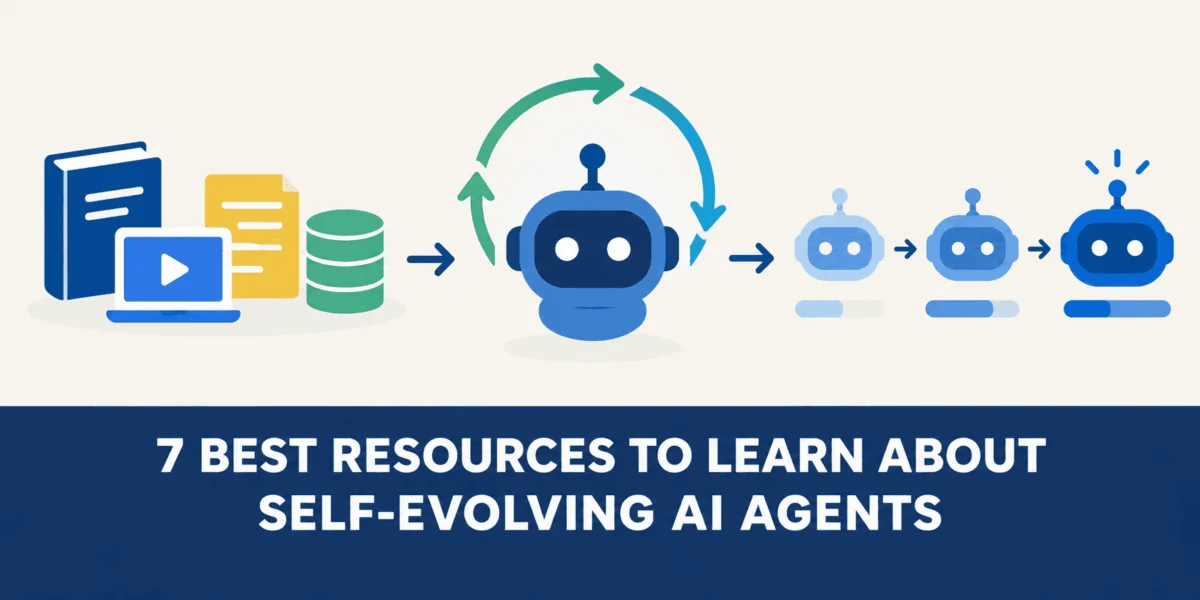
In the rapidly shifting landscape of artificial intelligence, a fundamental paradigm shift is underway. For the past several years, the industry has been defined by static models—systems that receive a prompt, execute a pre-defined instruction, and return a result. However, the next epoch of AI development is moving toward something far more ambitious: Self-Evolving AI Agents.
These systems represent a departure from traditional "input-output" workflows. Instead, they are designed to learn from their own history, refine their reasoning pipelines, and adapt their internal strategies through experience. Whether by accumulating long-term memory, optimizing their own prompt structures, or building reusable skill libraries, self-evolving agents aim to solve the "static performance" ceiling that currently limits modern AI. This article explores the seven essential resources to navigate this complex, fast-moving domain.
The Core Concept: Moving Beyond Static Logic
At its heart, a self-evolving AI agent is defined by a feedback loop. Unlike a traditional chatbot, these agents operate within an environment where they can observe the outcomes of their actions, evaluate their successes and failures, and use that data to modify their future behavior. This is often described as "recursively self-improving" (RSI) behavior, where the agent’s own evolution is the primary driver of its increasing efficacy.
The research community is currently focused on identifying which components of an agent are most susceptible to improvement. Is it the underlying Large Language Model (LLM) weights themselves? Is it the agent’s "scaffolding"—the prompts, memory, and tool-use strategies that surround the model? The distinction is critical, as it separates pure model fine-tuning from the higher-level engineering of autonomous cognitive architectures.
A Chronology of Agentic Development
To understand where we are going, we must look at the trajectory of the field:
- The Era of Instruction Following (2022–2023): AI was largely confined to zero-shot or few-shot prompting. The focus was on making models "smarter" through instruction tuning.
- The Rise of Tool-Use (2023–2024): With the introduction of frameworks like LangChain and LlamaIndex, agents gained the ability to "call" external APIs, perform web searches, and execute code. The "Think/Act/Observe" loop became the industry standard.
- The Shift Toward Autonomy (2025–Present): We are currently in a phase where researchers are asking, "How can the agent improve its own tools?" This involves automated prompt engineering, self-reflection on errors, and the development of "skill libraries" that allow an agent to become more efficient at specific tasks over time.
Essential Curated Resources for the Aspiring Agent Architect
To navigate this field, one must build a foundation from the ground up—starting with the basics of agentic workflows before diving into the complex recursive loops of self-improvement.
1. The Hugging Face Agents Course: The Foundation
Before exploring how an agent can "evolve," you must master how an agent functions. The Hugging Face Agents Course is the gold standard for this. It provides a comprehensive introduction to the fundamental Think/Act/Observe loop. By working through this, you gain practical experience with essential frameworks like smolagents, LangGraph, and LlamaIndex. The course is particularly valuable for its focus on observability and evaluation—two metrics that are mandatory when attempting to build a system that modifies its own behavior.
2. Stanford CS329A: Self-Improving AI Agents
For those seeking an academic rigor, Stanford’s CS329A is the definitive resource. This course moves beyond frameworks and dives into the research papers that define the field. It covers critical topics such as:
- Constitutional AI: How to align an agent’s evolution with human values.
- Test-time Compute: Scaling reasoning power during the inference phase.
- Verifiers: Using automated systems to grade an agent’s output, creating a feedback loop for improvement.
The syllabus is designed to encourage students to reproduce research, which is perhaps the best way to grasp the nuances of self-improving code.
3. A Comprehensive Survey of Self-Evolving AI Agents
If you require a conceptual map of the domain, read A Comprehensive Survey of Self-Evolving AI Agents (ArXiv: 2508.07407). This paper is essential because it defines the "optimizer" in the loop. It categorizes how different parts of an agent—memory, tools, prompts, and even multi-agent hierarchies—can be evolved. It is an indispensable guide for understanding how systems in fields as diverse as biomedicine and quantitative finance are beginning to deploy these techniques.
4. Self-Improvements in Modern Agentic Systems
Complementing the previous survey, this 2026-focused paper (ArXiv: 2607.13104) provides a taxonomy that is vital for modern practitioners. It distinguishes between improving the "Model" versus the "Scaffolding." For instance, a system that fine-tunes its own weights is fundamentally different from one that builds a dynamic database of reusable skills. This paper clarifies these distinctions, helping engineers decide which path of improvement is most suitable for their specific use case.
5. Awesome Self-Improving Modern Agentic Systems
As the field expands, searching arXiv daily becomes inefficient. The Awesome Self-Improving Agents repository serves as a living bibliography. It is organized by the "object of improvement"—whether the agent is optimizing its prompts, its tools, or its memory. This is the go-to resource for developers looking to integrate state-of-the-art benchmarks into their own projects.
6. Awesome RSI (Recursive Self-Improvement)
For those interested in the long-term, high-level implications of this technology, the Awesome RSI map is mandatory reading. It connects the dots between agentic systems and the broader goal of recursive self-improvement. It covers embodied AI (robots), automated scientific research, and safety considerations. It is the best resource for understanding how these small-scale improvements might eventually lead to systems with emergent capabilities.
7. Awesome Harness Engineering for Self-Improvement
Finally, we must address the "Harness." The harness is the surrounding infrastructure that allows an agent to exist and improve. This list focuses on the operational side: how to build the control loops, the evaluation benchmarks, and the automated feedback mechanisms. It teaches you how to design the "factory" that builds the intelligence.
Implications for the Future of Tech
The shift toward self-evolving agents has profound implications for software engineering. We are moving toward a future where developers spend less time writing individual functions and more time designing the "evolutionary environment" in which an agent resides.
Key Implications:
- Economic Efficiency: By automating the improvement of prompts and tools, companies can reduce the reliance on expensive manual prompt engineering.
- Domain Expertise: Agents will be able to master niche tasks (e.g., specific medical diagnostics or complex legal coding) far faster than humans, as they can "practice" these tasks in simulated environments.
- Safety Challenges: As agents gain the ability to rewrite parts of their own reasoning, the risk of "runaway" behaviors increases. Consequently, the field of AI Safety is becoming inextricably linked with self-improving agent research.
Conclusion: A Roadmap for Learning
The speed of progress in this domain is exhilarating but daunting. To avoid burnout, adopt a structured approach:
- Master the Basics: Start with the Hugging Face course.
- Understand the Research: Immerse yourself in Stanford’s CS329A.
- Synthesize: Use the surveys to categorize your knowledge.
- Engage with the Community: Follow the "Awesome" repositories to keep up with the latest GitHub releases and benchmarks.
Do not attempt to read everything at once. The most effective way to learn is to follow the theory for a week and then spend the next week building a small, self-improving agent that can, for example, optimize its own search queries based on previous failures. By moving from theory to application, you will find yourself at the very front of one of the most exciting transformations in modern computer science.
About the Author: Kanwal Mehreen is a distinguished Machine Learning Engineer and technical writer. A Google Generation Scholar and advocate for diversity in STEM, she is the founder of FEMCodes and has dedicated her career to exploring the intersection of AI with medicine and productive engineering. Her work continues to bridge the gap between complex academic research and practical, scalable technical implementation.