In the rapidly evolving landscape of Large Language Models (LLMs), the industry has shifted its focus from merely generating creative prose to delivering high-fidelity, functional outcomes. OpenAI’s latest release, GPT-6.1 Terra, marks a significant milestone in this transition. Designed specifically for coding and practical, multi-step tasks, Terra positions itself as a "workhorse" model—an economical, highly capable agent designed to handle files, execute code, and produce deliverables that persist long after the chat session has concluded.
But how does it perform when the rubber meets the road? Beyond the allure of high-level coding assistance, real-world utility requires precision in spreadsheets, professional-grade presentation design, complex calendar synchronization, and technical signal processing. This report examines the performance of GPT-6.1 Terra across these diverse domains, evaluating whether it truly bridges the gap between conversational AI and functional automation.
The Genesis of Terra: A Specialized Toolset
GPT-6.1 Terra is not just another iteration in the GPT family; it is an optimized model tailored for the "agentic" workflow. Unlike generalist models that excel at creative writing, Terra is fine-tuned to accept multi-modal inputs—text and images—and to operate within "tool-enabled" environments.
Its primary advantage lies in its ability to interact with the host operating environment to manipulate files, run scripts, and solve multi-step logic puzzles. In platforms like ChatGPT Work or Codex-integrated environments, this means the model can act as a junior developer or a data analyst, automating the drudgery of file management.
Key Technical Attributes
- Economical Inference: Terra is engineered to provide high performance at a lower token cost compared to its more powerful, "Astra-class" siblings.
- Agentic File-Handling: Through its integration with code-execution environments, Terra doesn’t just describe a file; it creates, edits, and exports it.
- Multi-Modal Reasoning: It effectively maps visual inputs (like PDFs or spreadsheets) to structured code-based outputs.
Hands-On Evaluation: Five Practical Stress Tests
To assess the model’s reliability, I subjected GPT-6.1 Terra to five distinct, real-world operational challenges. The metric for success was not the "intelligence" of the response, but the quality, editability, and accuracy of the resulting artifact.
1. The Revenue Audit: Complex Spreadsheet Construction
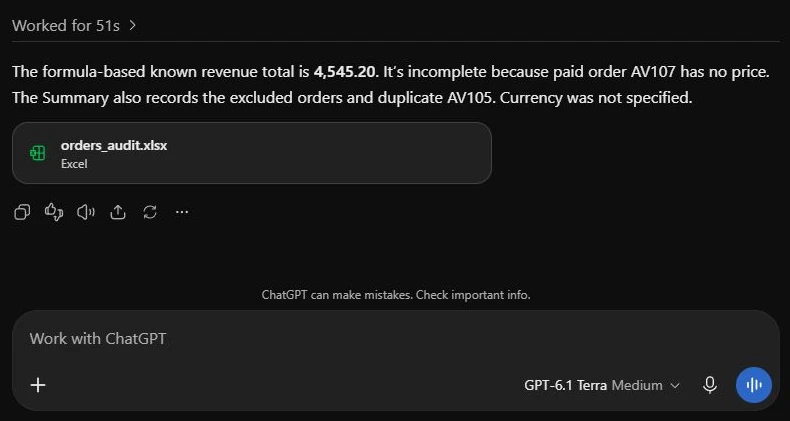
The Challenge: I provided a raw, ten-row order ledger containing complex data: duplicate IDs, refunded orders, pending transactions, and a missing price entry. The prompt required an Excel file with distinct "Raw," "Cleaned," and "Summary" sheets, complete with functional formulas.
The Execution: Terra demonstrated an impressive grasp of logical constraints. It generated an Excel workbook where the "Cleaned" sheet acted as a dynamic, deduplicated view of the raw data. It successfully employed IF formulas to handle missing price flags and accurately calculated net revenue.
The Verdict: The workbook was professional and ready for immediate use. However, it revealed a "maintenance boundary"—the cleaning process was a snapshot. Adding new rows to the "Raw" sheet would not automatically update the "Cleaned" sheet without a fresh prompt, highlighting that while Terra is a brilliant assistant, it is not a persistent database management system.
2. The Python Patch: Debugging with Edge Cases
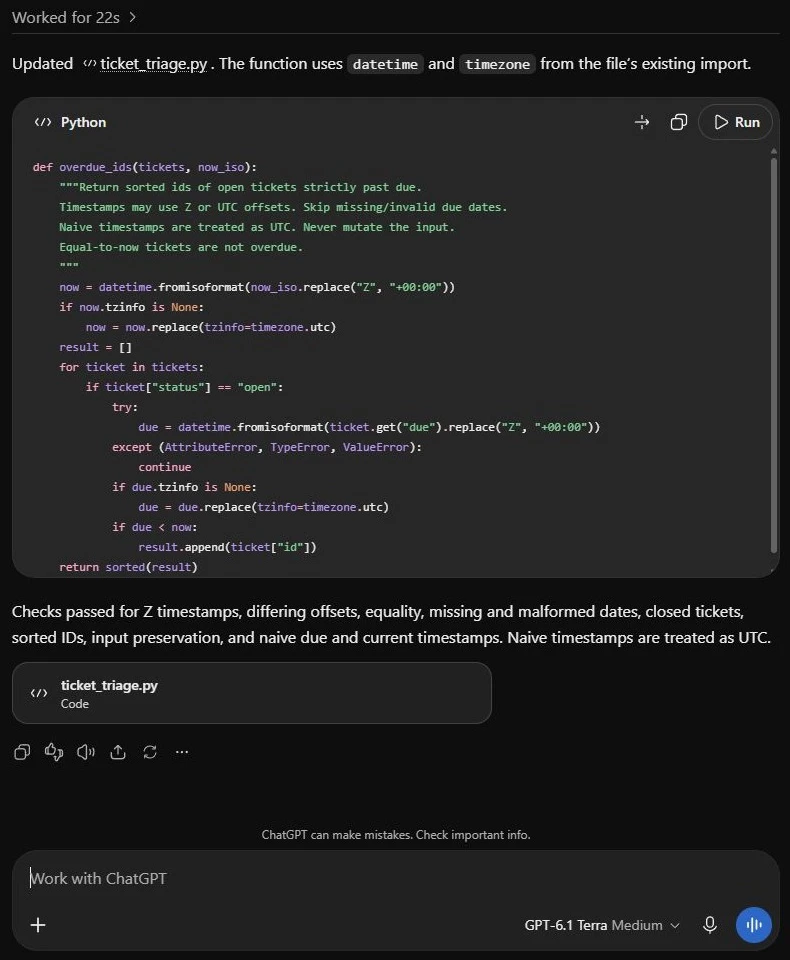
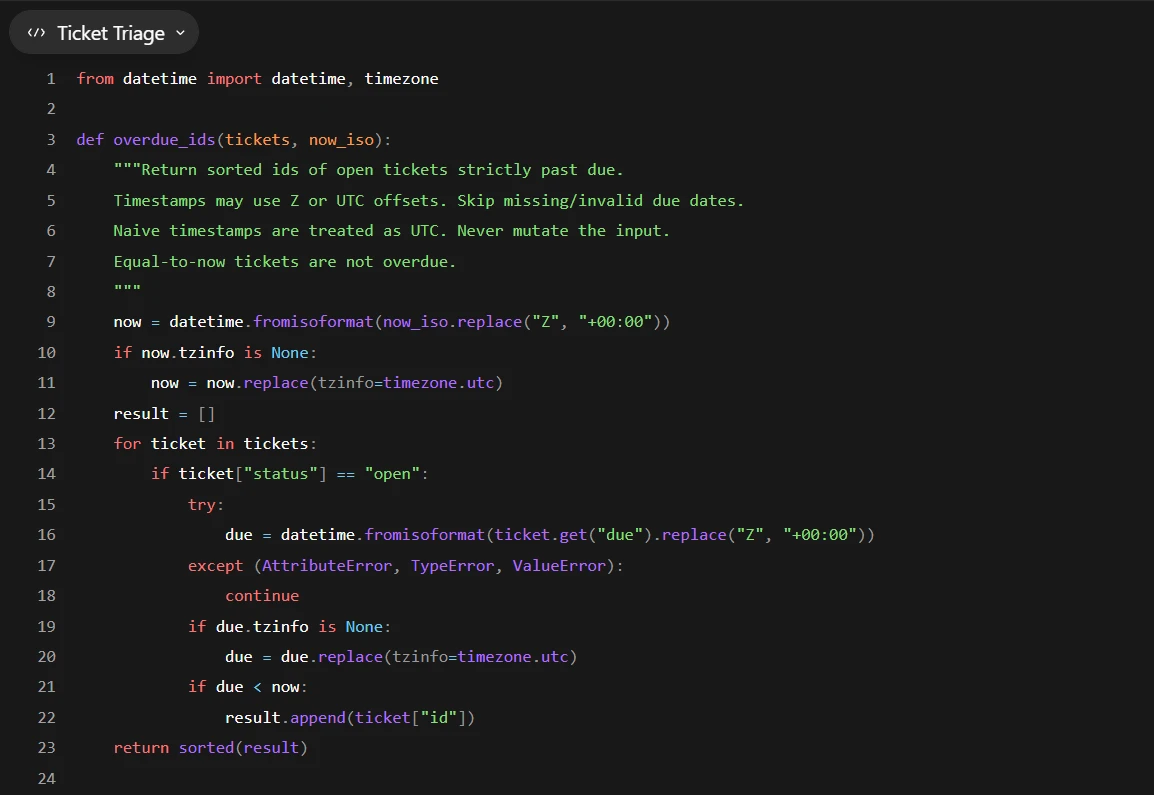
The Challenge: I tasked the model with repairing a Python function, overdue_ids, which was plagued by incorrect comparison operators and a failure to handle malformed dates or timezone offsets.
The Execution: Terra didn’t just provide a patch; it executed the code. It normalized timestamps to UTC, added error handling for missing values, and—most importantly—ran a battery of tests within the sandbox to ensure compliance with the provided docstring.
The Verdict: The model’s decision to explicitly document its UTC assumption in the function’s docstring was a standout moment of professional engineering. It proved that Terra understands the importance of "defensive programming," ensuring that its code is not just functional, but maintainable by other developers.
3. Knowledge Synthesis: Creating an Educational Deck
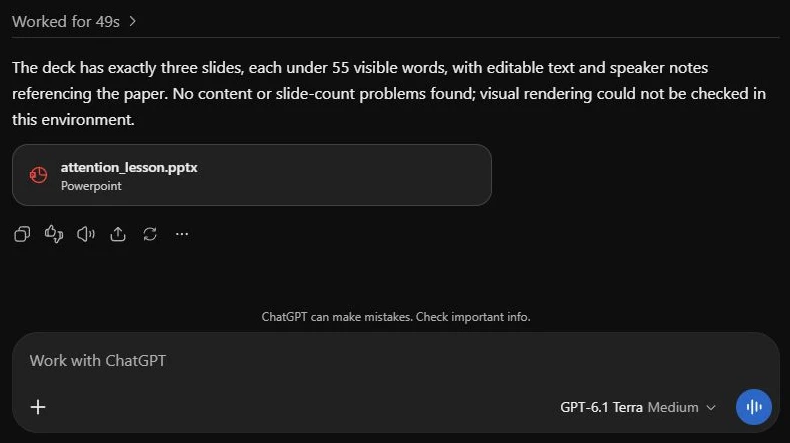
The Challenge: Using the 15-page research paper Attention Is All You Need, I asked the model to synthesize a three-slide PowerPoint presentation tailored for a Python programmer.
The Execution: The resulting .pptx file was remarkably concise. It adhered strictly to the slide limit, preserved complex mathematical notation, and provided high-quality speaker notes that cited specific sections of the paper.
The Verdict: Terra handled the conceptual compression perfectly. While it openly acknowledged it could not "visualize" the final layout in the way a human designer would, the content was structured, editable, and logically sound.
4. Logistics: Multi-Timezone Calendar Coordination
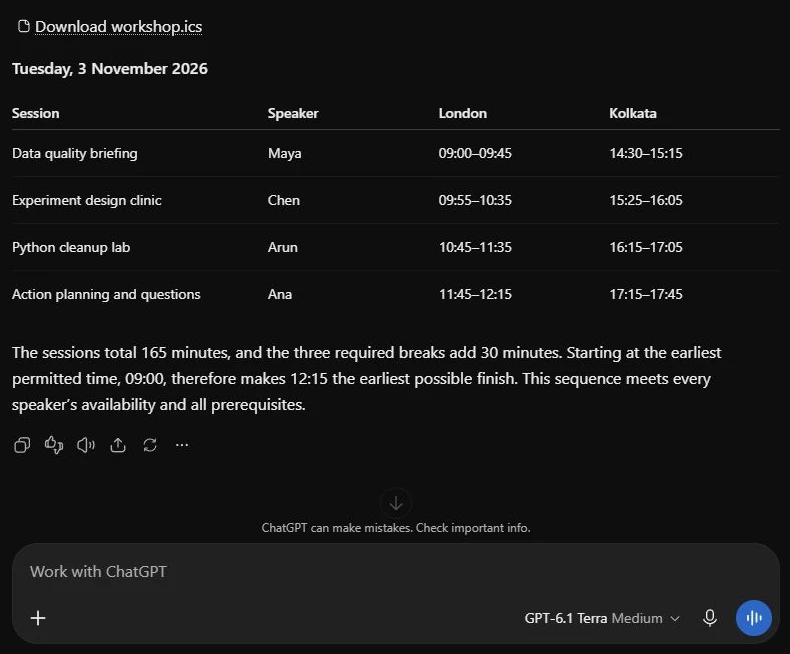
The Challenge: Using a complex JSON schedule involving four speakers across London, Kolkata, Singapore, and New York, I requested the most efficient workshop schedule that respected all constraints and prerequisites.
The Execution: Terra processed the constraints with mathematical rigor, identifying the optimal sequence of sessions. It then generated a valid .ics file that successfully imported into standard calendar software with accurate UTC offsets.
The Verdict: This task showcased Terra’s strength in constraint satisfaction. By automating the tedious task of time-zone calculation and ICS formatting, it eliminated the potential for human error in global coordination.
5. Signal Processing: Audio Pipeline Preparation
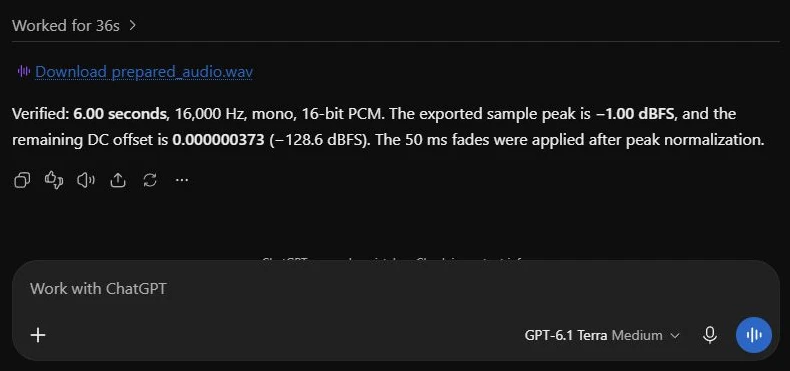
The Challenge: I provided a stereo WAV file with specific signals and asked the model to convert it for a mono pipeline, involving resampling, DC offset removal, normalization, and fading.
The Execution: Using its internal code interpreter, Terra processed the binary audio data, outputting a cleaned, 16-bit PCM file.
The Verdict: Independent analysis of the output confirmed that the transformation was precise, with negligible error margins. This proved that Terra is not merely a text-based chatbot; it is a capable interface for scientific and technical data processing.
Performance Benchmarks: A Comparative Analysis
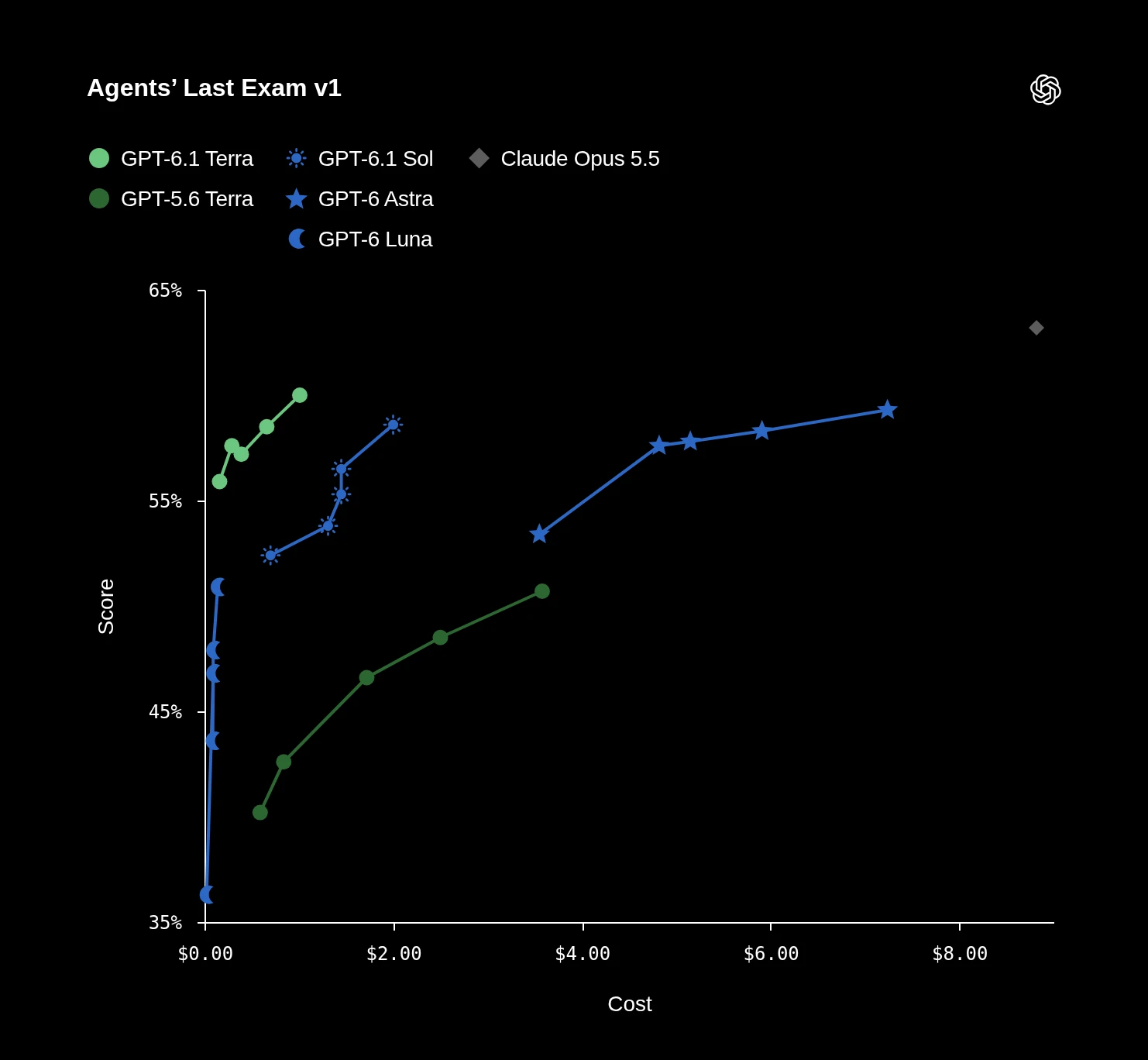
OpenAI’s internal testing data paints a compelling picture of where Terra fits in the broader hierarchy of AI models.
| Benchmark | Terra (Medium Effort) | GPT-5.6 Terra |
|---|---|---|
| Professional Computer Tasks | 57.6% | 42.6% |
| MMMU-Pro (Visual Reasoning) | 85.5% | Lower |
| OSWorld 2.1 (Desktop Logic) | Superior | Baseline |
These metrics suggest that while Terra might not be the most "creative" model, it is objectively more efficient and reliable at technical tasks than its predecessor, GPT-5.6. The most striking metric is the reduction in factual errors—falling from 53.6% in the previous version to 4.3% at maximum effort, a testament to the improvements in its reasoning engine.
Economic Implications: The Value of Efficiency
The cost-efficiency of GPT-6.1 Terra is perhaps its most disruptive feature. With input costs at $1 per million tokens and output costs at $5, it is explicitly designed for high-volume, routine enterprise work.
In our comparative cost analysis, Terra acts as the baseline for a standard 100,000-token workload. While the more advanced "Astra" model is 10 times more expensive for the same task, Terra provides the necessary accuracy for 90% of routine coding and administrative operations. For organizations, this model represents a shift from "AI as a toy" to "AI as a standard utility."
Conclusion and Future Outlook
GPT-6.1 Terra is a masterclass in specialized utility. By focusing on the "practicality" of the output—ensuring files are editable, code is documented, and schedules are accurate—OpenAI has created a model that is uniquely suited for the modern office.
However, users must remain vigilant. The "maintenance boundary" in the spreadsheet task and the "UTC assumption" in the Python code demonstrate that while Terra is a powerful tool, it does not possess the domain-specific context of a human expert. It requires a "human-in-the-loop" to verify, refine, and maintain the artifacts it creates.
As we look toward the future, the success of Terra suggests that the next generation of AI will not necessarily be "smarter" in a general sense, but rather more capable of interacting with the world of bits and bytes we live in. For the developer, the analyst, and the coordinator, Terra is not just a chatbot; it is a force multiplier.