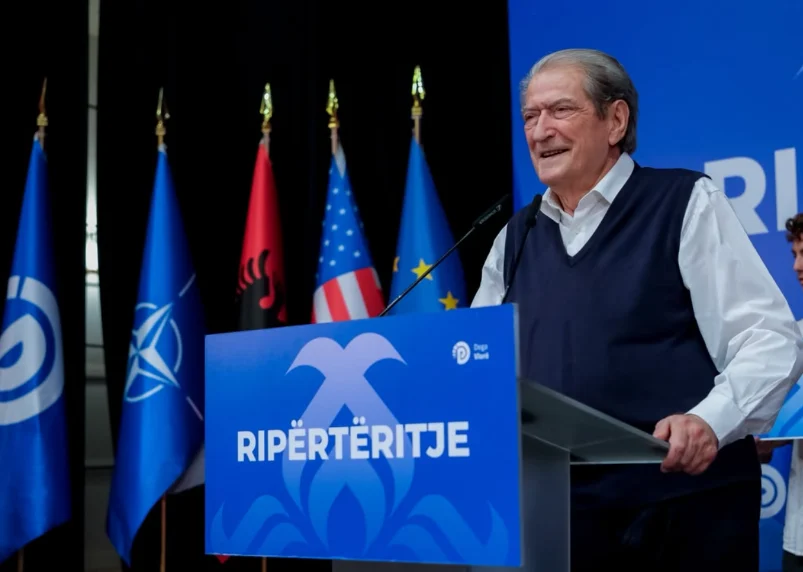
Vlora, Albania – In a powerful display of defiance and a rallying cry for nationwide action, Sali Berisha, the figurehead leader of the Democratic Party’s Re-establishment Commission, descended upon the coastal city of Vlora on Tuesday. His visit, part of the ongoing "RIPËRTËRITJES" (Renewal) tour, saw him engage with enthusiastic citizens and local democrats, delivering a scathing indictment of the current government and issuing an unequivocal call for the opposition to move from rhetoric to direct confrontation. Berisha’s address, punctuated by fiery rhetoric, underscored a pivotal moment in Albania’s political landscape, signaling an intensification of the opposition’s strategy to challenge what he termed a "regime" and its alleged "misgovernance."
The veteran politician’s presence in Vlora, a city historically significant for its role in Albanian independence and often considered a bastion of support for the ruling Socialist Party, was a deliberate choice designed to broaden the reach of his movement and galvanize support beyond traditional opposition strongholds. The "Renewal" initiative, which has seen Berisha tour various cities across the country, aims to rebuild and reinvigorate the Democratic Party from the grassroots up, following a period of internal strife and electoral setbacks. However, Tuesday’s message transcended internal party reform, evolving into a direct challenge to the very legitimacy and operational methods of the current administration.
In his impassioned speech, Berisha left no doubt about the urgency of the moment. "The developments demand that the Democratic Party responds flame for flame," he declared, his voice resonating with conviction as he articulated the profound dissatisfaction he claimed was sweeping across the nation. He stressed that the current juncture necessitates the Democratic Party’s full engagement, demanding that it be "all in the square" to directly confront the alleged "regime" that he contends has plunged the country into a state of "vile acts" and "national shames." This strong language reflects a deepening chasm between the opposition and the government, and Berisha’s commitment to a strategy of direct, public resistance.
The Genesis of a Confrontation: Berisha’s Accusations and Call to Arms
Berisha’s speech in Vlora was more than just a political address; it was a manifesto for resistance, a strategic blueprint for the opposition’s future actions. His core argument revolved around the premise that the Albanian people and, specifically, the democrats, have reached a breaking point. "Albanians and democrats can no longer tolerate the vile acts that are happening in this country due to misgovernance," Berisha asserted, painting a grim picture of a nation besieged by systemic failures and abuses of power. This statement encapsulates the broad range of grievances that the opposition has consistently raised, from pervasive corruption and economic stagnation to concerns over the rule of law and the erosion of democratic institutions.
The veteran leader did not shy away from using the most potent terms to describe the prevailing situation. He labeled the daily occurrences and revelations emerging from the government as "national shames," "national crimes," and even "constitutional crimes." This escalation in rhetoric signals a belief within Berisha’s faction that the government’s actions transcend mere political missteps, venturing into territories that undermine the foundational principles of the Albanian state and its constitutional order. Such accusations are designed to resonate deeply with a populace grappling with economic hardship and a sense of disillusionment with political elites.
Berisha’s call to action was unambiguous and forceful: "Therefore, we must gather, we must give the strongest, most resolute response." This exhortation is not merely a request for support but a demand for active participation, urging members and sympathizers of the Democratic Party to join a broader movement of civil disobedience and direct political engagement. The explicit reference to citizens already being "in the streets, in the square in Tirana" served as both an acknowledgment of existing discontent and a powerful invitation for others to join. He concluded this segment with a definitive statement: "Today, the place of every democrat is in the square, it is in confrontation, it is in battle." This declaration crystallizes the shift in strategy from parliamentary opposition to extra-parliamentary, direct action, positioning the public square as the primary arena for political struggle.
Chronology of Discontent: Berisha’s Resurgence and the PD’s Internal Strife
Sali Berisha’s current political trajectory is deeply intertwined with a complex chronology of events that have reshaped Albania’s political landscape over the past few years. His resurgence began in earnest after the United States Department of State designated him non grata in May 2021, citing alleged involvement in significant corruption. Far from retreating, Berisha leveraged this designation to launch a "Foltore" (Pulpit) movement, touring the country and presenting himself as a victim of international conspiracy orchestrated in collusion with the current Albanian government. This narrative resonated with a segment of the Democratic Party base, who felt alienated by the then-leader Lulzim Basha’s perceived concessions and lack of confrontational stance against the Socialist Party.
The "Foltore" movement quickly gained momentum, leading to a bitter internal power struggle within the Democratic Party. This culminated in a contested internal referendum, a dramatic storming of the party headquarters in January 2022, and eventually, the resignation of Lulzim Basha. Berisha and his "Re-establishment Commission" effectively seized control of the party’s symbols and a significant portion of its organizational structure, though the legal recognition of this leadership remains contentious and has been subject to protracted court battles. This internal schism has severely weakened the opposition, dividing its resources and public support at a critical juncture.
Since consolidating his position, Berisha has consistently advocated for a more aggressive and uncompromising approach towards the government of Prime Minister Edi Rama. His strategy has included organizing several large-scale national protests in Tirana, often drawing thousands of participants, to voice grievances ranging from economic hardship and alleged electoral fraud to corruption scandals and concerns over the independence of the judiciary. The "RIPËRTËRITJES" tour, which brought him to Vlora, is a continuation of this strategy, aimed at mobilizing the party base and preparing for sustained confrontation. These protests have been characterized by a strong anti-government sentiment, echoing the calls for "revolution" and "regime change" that have become hallmarks of Berisha’s recent rhetoric. The Vlora visit, therefore, is not an isolated event but a critical step in a meticulously planned, long-term campaign to challenge the status quo and regain political power.
Supporting Data and Context: The Roots of Public Discontent
While Berisha’s speech itself did not cite specific data, his accusations of "misgovernance," "vile acts," and "national crimes" draw heavily on a broad spectrum of widely perceived issues and official reports that have fueled public discontent in Albania. These underlying problems provide the context within which Berisha’s fiery rhetoric finds resonance.
Economically, Albania has faced significant challenges, exacerbated by global crises but often attributed by the opposition to domestic policy failures. Inflation, particularly in food and energy prices, has severely impacted household budgets, eroding purchasing power and pushing more families towards poverty. According to various economic analyses, the average Albanian wage struggles to keep pace with rising costs, leading to widespread financial insecurity. The emigration of young, skilled Albanians in search of better economic opportunities abroad continues at alarming rates, contributing to a demographic crisis and a loss of vital human capital. This brain drain is often cited by the opposition as a direct consequence of a lack of economic prospects and pervasive corruption at home.
Corruption remains a persistent and deeply entrenched problem, regularly highlighted in reports by international bodies such as Transparency International, the European Commission, and the U.S. State Department. These reports consistently point to concerns regarding the rule of law, judicial independence, and the perceived influence of organized crime and political patronage in public life. Berisha’s use of terms like "national crimes" and "constitutional crimes" is a direct appeal to these widely held perceptions, suggesting that corruption has not only become endemic but has also undermined the very foundations of the state. Critics of the government frequently point to alleged cronyism in public tenders, opaque privatization processes, and a lack of accountability for high-ranking officials as evidence of a "captured state."
Furthermore, the government’s handling of specific issues, such as the concessionary contracts in healthcare, infrastructure, and energy, has been a frequent target of opposition criticism. Allegations of inflated costs, lack of transparency, and undue benefits for politically connected businesses have fueled public cynicism. While the government consistently denies these allegations and points to its efforts in judicial reform and anti-corruption measures, the perception of widespread corruption persists, creating fertile ground for Berisha’s narrative of a "regime" acting against the interests of its citizens. The lack of robust investigative journalism and perceived government control over media outlets also contribute to a climate where public trust in institutions is often low, allowing narratives of systemic wrongdoing to take hold.
Official Responses: A Wall of Silence or Dismissal
The immediate official response to Berisha’s fiery address in Vlora, typical of the current political climate in Albania, has largely been one of either dismissal or strategic silence from the ruling Socialist Party (SP) and the government. Prime Minister Edi Rama’s administration generally refrains from directly engaging with Berisha’s rhetoric, often characterizing his actions as desperate attempts by a politically isolated figure to destabilize the country and obstruct its path towards European integration.
Government spokespersons and high-ranking Socialist Party officials often choose to ignore Berisha’s specific accusations, instead focusing on what they present as the government’s achievements in economic development, infrastructure projects, and progress towards EU membership. They typically frame Berisha’s protests and calls for confrontation as remnants of an old political guard, unable to adapt to modern European political standards and driven by personal grievances rather than genuine public interest. The narrative from the government side is often one of stability and progress, contrasting sharply with Berisha’s portrayal of a nation in crisis. They frequently highlight the ongoing justice reform efforts, which, paradoxically, have also led to the prosecution and investigation of figures from across the political spectrum, including those historically associated with the Democratic Party.
Within the fragmented Democratic Party itself, the response to Berisha’s Vlora address would likely be divided. The faction that remains loyal to the former leader, Lulzim Basha, or seeks a more moderate path, often views Berisha’s confrontational strategy as counterproductive. They might argue that such an approach further alienates potential voters, damages the party’s image, and plays into the hands of the ruling party by creating an environment of perpetual political instability. This internal opposition fears that Berisha’s aggressive tactics, particularly his non grata status, might isolate the Democratic Party internationally and hinder its ability to forge broader alliances. For these factions, the focus should be on internal reform, building a credible alternative program, and regaining public trust through more conventional political means, rather than engaging in a direct "battle" in the streets.
Therefore, while Berisha’s words in Vlora resonated strongly with his base and those deeply dissatisfied with the government, the broader political establishment in Albania either dismisses them as inflammatory and unconstructive or views them through the lens of internal party power struggles, rarely engaging directly with the substance of his allegations.
Implications: A Nation at a Crossroads
The implications of Sali Berisha’s escalating rhetoric and call for mass mobilization are far-reaching, touching upon the future of the Democratic Party, the stability of the current government, and the broader trajectory of Albanian democracy and its European aspirations.
For the Democratic Party, Berisha’s strategy represents a high-stakes gamble. By demanding that every democrat be "in the square, in confrontation, in battle," he is attempting to consolidate his control over the party and re-establish it as a potent force of opposition. If successful, this could galvanize a fragmented base and unite disparate elements of the anti-government sentiment. However, the risks are substantial. The confrontational approach, particularly when championed by a figure with Berisha’s controversial past and international sanctions, could further alienate moderate voters and international partners, potentially hindering the party’s ability to form broad electoral coalitions necessary to challenge the ruling Socialist Party. Moreover, a sustained period of intense protests carries the risk of internal fatigue, disillusionment if demands are not met, and potential for clashes, which could further damage the party’s public image and the country’s democratic reputation. The internal divisions within the PD remain a significant challenge; while Berisha has consolidated power within his faction, the party as a whole remains fractured, and a unified front is yet to be fully realized.
For the ruling Socialist Party (SP), Berisha’s renewed pressure poses a significant challenge, albeit one they have largely weathered in the past. While the government typically downplays or ignores Berisha’s protests, a sustained campaign of civil disobedience and widespread public discontent could erode public trust, distract from governance priorities, and potentially impact their electoral standing in future elections. The SP has consistently leveraged the opposition’s internal divisions and Berisha’s non grata status to portray itself as the sole guarantor of stability and European integration. However, if Berisha’s movement manages to tap into a broader reservoir of genuine public frustration over economic hardship, corruption, and perceived lack of accountability, the government could face increasing pressure to address these issues more substantively or risk a significant backlash. The government’s ability to maintain public order while navigating these political tensions will be crucial.
More broadly, for Albanian democracy, Berisha’s call for "battle" signals a potential period of heightened political polarization and instability. While vibrant opposition and public protest are essential components of a healthy democracy, the language of "regime" and "national crimes" can contribute to a climate of distrust and hinder constructive dialogue between political forces. Such an environment can complicate Albania’s efforts towards full integration into the European Union, as EU institutions often emphasize the importance of political stability, rule of law, and a functional multi-party system. A protracted period of political deadlock or unrest could divert attention and resources away from crucial reforms needed to meet EU accession criteria.
Finally, for the Albanian citizens, the implications are profound. They are caught between a government that touts progress and stability, and an opposition that warns of national collapse and demands radical action. The stakes are high: continued economic stagnation, persistent corruption, and a sense of political helplessness could lead to further disillusionment and emigration. Conversely, a genuine and constructive political struggle that forces accountability and brings about meaningful reforms could offer a path towards a more prosperous and democratic future. Berisha’s speech in Vlora, therefore, is not just a political event; it is a declaration of intent that will undoubtedly shape the contours of Albania’s political landscape in the months to come, pushing the nation further towards a critical juncture in its post-communist democratic journey. The "square" that Berisha evokes may indeed become the central stage for Albania’s ongoing political drama.