In an era of digital fragmentation and declining survey participation, the ability to accurately gauge public opinion remains a cornerstone of democratic discourse. Pew Research Center’s American Trends Panel (ATP) stands as a vital instrument in this endeavor. The release of data from Wave 200—conducted in the fall of 2026—offers not just a snapshot of American sentiment, but a masterclass in modern survey methodology. By balancing traditional rigor with cutting-edge digital engagement and AI-assisted analysis, the Center continues to set the gold standard for nationally representative polling.
Main Facts: The Anatomy of Wave 200
Wave 200 of the American Trends Panel was conducted from September 28 to October 4, 2026. Designed to capture the pulse of the U.S. adult population, the survey achieved a robust response rate of 87% among the 5,835 panelists invited to participate. Ultimately, 5,062 individuals completed the survey, providing a rich, high-fidelity dataset that reflects the diversity of the American experience.
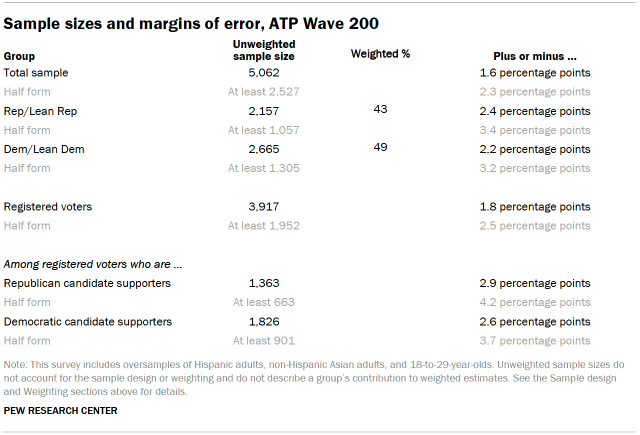
The survey was administered by SSRS, a leader in public opinion research, utilizing a hybrid model of online (4,874 participants) and live telephone interviews (188 participants). To ensure inclusivity, all materials were available in both English and Spanish. With a margin of sampling error of plus or minus 1.6 percentage points, the results provide a high degree of statistical confidence, allowing researchers to draw nuanced conclusions about the attitudes of the American public.
Crucially, this wave employed targeted oversampling of specific demographic groups—Hispanic adults, non-Hispanic Asian adults, and young adults aged 18 to 29. By intentionally increasing the sample size for these cohorts, Pew Research Center ensures that the experiences and perspectives of these historically underrepresented or smaller groups are not merely captured, but accurately weighted to reflect their true proportion within the broader national population.

Chronology: The Lifecycle of a Modern Survey
The journey from initial recruitment to final data release is a meticulously timed operation. The ATP, which has evolved since its inception in 2014, relies on a sophisticated "address-based sampling" (ABS) framework. Since 2018, this process has begun with the mailing of physical recruitment materials to households randomly selected from the U.S. Postal Service’s Delivery Sequence File—a database covering approximately 90% to 98% of the American population.
The Recruitment Phase
Once a household is selected, a specific adult—the one with the next upcoming birthday—is invited to join the panel. This randomization is essential to eliminate self-selection bias. Over the years, the Center has supplemented this base with periodic, intensive recruitment drives aimed at bolstering representation for specific demographics, such as Black and Asian populations, ensuring the panel remains a dynamic reflection of a shifting nation.
The Data Collection Window
For Wave 200, the activity began well before the official launch date.
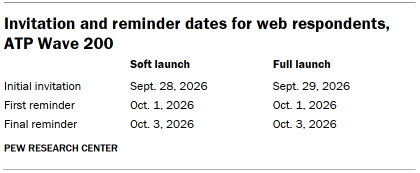
- September 25: Pre-notification postcards were mailed to phone-based participants.
- September 28: The "soft launch" began, with 60 panelists testing the survey logic and flow. Simultaneously, online participants received postcard notifications.
- September 29: The full-scale launch commenced, with email and SMS invitations sent to the remaining pool of panelists.
- October 4: The field period concluded, marking the end of active data collection.
During this window, respondents were encouraged to participate through a system of post-paid incentives, ranging from $5 to $20. These amounts are calibrated to reflect the "difficulty" of reaching specific demographic groups, thereby mitigating the risk of non-response bias.
Supporting Data and Technical Rigor
The integrity of the ATP rests on its commitment to technical transparency. Before a single respondent logged on, the questionnaire underwent a rigorous testing phase. Researchers at Pew and SSRS scrutinized the survey on various platforms—from high-end desktop monitors to mobile devices—to ensure a seamless user experience.
Data quality was further protected by a "cleaning" process. Researchers monitored for "satisficing," a behavior where respondents provide low-effort answers, such as selecting only the first or last option in a series. In Wave 200, this scrutiny resulted in the removal of eight responses, ensuring that the final analysis was based solely on high-quality, authentic feedback.
The Role of Artificial Intelligence
In a forward-looking move, the Center integrated AI-assisted text classification to code open-ended responses. This allowed for the rapid processing of qualitative data. However, the Center maintains a "human-in-the-loop" protocol: every AI-generated code is reviewed, validated, and, where necessary, corrected by human researchers before the final data is analyzed. This hybrid approach represents the future of social science—combining the speed of machine learning with the nuanced understanding of human expertise.
Weighting and Calibration
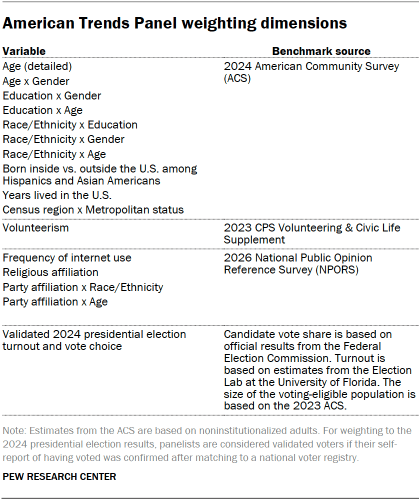
The final data is subject to a multi-stage weighting process. Initially, panelists are assigned a base weight representing their probability of selection. This is then calibrated against known population benchmarks from the U.S. Census Bureau. The final weights are "trimmed" at the 1st and 99th percentiles to prevent outliers from skewing the results, ensuring the final statistical portrait is stable and representative.
Official Responses and Methodology Transparency
Pew Research Center operates under the philosophy that "methodology is as important as the results themselves." By making the details of their weighting dimensions, sampling errors, and response rates public, they provide a roadmap for other researchers and critics alike.
The Center acknowledges that even the most rigorous survey faces challenges. The cumulative response rate—which accounts for the initial recruitment phase and subsequent attrition over years—stands at 3%. While this number may appear low to the casual observer, it is a standard metric in modern, long-term panel research. The Center mitigates this through continuous re-weighting and by being transparent about the "break-off rate," which, in this wave, was a remarkably low 1%.
Furthermore, the Center encourages users to look beyond the top-line numbers. By providing specific tables on sample sizes and margins of error for various subgroups, they enable journalists and policymakers to understand the limits of the data. As the Center notes, "One should bear in mind that question wording and practical difficulties in conducting surveys can introduce error or bias into the findings of opinion polls." This admission of fallibility is, ironically, the strongest evidence of their reliability.
Implications: Why This Matters for 2026 and Beyond
The methodology employed in Wave 200 of the American Trends Panel has profound implications for the future of public policy and social research.
Bridging the Digital Divide
By utilizing both online portals and live telephone interviews, the ATP acknowledges that the "digital divide" remains a real factor in American life. Ignoring those without consistent high-speed internet would lead to a skewed, affluent, and urban-centric view of the country. By keeping the telephone option open, the Center ensures that older, rural, and economically disadvantaged voices remain in the conversation.
Combating Polarization through Data
In a polarized political climate, the public often views polling with skepticism. The ATP’s transparent, rigorous approach serves as an antidote to this cynicism. When the methodology is laid bare—showing exactly how oversampling is used to help, not bias, the results—it invites trust. It proves that the goal is not to force a specific narrative, but to provide a mirror to the nation.
The Future of Representative Democracy
As we look toward the remainder of the decade, the ability to aggregate the opinions of millions of citizens into a representative 5,000-person sample is nothing short of miraculous. The ATP’s evolution from landline-based RDD (Random Digit Dialing) to sophisticated, address-based, multi-modal digital panels mirrors the evolution of society itself.
Ultimately, the data from Wave 200 serves as a critical infrastructure project for the American public. It provides the empirical foundation upon which journalists report, academics study, and leaders decide. In an age of information overload, the American Trends Panel reminds us that while data is plentiful, high-quality, representative, and transparently derived information is the rarest and most valuable commodity of all. By adhering to these strict methodological standards, Pew Research Center ensures that when we talk about "what Americans think," we are actually hearing them.