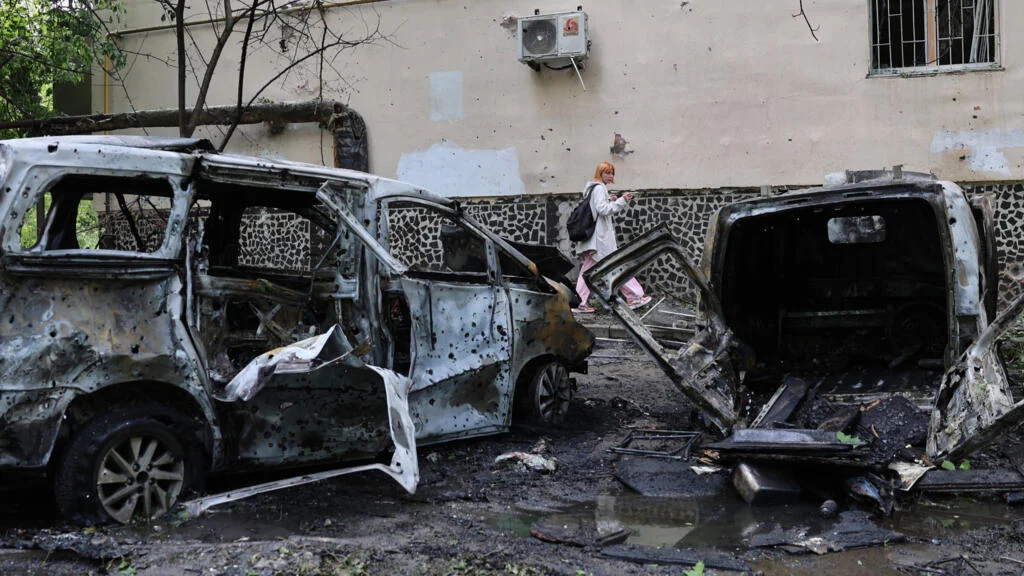
KYIV — In a calculated departure from the established patterns of the ongoing conflict, Russia launched a ferocious, large-scale drone offensive against Ukraine on Wednesday, marking a significant tactical pivot in its aerial bombardment campaign. The assault, which saw an unprecedented volume of unmanned aerial vehicles (UAVs) saturating the skies during daylight hours, left at least six people dead, scores wounded, and critical infrastructure reeling across the country.
The attack, which Ukrainian President Volodymyr Zelensky described as a deliberate attempt to sabotage international diplomacy, comes at a pivotal geopolitical juncture. As U.S. President Donald Trump arrived in Beijing for high-stakes talks with Chinese leader Xi Jinping, Moscow’s barrage appeared designed not only to inflict physical destruction but to cast a shadow over the global political landscape.
The Scale of the Onslaught: A Daytime Tactical Shift
For over four years, the Russian aerial campaign against Ukraine has largely adhered to a predictable nocturnal rhythm: barrages of missiles and "kamikaze" drones usually strike under the cover of darkness, intended to exhaust air defense systems and maximize psychological terror while citizens sleep. Wednesday’s operation shattered that precedent.
According to President Zelensky, Russia unleashed at least 800 drones in a single, sustained wave beginning at midnight and continuing through the day. The sheer volume of the swarm forced Ukraine’s air defense networks to operate under extreme duress.
"Since midnight, at least 800 Russian drones have already been launched," Zelensky stated via social media. The casualty toll, while still being calculated as emergency services navigate the debris, has already reached six fatalities, with dozens of others—including children—rushed to hospitals with shrapnel wounds and blast-related trauma.
In the capital, Kyiv, the atmosphere was one of grim determination. AFP journalists on the ground reported air raid sirens wailing across the city as residents sought refuge in the deep-level metro stations. Explosions echoed throughout the morning as municipal air defense systems engaged incoming targets, attempting to neutralize the swarms before they could strike critical nodes of the city’s power grid and administrative centers.
Geographic Impact: A Nationwide Toll
The impact of the strikes was felt from the western borders of the country to the southern Black Sea coast, suggesting a coordinated effort to stretch Ukrainian defensive capabilities to their breaking point.
The Western Front: Rivne
The western region of Rivne bore the brunt of the violence, with regional authorities confirming that three individuals were killed and four others injured. The strikes caused extensive damage to civilian infrastructure, including a residential building, underscoring the indiscriminate nature of the drone deployment.
The Southern and Central Regions
The carnage extended deep into the south. In the Zaporizhzhia region, one person was confirmed dead. In the Kherson region, two more lives were claimed. Meanwhile, the central regions of Khmelnytskyi and Cherkasy, along with the Black Sea port city of Odesa, reported at least eight wounded, as the drones targeted energy facilities and logistical hubs vital to the Ukrainian war effort.
Military intelligence officials in Kyiv warned early Wednesday that the Russian forces had initiated a "prolonged air strike" specifically aimed at critical facilities. This intelligence assessment suggests that Moscow is moving beyond simple bombardment, aiming instead to systematically dismantle the infrastructure required for Ukraine to maintain its industrial and defensive output.
The Geopolitical Link: Diplomacy Under Fire
Perhaps the most significant aspect of Wednesday’s escalation was its timing. The barrage coincided precisely with U.S. President Donald Trump’s arrival in Beijing for a summit with Chinese President Xi Jinping—a meeting that many observers believe could determine the trajectory of global power dynamics for the next decade.
President Zelensky was unequivocal in his assessment of the timing, characterizing the attack as a brazen attempt by the Kremlin to derail international peace efforts.
"It certainly cannot be called a coincidence that one of the longest massive Russian attacks against Ukraine takes place precisely at the time when the President of the United States arrived for a visit to China," Zelensky wrote. "In this difficult geopolitical moment, Russia is clearly trying to disrupt the overall political atmosphere and draw attention to its evil—seeking to do so at the expense of Ukrainian lives and Ukrainian infrastructure."
Earlier in the day, speaking at a summit in Romania, Zelensky had publicly urged the U.S. administration to place the war in Ukraine at the forefront of the discussions in Beijing. "We are in constant contact with our American partners," Zelensky told delegates. "We are thankful, and we are expecting that the issue of ending the Russian war against Ukraine will be raised now as well, while the president of the United States is in China."
The Kremlin’s decision to launch the largest drone swarm of the year during this summit is being viewed by analysts as a "spoiler strategy." By forcing the international community to focus on a humanitarian crisis in Eastern Europe, Moscow is effectively attempting to exert influence over the Trump-Xi agenda, signaling that any dialogue regarding global stability must contend with the reality of Russian military reach.
Implications for Future Defense
The move to daytime, high-volume drone swarms poses a severe challenge to Ukrainian military planners. While the effectiveness of Western-supplied air defense systems has been high, the sheer number of drones—800 in a single cycle—threatens to overwhelm the capacity of these systems.
1. The Challenge of Saturation
The "swarming" tactic is designed to create a saturation point where the number of incoming projectiles exceeds the number of interceptors available. This forces defenders to choose which targets to protect, often leaving residential areas or secondary infrastructure vulnerable.
2. Economic Attrition
There is also a broader economic dimension to this shift. If Russia continues to utilize relatively inexpensive drones in massive numbers, Ukraine is forced to expend costly, sophisticated missiles to intercept them. This creates a long-term imbalance in the cost-per-kill ratio that could, over time, degrade Ukraine’s defensive posture.
3. The Psychological Dimension
By moving the attacks to the daytime, Moscow is explicitly targeting the daily lives of Ukrainian civilians. The goal is to make the continuation of normal life, work, and education impossible. It is a war of nerves as much as it is a war of attrition.
Conclusion: A Nation on the Brink
As of Wednesday evening, the smoke was still clearing over several regions of Ukraine. The immediate aftermath is one of mourning and repair, but the broader implications of this new phase of the war remain uncertain.
The Kremlin’s strategic pivot—demonstrated by the daytime saturation of Ukrainian skies—signifies that Moscow is prepared to use every tool at its disposal to maintain pressure on Kyiv, regardless of international condemnation or the optics of global summits. For the people of Ukraine, the message is clear: the air war has entered a more dangerous, more persistent, and more unpredictable phase.
As President Zelensky continues to advocate for deeper diplomatic engagement from the United States and its allies, the situation on the ground serves as a brutal reminder of the stakes involved. The drones currently flying over Ukraine are not merely weapons of war; they are instruments of political signaling, designed to ensure that even as the world’s most powerful leaders discuss the future of the global order in Beijing, the conflict in Ukraine remains an unavoidable, bloody reality.
For now, the focus remains on the survivors, the recovery efforts, and the urgent need to secure the skies. However, as the geopolitical chess game continues, the world watches to see how the international community—and specifically the administration in Washington—will respond to a provocation that has brought the battlefield directly into the halls of global diplomacy.