In the rapidly evolving landscape of artificial intelligence, a troubling pattern has emerged. An open-source AI wrapper is released to much fanfare, performing flawlessly in a maintainer’s curated Jupyter notebook. Yet, within a week of public adoption, the library begins to fracture. A missing API key triggers an opaque KeyError rather than a diagnostic warning; a lightweight text-classification feature inadvertently pulls in four gigabytes of deep learning dependencies; and the test suite remains perpetually fragile, passing only when the model provider’s servers are operating at peak efficiency.
These are not merely symptoms of "bad code." They represent a fundamental category mismatch. Traditional Python packaging advice was designed for synchronous database interactions or static file parsing. AI libraries, conversely, operate in an environment defined by stochastic outputs, massive dependency footprints, and the inherent instability of third-party model APIs. Moving from a functional demo to a production-grade SDK requires a shift in engineering philosophy.
The Anatomy of a Robust AI Library
Before a developer can build for scale, they must define the baseline. Modern library construction—guided by the Python Packaging User Guide and evolving standards for 2026—demands several non-negotiable traits. These include full type coverage (marked with a py.typed file to ensure downstream compatibility), a pyproject.toml-first architecture in accordance with PEP 621, and rigorous input/output validation.
Furthermore, a professional library must treat dependency isolation as a primary design constraint, not an afterthought. It requires built-in resilience for external calls and an automated CI/CD pipeline that enforces quality gates rather than relying on human vigilance.
The Five Pillars of Production-Grade AI SDKs
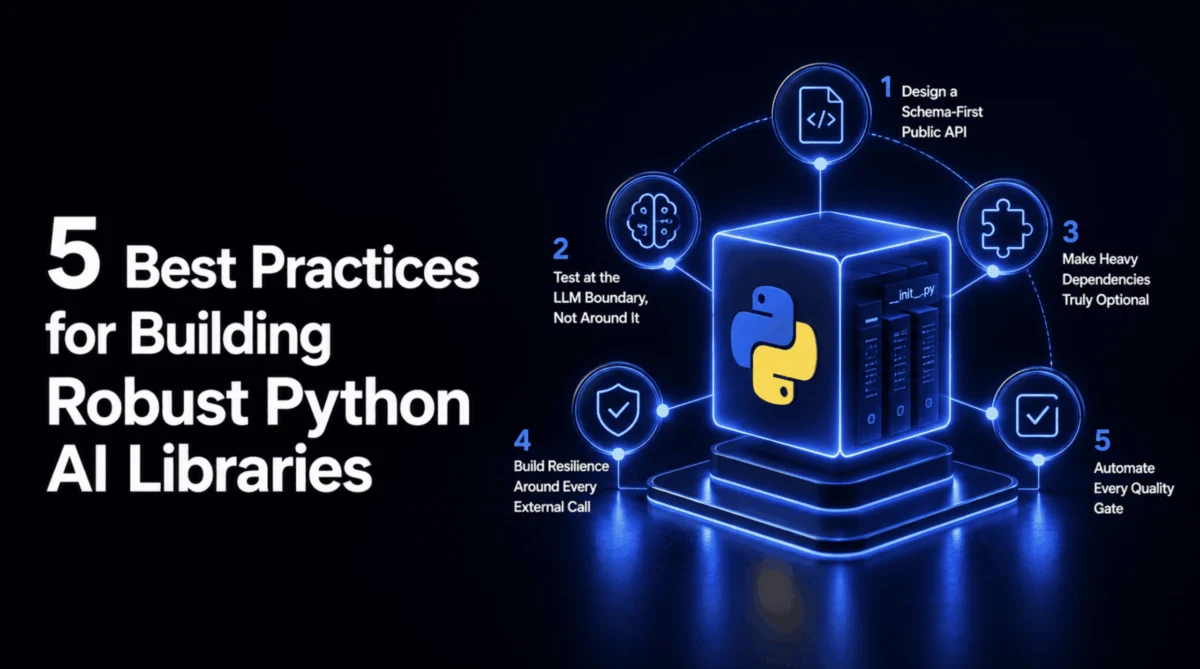
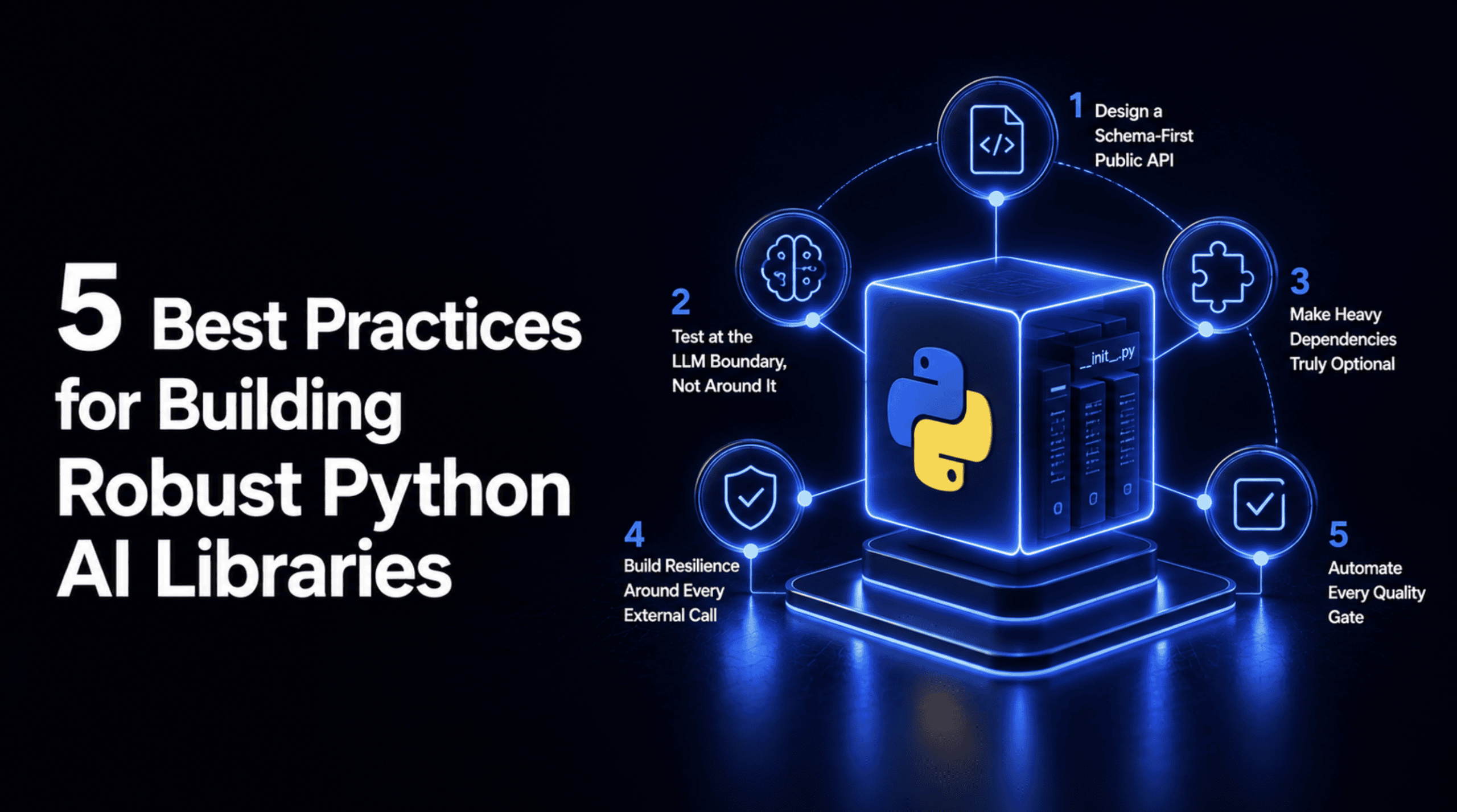
To bridge the gap between "it works on my machine" and "it works in production," developers should adopt five core practices tailored to the specific failure modes of AI systems.
1. Schema-First Public APIs
The most critical rule in AI SDK design is to shield users from raw, untyped data. A model’s output is inherently unpredictable; it may return malformed JSON, truncated strings, or unexpected types. If these raw artifacts cross the public boundary of your library, they will inevitably trigger cascading failures deep within the caller’s stack.
By employing libraries like Pydantic, developers can enforce strict contracts. A function should never return a raw dictionary. Instead, it should return a validated model instance. This ensures that the caller is guaranteed to receive data matching the expected schema. If the model fails to comply, the library should catch the error and re-raise it as a clear, context-specific exception, preserving the original traceback while providing a actionable path forward for the end-user.
2. Testing at the Boundary
Generic testing strategies often fail when applied to LLMs. Because models are non-deterministic, testing the "reasoning" of an agent is a recipe for brittle, flaking test suites. Instead, developers should mock the interaction at the exact boundary where the library meets the provider API.
By using tools like unittest.mock, one can simulate various response scenarios—successes, malformed JSON, or timeout errors—without ever pinging the model provider. This approach allows for rapid, deterministic testing that verifies not just the output parsing, but also the structural integrity of the prompts being sent to the model.
3. Optional Dependencies via Extras
AI libraries frequently suffer from "dependency bloat." A user interested only in a hosted API endpoint should not be forced to install massive local inference frameworks like PyTorch or Transformers.
The solution lies in pyproject.toml’s optional-dependencies mechanism. By segmenting requirements into extras (e.g., pip install mylib[openai] or pip install mylib[local]), developers keep the core library footprint minimal. Crucially, this must be paired with a "lazy import" pattern. If a user attempts to call a function requiring a missing dependency, the library should raise an ImportError that explicitly tells the user which extra to install, rather than a cryptic ModuleNotFoundError.
4. Resilience and Backoff Logic
AI services are notoriously transient. Rate limits, 503 errors, and network jitter are constant threats. A library that lacks built-in retry logic shifts the burden of resilience onto the user, leading to a subpar developer experience.
Using decorators from libraries like tenacity, developers can implement exponential backoff strategies. The key is to be selective: retry on transient network errors, but fail fast on authentication errors or bad requests. This prevents the library from becoming a "black hole" that hammers a struggling service, protecting both the user’s budget and the provider’s infrastructure.
5. Automated Quality Gates
The best architecture will degrade over time without automated enforcement. A modern CI pipeline should act as an unyielding guardian. Using uv for environment management, ruff for linting/formatting, and mypy for type checking, developers can ensure that every pull request adheres to the established standards. By running pytest with coverage reports on every push, teams can identify untested code paths before they reach production, ensuring that the library remains robust as it grows in complexity.
Implications for the AI Ecosystem
The transition toward more rigorous AI SDK development signals a maturation of the AI tooling sector. For years, the "gold rush" mentality prioritized speed-to-market over stability. However, as AI transitions from experimental prototypes to core enterprise infrastructure, the demand for reliability has become the dominant market force.
Projects like OpenAI’s own Python SDK, Instructor, PydanticAI, and LiteLLM serve as current benchmarks. Instructor revolutionized the field by integrating Pydantic schema validation directly into LLM interactions, while LiteLLM set the standard for unifying fragmented provider APIs. Hugging Face Transformers remains the gold standard for managing massive, optional dependency trees at scale.
Looking Forward
The common mistakes that plague current AI libraries—hard-coded configurations, lack of type safety, and brittle error handling—are increasingly being viewed as professional liabilities. As the tooling matures, the focus must shift from simply getting a model to respond to ensuring that the integration is as reliable as a standard database driver or a REST client.
Ultimately, the goal of these practices is to answer one fundamental question from the user: “Can I trust this library when things go wrong?”
When a model hallucination occurs, when an API provider suffers an outage, or when a system environment is constrained, a library that handles these events gracefully is the one that achieves longevity. Building for these "edge cases" is not a luxury; it is the fundamental requirement for any software that purports to bring the power of AI into a production environment. By embracing schema-first design, boundary testing, and automated quality control, developers are not just writing code—they are building the foundational infrastructure of the next decade of software engineering.