The Sydney Opera House is more than just a World Heritage-listed landmark; it is a monument to the friction between visionary ambition and the harsh realities of execution. Its history—marked by political infighting, astronomical budget overruns, and the tragic resignation of its architect, Jørn Utzon—serves as an unlikely but profound backdrop for the modern challenges facing today’s Chief Procurement Officers (CPOs).
Last week, the 2026 Australia Forum convened within those very halls, bringing together leaders to discuss a different kind of structural transformation: the integration of Artificial Intelligence into the procurement function. Just as the Opera House required a fundamental rethinking of structural engineering in the 1960s, today’s corporate landscape demands a similar, if less concrete, transformation of workflows and workforce capabilities.
The Echoes of Ambition: A Chronology of the Sydney Opera House
To understand the gravity of the modern corporate challenge, one must first look at the history of the venue where the forum took place.
The Vision (1957)
Danish architect Jørn Utzon won an international design competition with a concept that was, at the time, considered impossible to build. His "sails" defied existing structural norms, necessitating years of iterative mathematical modeling that pushed the limits of mid-century engineering.
The Conflict (1960–1966)
As the project evolved, the gap between artistic vision and budgetary reality widened. Political pressure mounted as costs ballooned. In 1966, following a change in government, the relationship between the state and Utzon reached a breaking point. Utzon was forced to resign, leaving behind a project he would never see completed or experience in person.
The Legacy (1973–Present)
The building was finally completed in 1973, significantly over budget and years behind schedule. Yet, it stands today as a testament to the fact that while the journey of innovation is often fraught with controversy and friction, the end result can redefine an entire nation’s identity.
This duality—the struggle of the process versus the brilliance of the outcome—provided a poignant framework for the discussions held during the 2026 Australia Forum.
Navigating the AI Frontier: Insights from Industry Leaders
The 2026 Forum focused on how procurement leaders are moving beyond the hype cycle of AI to implement tangible, scalable strategies. Two standout case studies set the tone: Kimberley Fisk, CPO of New Zealand-headquartered dairy giant Fonterra, and Angela Connolly, CPO of the Commonwealth Bank of Australia (CommBank).
Both leaders emphasized that AI is not merely a tool for efficiency; it is a catalyst for the evolution of the procurement professional. The discussion centered on how to navigate the "dizzying" speed of technological change without losing sight of the strategic value procurement brings to the enterprise.
Angela Connolly’s Framework: A Blueprint for Adoption
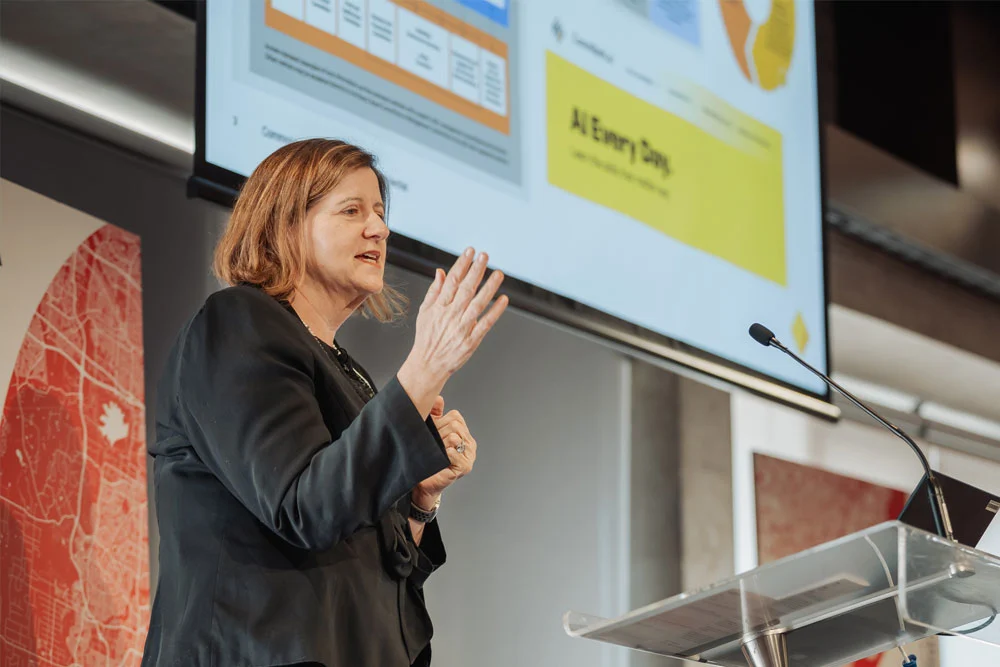
Angela Connolly presented a pragmatic, seven-step framework designed to demystify AI adoption within the Commonwealth Bank:
- Democratize: The goal is to place AI capabilities in the hands of every employee. This involves normalizing both successes and failures, fostering a culture where the question "How can AI help me today?" is a standard part of the daily workflow.
- Scale: Moving from pilot projects to industrialization. This requires a centralized repository of use cases, reusable prompts, and "agentic" patterns. The goal is to turn one person’s breakthrough into everyone’s starting point.
- Redesign: This is perhaps the most challenging phase. It requires teams to stop automating existing, broken processes and instead ask, "If we started from scratch, would we design this process the same way?"
- Leverage, Scan, Rinse, and Repeat: The final stages of the cycle focus on continuous improvement. By scanning for new advancements and refining the existing workflows, the organization ensures it remains agile in the face of rapid technical evolution.
The Human Element: Why "Keeping Calm" Is the Ultimate Strategy
While frameworks provide the necessary structure for change, the most significant barrier to AI adoption remains human behavior. During a breakout session, I asked Mark Sheldrick of Transurban for his singular piece of advice to CPOs tasked with leading their teams through this era of profound change.
His response was deceptively simple: "Keep calm."
In an industry currently inundated with vendors, consultants, and internal stakeholders all promising the "next big thing," the temptation to react impulsively—to jump on every AI trend without proper vetting—is immense. Sheldrick’s advice serves as a vital counterweight to the "fear of missing out" (FOMO) that drives much of the current corporate investment in AI.
Implications for the Procurement Function
The implications of these discussions are clear. The role of the CPO is shifting from a transactional gatekeeper to a strategic architect.
- From Automation to Transformation: Procurement leaders must move beyond simple automation. The real value of AI lies in the ability to redesign workflows from the ground up, identifying bottlenecks that have existed for decades.
- The Democratization of Intelligence: By providing teams with the tools to innovate at the local level, CPOs can foster a culture of grassroots problem-solving. This mirrors the collaborative spirit that eventually allowed the Sydney Opera House to be completed.
- Managing the Hype Cycle: Just as the Opera House project suffered from a lack of clear, manageable milestones during its early years, procurement teams must guard against over-promising the results of AI integration. Consistency of thought and a steady, long-term approach are the best antidotes to market volatility.
Official Perspectives: The Institutional View
The Forum underscored that while individual companies like Fonterra and CommBank are leading the charge, the broader procurement community is still in the "learning phase."
Official commentary from the event organizers highlighted that procurement’s transition into AI is not a destination but an ongoing process of discovery. "We are in a period of unprecedented volatility," noted one industry observer. "The CPOs who succeed will be those who balance the radical potential of AI with the traditional procurement tenets of risk management, cost control, and value creation."
The consensus among delegates was that while the technology is powerful, it is the capabilities of the people wielding it that will determine success. The procurement professional of 2030 will look very different from the one of 2020, likely acting more as a data scientist and strategic advisor than a traditional buyer.
Conclusion: Lessons for the Future
The story of the Sydney Opera House is a cautionary tale of what happens when vision outpaces process, but it is also a triumphant story of human persistence. As CPOs across Australia, New Zealand, and the globe navigate the AI revolution, the parallels are striking.
There will be budget overruns, there will be "political" friction within organizations, and there will be moments where the path forward seems impossible. However, by adopting the structured, iterative approach championed by leaders like Angela Connolly and maintaining the steady, calm perspective advocated by Mark Sheldrick, procurement leaders can ensure their own "monuments" to progress are built on solid ground.
The 2026 Australia Forum at the Opera House was more than a professional gathering; it was a reminder that even the most daunting, complex projects can be realized if we have the right framework, the right talent, and, above all, the composure to see the vision through to the end. As the industry looks toward the next decade, the challenge is not just to build something new, but to build something that lasts—something that, much like the sails of the Opera House, will stand as a beacon of innovation for years to come.