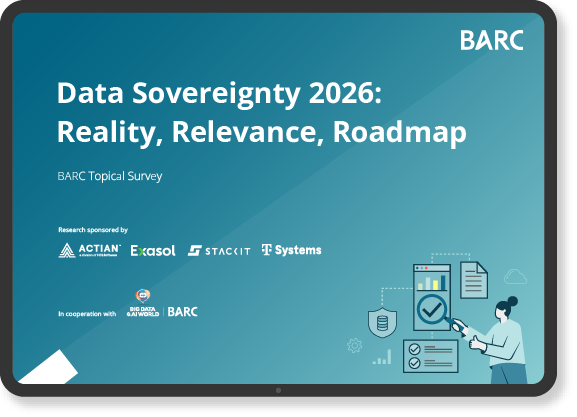
In the rapidly evolving landscape of global enterprise, the concept of "data sovereignty" has undergone a radical transformation. Once relegated to the periphery of IT compliance and legal checklists, data sovereignty has emerged as a cornerstone of corporate strategy. According to the latest comprehensive survey from BARC—Data Sovereignty 2026: Reality, Relevance, Roadmap—organizations are no longer viewing the control of their data merely as a defensive posture against regulatory overreach. Instead, it has become a fundamental prerequisite for operating data- and AI-driven processes at an acceptable level of risk.
As of September 2026, the findings from a survey of 320 organizations worldwide reveal that the digital autonomy of an enterprise is now inextricably linked to its ability to innovate.
The Evolution: From Compliance to Strategic Asset
For years, "data sovereignty" was synonymous with GDPR, CCPA, and a litany of other regional privacy mandates. It was a cost center—a box to be ticked to avoid fines. However, the 2026 data indicates a paradigm shift. With the proliferation of generative AI and large-scale machine learning models, companies are finding that the "black box" nature of third-party AI services poses an existential risk.
If an organization cannot trace the provenance of its training data, or if it cannot guarantee that its proprietary intellectual property is not being ingested into a vendor’s global model, it loses its competitive edge. Sovereignty is now understood as the capability to maintain full control over the lifecycle, residency, and usage rights of data.
The 2026 Landscape
The survey highlights that 320 organizations, representing a cross-section of global industries, are now building "sovereignty roadmaps." These roadmaps prioritize:
- Infrastructure Independence: Reducing lock-in to single hyperscaler cloud providers.
- Data Residency: Ensuring that data remains within specified legal jurisdictions to comply with evolving international trade and security laws.
- AI Governance: Establishing strict protocols for how internal data interacts with external AI architectures.
Chronology of a Shifting Mandate
The path to the current state of data sovereignty was not linear. It was accelerated by a series of geopolitical and technological tipping points.

- 2022–2023 (The Awakening): Initial concerns were sparked by the sudden rise of LLMs. Organizations began to realize that using public-facing AI tools could lead to the "leakage" of sensitive corporate information.
- 2024 (The Regulatory Surge): New international data treaties and the solidification of AI-specific legislation globally forced companies to move from reactive measures to proactive governance.
- 2025 (The Integration Phase): Companies began integrating sovereignty requirements into their core procurement and IT architectural processes. It was no longer an "add-on" but a requirement for any new technology vendor.
- 2026 (The Strategic Mandate): As evidenced by the BARC study, data sovereignty is now treated as a "strategic condition." Without it, digital transformation projects are often stalled at the C-suite level due to risk assessment failures.
Supporting Data: What the Numbers Tell Us
The BARC survey provides a sobering look at how companies are struggling to balance innovation with autonomy. While the appetite for AI integration remains at an all-time high, the technical debt associated with fragmented data landscapes is rising.
According to the report, over 65% of surveyed organizations now cite "loss of control over data flows" as a primary concern when evaluating new cloud-native AI tools. Furthermore, the survey found that organizations with a documented "Sovereignty Roadmap" reported a 30% faster deployment time for internal AI models compared to those without. This counter-intuitive finding suggests that having clear rules—while seemingly restrictive—actually removes the "analysis paralysis" that often plagues legal and compliance departments during the procurement phase.
Expert Insight: The View from the Top
The research, led by BARC experts Timm Grosser and Dr. Carsten Bange, emphasizes that the human element of this transition is just as critical as the technical one.

Timm Grosser: The Architect of Strategy
Timm Grosser, Senior Analyst at BARC, has long focused on the intersection of data strategy and management. His analysis suggests that organizations are currently in a "re-centralization" phase. "For a decade, we saw the democratization of data lead to fragmented silos," Grosser notes. "Now, to achieve sovereignty, firms are pulling back, establishing centralized governance structures that provide the necessary oversight without stifling the speed of local innovation."
Dr. Carsten Bange: The Visionary
Dr. Carsten Bange, founder and CEO of BARC, views the current climate as a crucible for the next generation of industry leaders. "Transformation is no longer just about adopting a new tool; it is about defining the boundaries of your digital footprint," Dr. Bange argues. "The companies that will dominate the late 2020s are those that have successfully balanced the openness required for AI innovation with the strict control required for corporate security."
Implications for the Future
What does this mean for the average enterprise? The implications of the 2026 findings are profound and suggest a multi-year trend toward "sovereign-by-design" architectures.
1. The Rise of Private AI Clouds
We are seeing a marked shift away from purely public, multi-tenant AI environments. Organizations are increasingly investing in private, localized AI instances where they retain total control over the weights, the training data, and the deployment environment.
2. Vendor Accountability
Vendors are being forced to change their business models. The days of "black box" as-a-service offerings are numbered. Enterprises are demanding transparency, data portability, and verifiable "kill switches" for their data within vendor systems. Any provider unable to offer these features is finding it increasingly difficult to pass the procurement vetting process of large-scale enterprises.
3. The Talent Gap
There is a growing demand for a new type of professional: the "Data Sovereignty Architect." This individual must possess deep technical knowledge of cloud infrastructure and AI models, combined with a sophisticated understanding of international data law. As the BARC report indicates, this role is becoming as vital to the organization as the CTO or the CISO.
Conclusion: The Road Ahead
As we look toward the remainder of 2026 and into 2027, the message from the research is clear: sovereignty is the new bedrock of trust. Organizations that ignore this reality do so at their own peril, risking not only regulatory fines but also the erosion of their most valuable asset—their proprietary data.
The "Data Sovereignty 2026" report serves as a wake-up call. It is no longer enough to participate in the digital economy; one must do so on one’s own terms. Whether through the implementation of hybrid cloud strategies, the adoption of strict data governance frameworks, or the pursuit of vendor-neutral AI architectures, the path forward requires a deliberate, strategic commitment to autonomy.
For those interested in the full scope of these findings, the complete Data Sovereignty 2026: Reality, Relevance, Roadmap report is available through the BARC research portal. As the industry continues to navigate the complexities of an AI-driven future, the lessons provided by Grosser, Bange, and their team will undoubtedly serve as a critical guide for leaders looking to steer their organizations toward a more secure and sovereign future.

Disclaimer: This article is based on the research findings from BARC. For in-depth access to the full survey data, whitepapers, and strategic roadmaps, readers are encouraged to subscribe to the BARC+ platform, which provides ongoing insights into the evolving world of data and analytics.