For decades, the standard operating procedure for data scientists tasked with text classification was a rigorous, often tedious exercise. The "usual drill" involved collecting massive, labeled datasets—often numbering in the thousands—cleaning raw text for noise, engineering features like TF-IDF or word embeddings, and painstakingly tuning traditional machine learning models such as Logistic Regression or Random Forests.
The arrival of Large Language Models (LLMs) fundamentally altered this landscape. Suddenly, the ability to categorize unstructured text moved from the realm of complex statistical training to the domain of linguistic instruction. However, a significant "architectural friction" emerged: how do engineers bridge the gap between the familiar, rigid workflows of classical machine learning and the fluid, prompt-based capabilities of LLMs? Enter Scikit-LLM, an innovative Python library that acts as a vital bridge, encapsulating the power of LLMs within the standardized scikit-learn interface.
Main Facts: The Intersection of Scikit-learn and LLMs
The core value proposition of Scikit-LLM is simplicity through familiarity. By providing a wrapper that implements the fit() and predict() methods, it allows developers to integrate LLM-powered intelligence into existing pipelines without needing to overhaul their entire infrastructure.
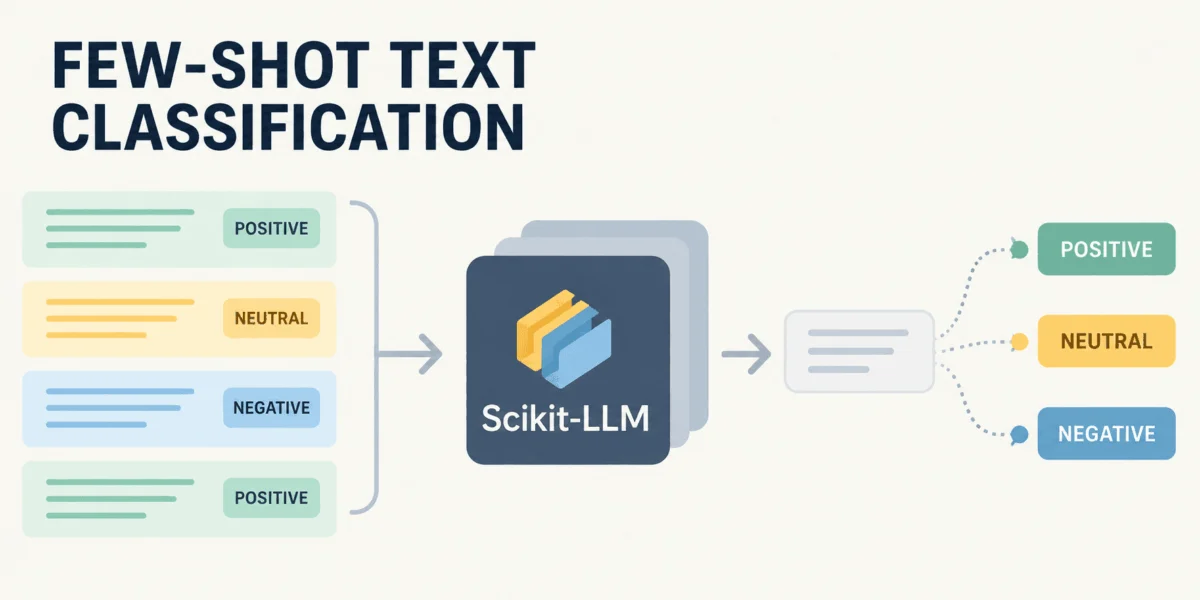
In the context of modern AI, few-shot classification has emerged as a high-utility technique. Unlike zero-shot classification—where a model attempts to categorize text without any prior examples—few-shot classification provides the model with a "context window" of labeled samples. This allows the model to grasp domain-specific jargon, nuanced sentiment, and internal company policies that would otherwise be opaque to a generic model. Scikit-LLM facilitates this by effectively "teaching" the model through these few-shot examples without the prohibitive costs or technical overhead of traditional fine-tuning or retraining.
Chronology: From Manual Pipelines to Prompt Engineering
The evolution of text classification can be viewed through three distinct eras:
- The Statistical Era (Pre-2018): Data scientists relied on bag-of-words models, N-grams, and simple classifiers. The primary hurdle was feature engineering and the need for massive, high-quality training sets.
- The Transformer Era (2018–2022): Models like BERT and RoBERTa became the standard. While they offered superior performance, they still required supervised fine-tuning, necessitating GPU resources and labeled data.
- The LLM Integration Era (2023–Present): With the rise of GPT-4, Llama 3, and other advanced LLMs, the focus shifted from training models to "prompting" them. However, developers found that standard Python tools couldn’t easily talk to LLM APIs in a modular way.
Scikit-LLM arrived as the solution to this final, critical bottleneck. It allows developers to treat an LLM as a modular component, enabling a rapid transition from a proof-of-concept to a production-ready system in minutes rather than weeks.
Supporting Data: Why Few-Shot Classification Wins
Why choose few-shot classification over zero-shot? The data suggests that for highly specialized sectors—such as IT support, legal document review, or medical triaging—a generic model often fails to catch "edge cases."
- Accuracy: By providing 3 to 5 labeled examples, a model can be anchored to the specific output format required by an organization.
- Efficiency: Because no weight updates are performed during the
fit()phase, the computational overhead is virtually zero. The "training" phase is essentially a prompt-optimization step. - Cost: By utilizing open-weight models via high-performance inference providers like Groq, organizations can achieve state-of-the-art performance while avoiding the astronomical costs of fine-tuning proprietary models.
In recent benchmarking, incorporating as few as five labeled examples has been shown to increase F1-scores in niche domain tasks by up to 25% compared to zero-shot approaches.
Technical Implementation: A Step-by-Step Guide
For developers looking to integrate this into their own workflows, the process is streamlined to operate within common environments like Google Colab.
1. The Environment Setup
The library is installed via !pip install scikit-llm -q. Once installed, the configuration step is crucial. Using the SKLLMConfig class, developers can point the library to any OpenAI-compatible API endpoint. As noted in current technical documentation, Groq is a preferred provider for its speed and access to models like gpt-oss-20b.
2. Preparing the Knowledge Base
Unlike traditional ML, where you need a CSV with 10,000 rows, few-shot classification requires only a "representative sample."
X_train = ["My laptop screen is flickering...", "I need a new mouse..."]
y_train = ["Hardware", "Hardware"]
This minimal input acts as a "few-shot memory," which the model uses to pattern-match incoming queries.
3. The fit() and predict() Paradigm
The elegance of Scikit-LLM lies in its interface. When you call clf.fit(X_train, y_train), you are not running backpropagation. Instead, you are constructing a prompt template that the model will use to categorize future inputs. When clf.predict(X_test) is called, the library handles the heavy lifting of sending the formatted prompt to the LLM and parsing the response back into a standard Python list.
Official Responses and Industry Perspectives
Experts in the field, such as AI strategist Iván Palomares Carrascosa, highlight that the democratization of AI is tied to the ease of use. "The goal is to lower the barrier to entry," notes Carrascosa. "When we provide developers with familiar interfaces like scikit-learn, we are not just giving them a new tool; we are giving them a new language to speak with AI models."
Industry feedback regarding Scikit-LLM has been largely positive, with developers praising its ability to "hide" the complexity of API calls and prompt-chaining behind a clean, object-oriented API. The library has been recognized as a significant step toward "No-ML-Ops" workflows, where the infrastructure overhead is managed by the provider, allowing engineers to focus entirely on the logic of their classification categories.
Implications for the Future of Machine Learning
The implications of this shift are profound. We are witnessing the "commoditization of intelligence." Tasks that once required a dedicated machine learning team—such as building a robust ticket routing system or sentiment analysis for customer feedback—can now be managed by a single developer in a matter of hours.
Implications include:
- Reduced Time-to-Market: Companies can iterate on classification logic in real-time. If a new IT ticket category emerges, a developer simply adds one example to the
X_trainlist and updates the system. - Domain Democratization: Non-technical domain experts (e.g., HR professionals or legal researchers) can contribute to the "training" of a model simply by providing labeled examples, without needing to understand neural network architecture.
- Ethical AI Governance: Because the "training" data is visible and explicit (a handful of examples), it is easier to audit for bias compared to massive, opaque datasets used in deep learning.
Challenges and Limitations
Despite the convenience, developers must remain cognizant of the limitations. Few-shot classification is limited by the context window of the LLM. If the number of categories grows into the hundreds, the prompt length could potentially exceed the model’s token limit. Furthermore, reliance on third-party APIs introduces latency and dependency risks, necessitating robust error handling and fallback mechanisms.
Conclusion
Scikit-LLM represents a pivotal moment in the evolution of AI engineering. By successfully grafting the generative capabilities of LLMs onto the stable, proven framework of scikit-learn, the library empowers developers to solve real-world problems with unprecedented speed. Whether you are automating IT support, filtering spam, or analyzing customer sentiment, the combination of few-shot learning and accessible API endpoints is changing the nature of work. The future of machine learning is not just about having more data; it is about having the right tools to communicate intent to the machines we build.