The software industry has long operated on the mantra of "write once, run anywhere." Since the inception of the container movement, Docker has been the undisputed standard for packaging applications, dependencies, and configurations into portable, immutable units. Today, as the artificial intelligence landscape shifts from simple chat interfaces to complex, autonomous multi-agent systems, the industry faces a new crisis: the "agentic sprawl." How do we build, version, and share AI agents with the same reliability we expect from web services?
The answer, it seems, lies in the evolution of the Docker ecosystem itself. With the introduction of Docker Agent, the company is applying its proven containerization philosophy to the world of Large Language Models (LLMs), enabling developers to define, distribute, and orchestrate AI teams as declarative artifacts.
The Genesis: From Containers to Cognitive Agents
To understand the significance of Docker Agent, one must look at the evolution of the Docker platform over the past twenty-four months. Docker’s trajectory has not been accidental; it has been a methodical pivot toward the "Agentic Era."
A Chronology of Innovation
- Early 2025: Docker begins laying the groundwork for native AI integration, shifting focus from pure infrastructure to AI-ready environments.
- July 2025: A landmark announcement extends the Docker Compose specification to support agents and AI models natively. This allowed developers to define AI models as services, providing a bridge between traditional DevOps and the burgeoning world of LLMs.
- Mid-2025: The launch of Docker Model Runner provided a crucial breakthrough: the ability to run models locally, bypassing the dependency on cloud API keys and addressing privacy concerns.
- March 2026: The official release of the
docker-agentGo module marks the transition from experimental features to a dedicated, high-performance CLI tool. - Present Day: With over 3,300 GitHub stars and nearly 10,000 commits, Docker Agent has emerged as the definitive tool for developers who demand reproducibility in their AI pipelines.
The Architecture of Docker Agent
At its core, Docker Agent is an Apache 2.0-licensed CLI plugin designed to simplify the lifecycle of an AI agent. By moving away from imperative code-heavy definitions, Docker Agent adopts a declarative YAML/HCL approach.
Why Declarative Matters
In traditional AI development, agents are often tangled in messy Python scripts, hard-coded environment variables, and proprietary frameworks. Docker Agent decouples the "brain" (the LLM) from the "hands" (the tools and orchestration logic).
- Provider Agnostic: Whether you prefer the reasoning power of Anthropic’s Claude 3.5 Sonnet, the massive context window of Google’s Gemini, or the efficiency of a local model via Docker Model Runner, the configuration remains identical.
- Tooling via MCP: By leveraging the Model Context Protocol (MCP), agents gain access to a standardized ecosystem of tools. Whether it is a filesystem, a shell interface, or specialized web searchers, these tools can be containerized, ensuring that the environment an agent sees is isolated and secure.
- OCI Registry Compatibility: Perhaps the most radical feature is the ability to push and pull agent definitions to standard OCI registries. This means an agent can be versioned, tagged, and pushed to the same repository as a backend API, creating a unified DevOps pipeline for the entire application stack.
Practical Implementation: Building Your First Agent
For developers looking to get started, the barrier to entry is intentionally low. Installation is seamless for those already using Docker Desktop 4.63 or newer.
The Single-Agent Paradigm
A foundational agent in Docker Agent is defined by its agent.yaml file. Consider a coding assistant defined as:
agents:
  root:
    model: anthropic/claude-sonnet-4-5
    description: A helpful coding assistant
    instruction: |
      You are an expert software developer. Help users write clean, efficient code.
    toolsets:
      - type: filesystem
      - type: shell
The simplicity here is deceptive. By defining the toolsets as declarative types, the engine handles the boilerplate of authentication, sandboxing, and session management. When invoked via docker agent run, the agent initializes within a strictly defined environment, ensuring that the "it works on my machine" problem is eliminated.
Orchestrating Intelligence: The Multi-Agent Team
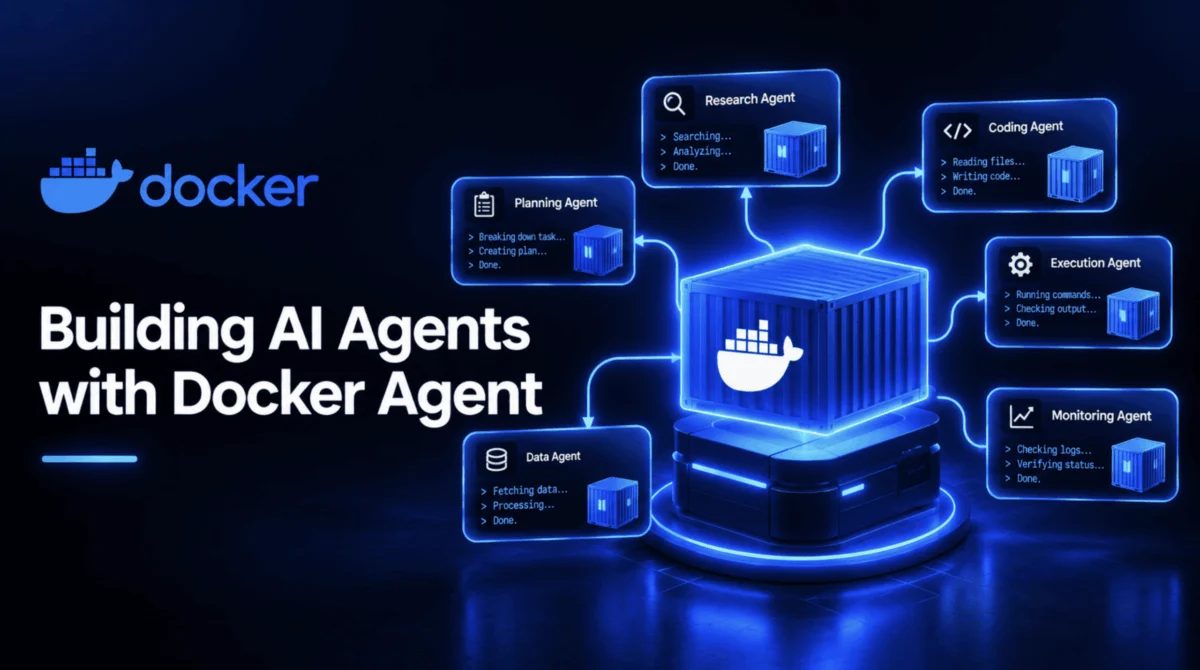
The true power of Docker Agent is revealed when transitioning from a single assistant to a collaborative, multi-agent team. In a real-world scenario—such as a research and reporting workflow—one agent cannot effectively handle everything.
The Team Hierarchy
By utilizing the sub_agents parameter, developers can create a "Coordinator" agent. The coordinator manages a research agent (using DuckDuckGo for real-time data) and a writer agent (focused on synthesis and formatting).
- Coordinator: Delegates the research to the expert, then reviews the findings.
- Researcher: Uses MCP-based tools to traverse the web and extract structured data.
- Writer: Operates on the filesystem to draft final documentation.
This separation of concerns allows developers to optimize the model choice for each specific role. You might choose a high-reasoning model for the coordinator while using a lower-latency, cost-effective model for the researcher. This granularity is impossible in monolithic, single-prompt architectures.
Implications: The Future of AI DevOps
The introduction of Docker Agent signals a shift in how enterprises will handle AI governance.
1. Reproducibility and Auditing
By treating agents as artifacts, organizations can now perform "AI audits." If a model behaves unexpectedly, the team can roll back to a previous sha256 digest of the agent configuration. This provides a clear, version-controlled history of how an AI system evolved.
2. Security and Isolation
Because tools like MCP servers run within their own containers, the risk of an agent performing unauthorized actions on the host machine is significantly mitigated. The container acts as a "safety harness," restricting the agent’s reach to only what is explicitly permitted in the declarative config.
3. Collaborative Development
When agents can be shared via standard registries, we enter an era of "Agent Repositories." Teams can publish specialized agents—an "Infrastructure Auditor" or a "Database Migrator"—that other teams can pull and integrate into their own pipelines, much like pulling an off-the-shelf library.
Expert Perspective: Validation as a First-Class Citizen
One of the most important takeaways from the Docker Agent ecosystem is the emphasis on schema validation. Developers are no longer guessing whether their YAML is correct. Using standard JSON Schema tools, one can validate an agent configuration before it ever touches an LLM.
As demonstrated in the project’s documentation, building a validator that catches errors—such as unsupported tool types or missing environment dependencies—is a trivial yet crucial step. This "shift-left" approach to AI ensures that configuration errors are caught at the development stage, rather than failing mid-way through a long-running, expensive agentic task.
Conclusion: A New Standard for AI Workflows
Docker has successfully bridged the gap between the chaotic, experimental world of LLM prompting and the rigorous, stable world of enterprise software. By transforming agents into portable, versioned, and containerized entities, Docker Agent provides the framework necessary for AI to move from the playground to the production floor.
For engineers, the instruction is clear: start small, define your tools, and leverage the registry. The goal is no longer just to build an AI that works—it is to build an AI that can be maintained, shared, and scaled with the reliability of a container. As the ecosystem continues to grow, we are likely to see the rise of a new generation of "Agent Ops" professionals, tasked with managing these cognitive teams with the same discipline that we have applied to our infrastructure for the last decade.
About the Author: Shittu Olumide is a software engineer and technical writer dedicated to demystifying the complexities of modern software infrastructure and artificial intelligence.