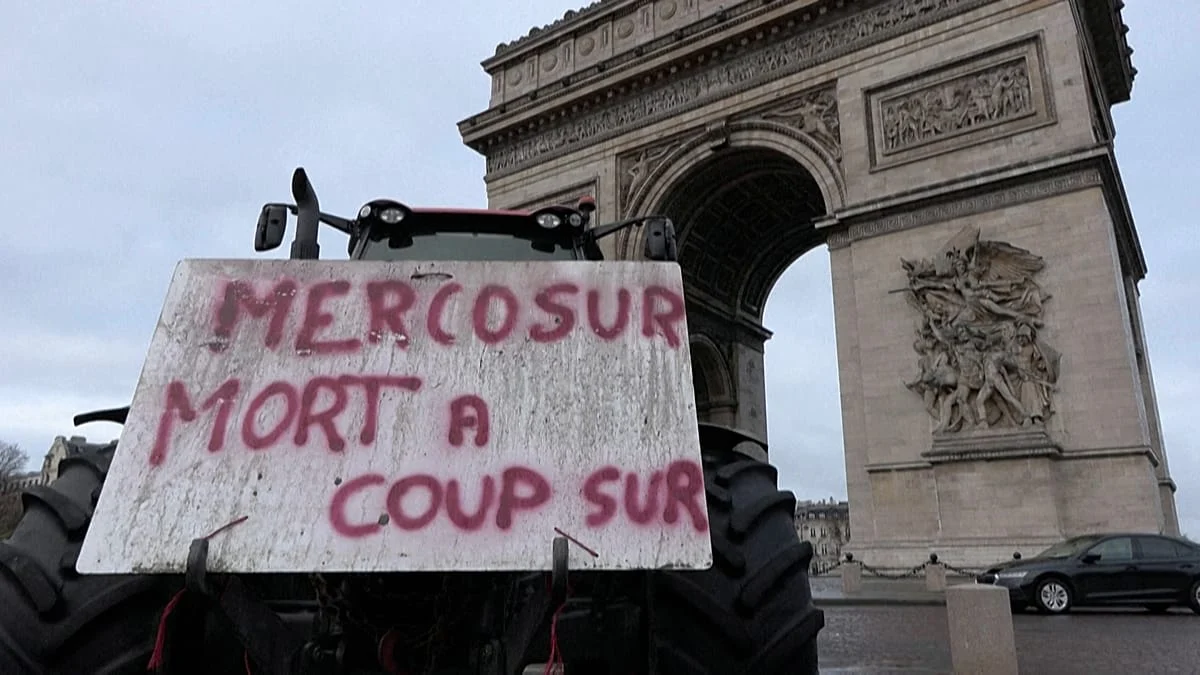
PARIS – In a defiant display of agricultural unrest that brought the heart of the French capital to a standstill, hundreds of farmers descended upon Paris on January 8. Defying police bans and navigating the early morning gloom with a convoy of roughly 100 tractors, demonstrators converged on the National Assembly, signaling a deepening rift between the nation’s rural heartland and the political establishment in Brussels and Paris.
The protests, which rippled across 39 departments nationwide, represent a boiling point in a long-standing dispute over international trade policies, environmental regulations, and the perceived abandonment of France’s historic agricultural sector.
The Chronology of the Siege on Paris
The mobilization, orchestrated by the Coordination Rurale union, began long before the first light of dawn. Despite a strict prohibition issued by the Paris Prefecture—intended to prevent the paralyzing of urban traffic—farmers successfully infiltrated the capital’s perimeter.
By the early morning hours, the iconic silhouettes of the Arc de Triomphe and the Eiffel Tower were flanked by the heavy machinery of the French agricultural industry. What began as a strategic entry into the city transformed into a symbolic occupation of the political center. By mid-morning, the focus of the dissent had shifted to the National Assembly, where hundreds of farmers gathered to voice their grievances.
The atmosphere turned volatile as the day progressed. The arrival of National Assembly President Yaël Braun-Pivet was met with a chorus of boos, reflecting the deep-seated resentment toward the political class. While the primary demonstration in Paris concluded by the evening, the union’s leadership issued a clear warning: the protest was merely a precursor to a larger, more protracted struggle.
The Catalyst: The EU-Mercosur Trade Agreement
At the center of the controversy lies the pending EU-Mercosur trade deal, a comprehensive agreement intended to facilitate trade between the European Union and the four founding members of the South American trade bloc: Brazil, Argentina, Paraguay, and Uruguay.
For the European Commission, the deal represents a gateway to massive markets and a strengthening of geopolitical ties. However, for the French agricultural sector, it is viewed as an existential threat. The primary concern is the influx of cheaper agricultural commodities—specifically beef, poultry, and sugar—that are produced in South America under environmental and animal-welfare standards that are vastly less stringent than those mandated within the European Union.
French farmers argue that this creates an uneven playing field. They contend that while they are burdened by the rising costs of complying with the EU’s "Green Deal" and rigorous phytosanitary regulations, the deal would effectively reward foreign competitors for utilizing methods that would be illegal within European borders.
Supporting Data: A Nationwide Movement
The events in Paris were not an isolated incident but the focal point of a wider, coordinated effort. According to data provided by the French Interior Ministry, the reach of the protest was significant:
- Geographic Scope: Demonstrations were recorded in 39 distinct departments across France.
- Participation: Approximately 2,200 farmers were involved in the day’s activities.
- Mechanical Presence: A total of 625 tractors were utilized in various roadblocks, slow-downs, and protests across the country.
Beyond the trade deal, the Coordination Rurale highlighted a secondary, localized crisis: the government’s handling of an outbreak of lumpy skin disease in cattle. Farmers argued that the state’s response—characterized by what they describe as bureaucratic inertia and insufficient financial support—has left livestock owners vulnerable to devastating economic losses. This compounded frustration served as a secondary propellant for the nationwide turnout.
Official Responses and Political Maneuvering
The political response to the protests has been a delicate balancing act for the administration of President Emmanuel Macron. Recognizing the volatility of the situation and the historical significance of the agricultural lobby in French politics, the government has attempted to project a posture of solidarity.
President Macron, speaking ahead of a pivotal European vote on the matter, stated clearly that France would oppose the EU-Mercosur agreement in its current form. The government’s official line is that the agreement must be renegotiated to ensure that "mirror clauses"—which would require imports to adhere to the same environmental and health standards as European products—are strictly enforced.
In contrast, officials in Brussels maintain a more pragmatic stance. Representatives of the European Commission have argued that the concerns of the farmers are being addressed through robust safeguards. They emphasize that European food-safety standards remain non-negotiable and that sensitive agricultural imports will be governed by strict quotas, designed to prevent the market from being flooded by cheap foreign goods.
Implications: A Future of Uncertainty
The January 8 protests represent more than just a dispute over trade quotas; they underscore a fundamental disconnect between the globalized economic vision of the EU and the localized, traditional livelihoods of French farmers.
Economic Implications
If the EU-Mercosur deal proceeds without significant amendments, the French agricultural sector faces the risk of price deflation and potential market displacement. Small-to-medium family farms, already operating on thin margins, may find themselves unable to compete with the economies of scale offered by massive South American agribusinesses.
Political Implications
The boos directed at the National Assembly signal a growing populist sentiment in rural France. This presents a significant challenge for the Macron administration, which must navigate the pressure of international diplomatic commitments while simultaneously managing domestic social stability. If the government fails to secure tangible concessions, the Coordination Rurale has hinted that future protests could be more frequent and potentially more disruptive.
Environmental and Ethical Concerns
The dispute also highlights a broader debate regarding the "exportation" of environmental standards. By signing trade deals with countries that may not prioritize deforestation prevention or animal welfare to the same degree as the EU, critics argue that the bloc is essentially outsourcing its pollution and ethical failings to satisfy the demand for cheaper consumer goods.
Conclusion: The Road Ahead
As the dust settles on the streets of Paris, the fundamental issues remain unresolved. The Coordination Rurale has retreated, but they have made it clear that their tractors are not being permanently parked. They remain in a state of mobilization, awaiting concrete action from the government to protect their livelihoods from what they perceive as unfair, externally imposed market forces.
The standoff between the farmers and the state is a microcosm of a broader European tension. As the EU pushes toward a future defined by expanded trade and strict environmental targets, the cost of that transition is increasingly being felt by those at the very foundation of the continent’s food supply. Whether through a renegotiation of the Mercosur deal, increased subsidies, or a radical shift in agricultural policy, the French government now faces the daunting task of reconciling the demands of the global market with the survival of its rural heartland.
For now, the countryside remains watchful, and the specter of further protests looms large over the European political agenda. The fight for the future of French agriculture is not only a national concern; it is a battle over the very definition of European sovereignty, sustainability, and the value placed on the dignity of the rural producer.