In the rapid evolution of Large Language Models (LLMs), the industry has shifted its focus from training massive models to the grueling challenge of serving them efficiently. While developers often obsess over quantization, pruning, and distillation, the true "silent killer" of production performance is the Key-Value (KV) cache. As context windows expand into the hundreds of thousands of tokens, the memory requirements for maintaining these caches have become the primary constraint on concurrency, latency, and overall throughput.
Two landmark innovations—PagedAttention and RadixAttention—have fundamentally altered this landscape. By decoupling memory allocation from computational logic and transforming the cache into a persistent, searchable index, these technologies have enabled a new generation of high-performance LLM infrastructure.
The KV Cache: The Industry’s Silent Bottleneck
To understand why these breakthroughs matter, one must first understand the mechanics of autoregressive decoding. Every time a transformer generates a token, it must "attend" to every preceding token. To avoid recomputing the entire history for every step, serving engines cache the Key (K) and Value (V) vectors of previous tokens.
The Math of Memory Exhaustion
The memory footprint of this cache is not trivial. It scales linearly with sequence length, model depth, and the number of heads. For a model like Llama-3 8B, each token requires approximately 128 KiB of space. A single 100,000-token prompt consumes nearly 12.8 GiB of GPU VRAM before a single request is even processed. When multiplied by concurrent users, the GPU memory ceiling is reached almost instantly.

The Two Core Challenges
The industry faced two distinct problems:
- Memory Allocation Inefficiency: Systems were over-allocating memory based on worst-case scenarios, leading to massive waste.
- Computational Redundancy: Systems were re-calculating the exact same "system prompts" or "prefix histories" for every single request, wasting millions of floating-point operations.
PagedAttention: The OS-Inspired Revolution
By 2023, the standard approach was to reserve a single, large, contiguous block of memory for each sequence. Because the engine couldn’t predict output length, it allocated space for the maximum context window. This resulted in "internal fragmentation," where the reserved space sat empty, and "external fragmentation," where the remaining memory was too scattered to fit new requests.
Borrowing from Operating Systems
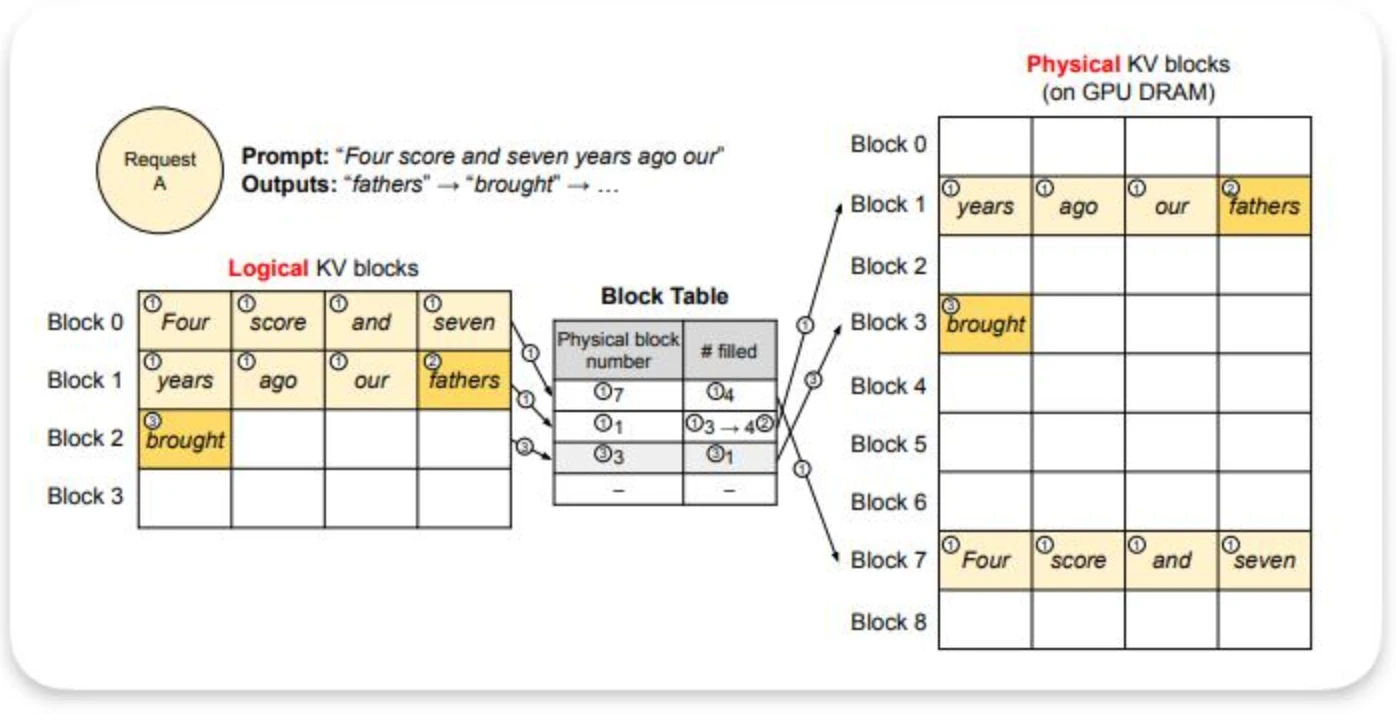
PagedAttention was introduced as a paradigm shift. Inspired by virtual memory in modern operating systems, it divides the KV cache into fixed-size blocks (typically 16 or 32 tokens).
- Block Tables: Instead of a contiguous buffer, the engine uses a block table to map logical token sequences to scattered physical memory locations.
- On-Demand Growth: The system allocates memory only as needed. If a request only generates 60 tokens, it consumes only the blocks required for those 60 tokens.
- Copy-on-Write: PagedAttention enables efficient memory sharing. Multiple requests with the same prompt can point to the same physical memory, drastically reducing the memory footprint for beam search or multi-turn conversations.
The result is a near-total elimination of fragmentation, allowing systems to pack significantly more concurrent requests onto the same hardware.
RadixAttention: The Cache as a Searchable Index
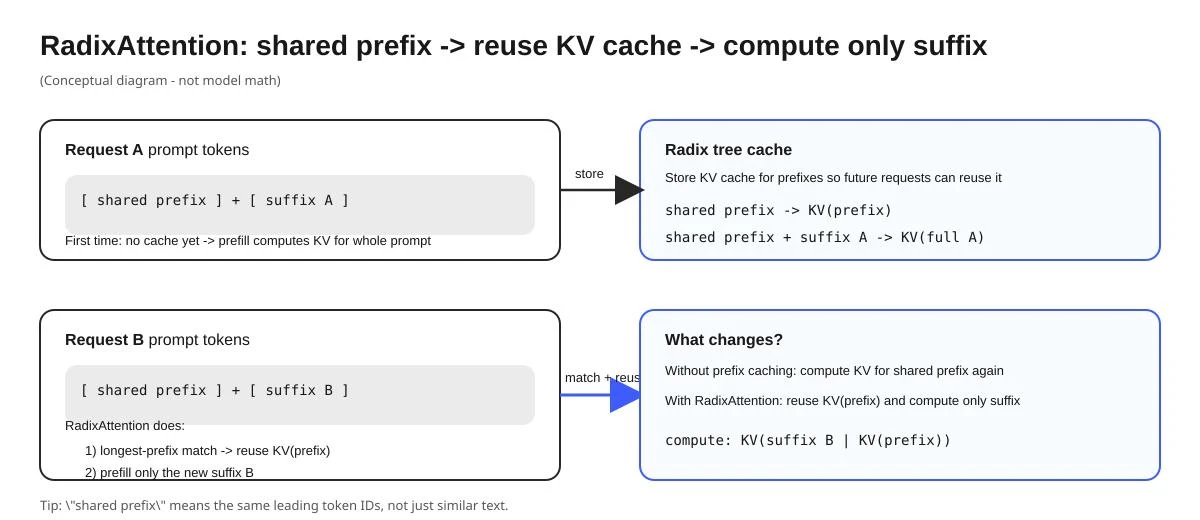
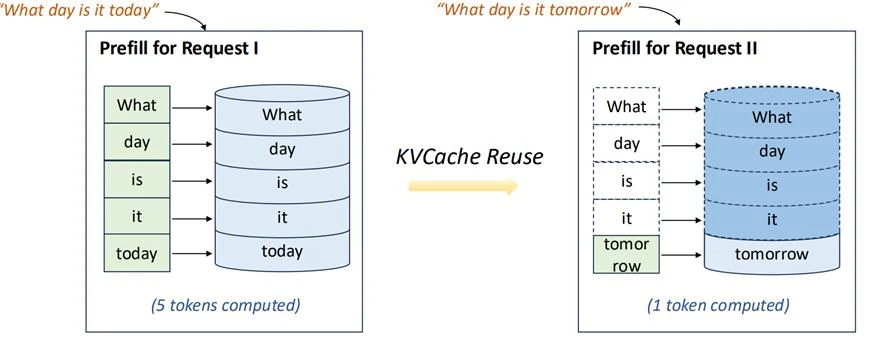
If PagedAttention optimized where we store the data, RadixAttention optimized what we compute. In real-world production, requests are rarely unique. Agents, RAG (Retrieval-Augmented Generation) pipelines, and chatbots often repeat the same initial system instructions or context prefixes.
The Radix Tree Architecture
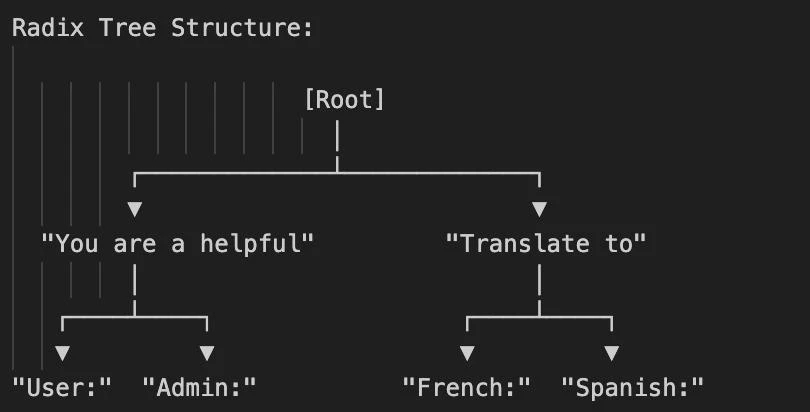
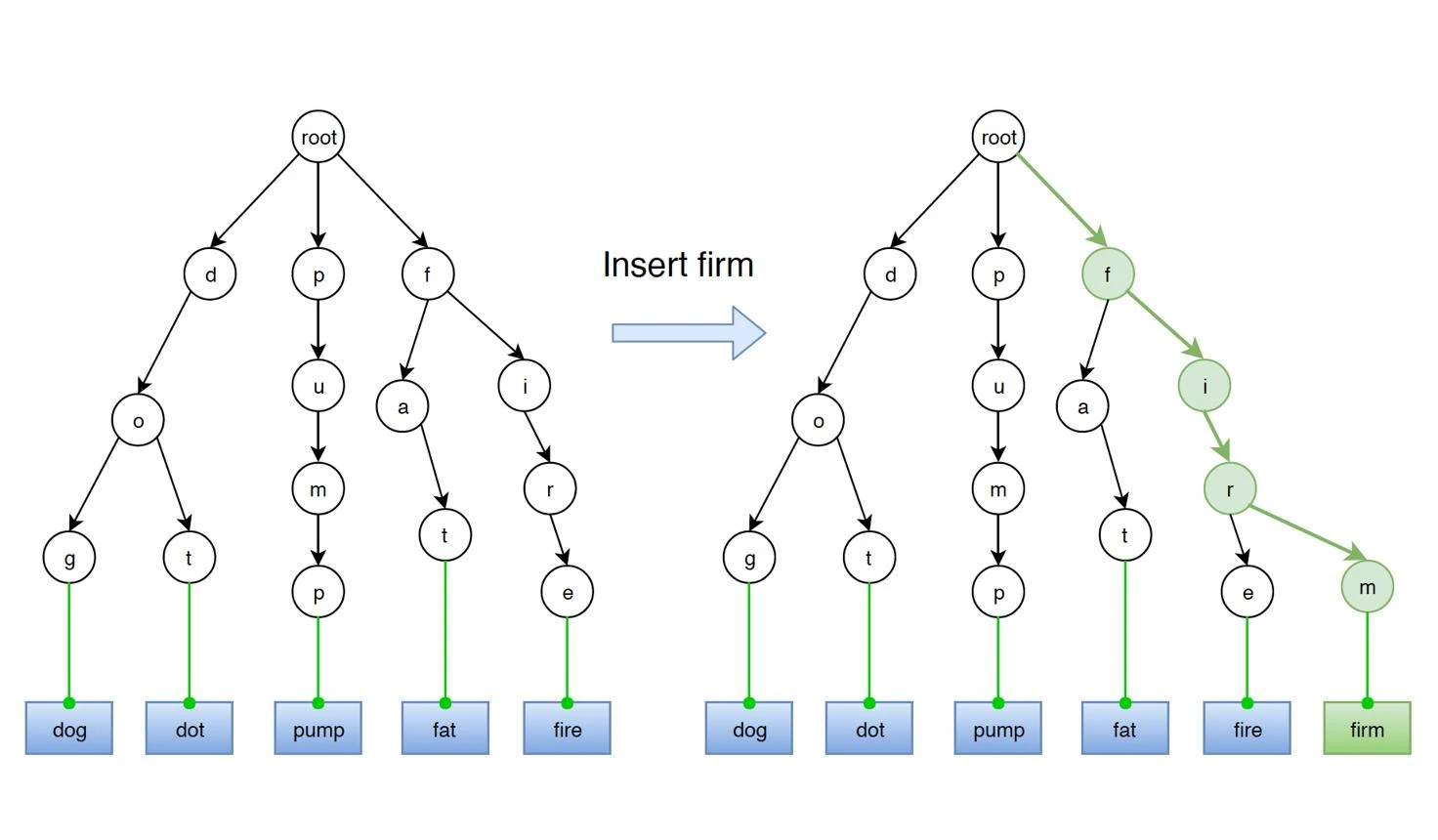
RadixAttention treats the KV cache not as a disposable buffer, but as a persistent radix tree. Each edge in the tree represents a sequence of tokens. When a new request arrives:
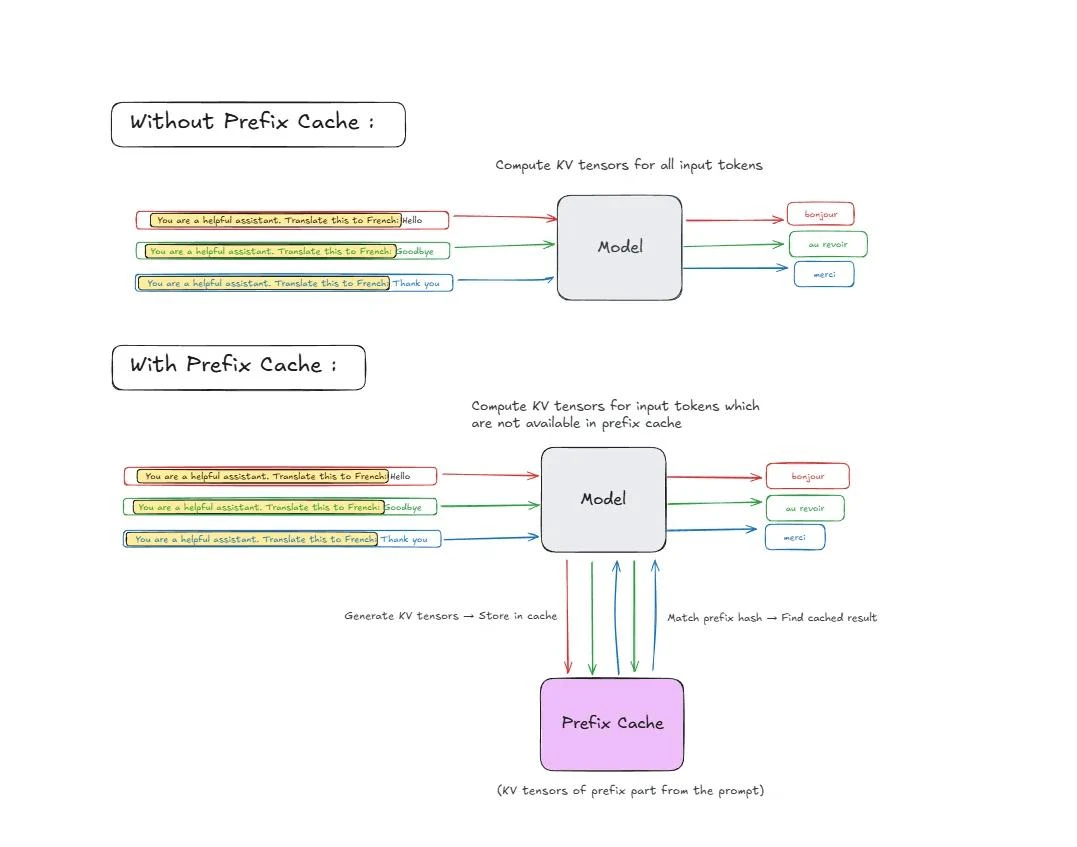
- Longest Prefix Matching: The engine traverses the tree to find the longest existing sequence that matches the incoming prompt.
- Partial Recomputation: If 90% of the prompt exists in the cache, the system skips the prefill for those tokens entirely, computing only the remaining 10% (the "suffix").
- Insertion: After generation, the new path is inserted into the tree, becoming a potential starting point for future requests.
This innovation drastically reduces the "Time to First Token" (TTFT), the most critical metric for user-facing applications.
Comparative Analysis: Paged vs. Radix
While often discussed in tandem, their roles are distinct. PagedAttention is the foundation (memory management), while RadixAttention is the optimizer (computation management).
| Feature | PagedAttention | RadixAttention |
|---|---|---|
| Primary Goal | Minimize Fragmentation | Eliminate Redundant Prefill |
| Data Structure | Block Table | Radix Tree |
| Core Benefit | Higher Concurrency | Lower TTFT |
| Scope | Physical Memory Layout | Semantic Prefix Cache |
Implications for Production Infrastructure
The adoption of these technologies has necessitated a total overhaul of the serving stack.
Cache-Aware Routing
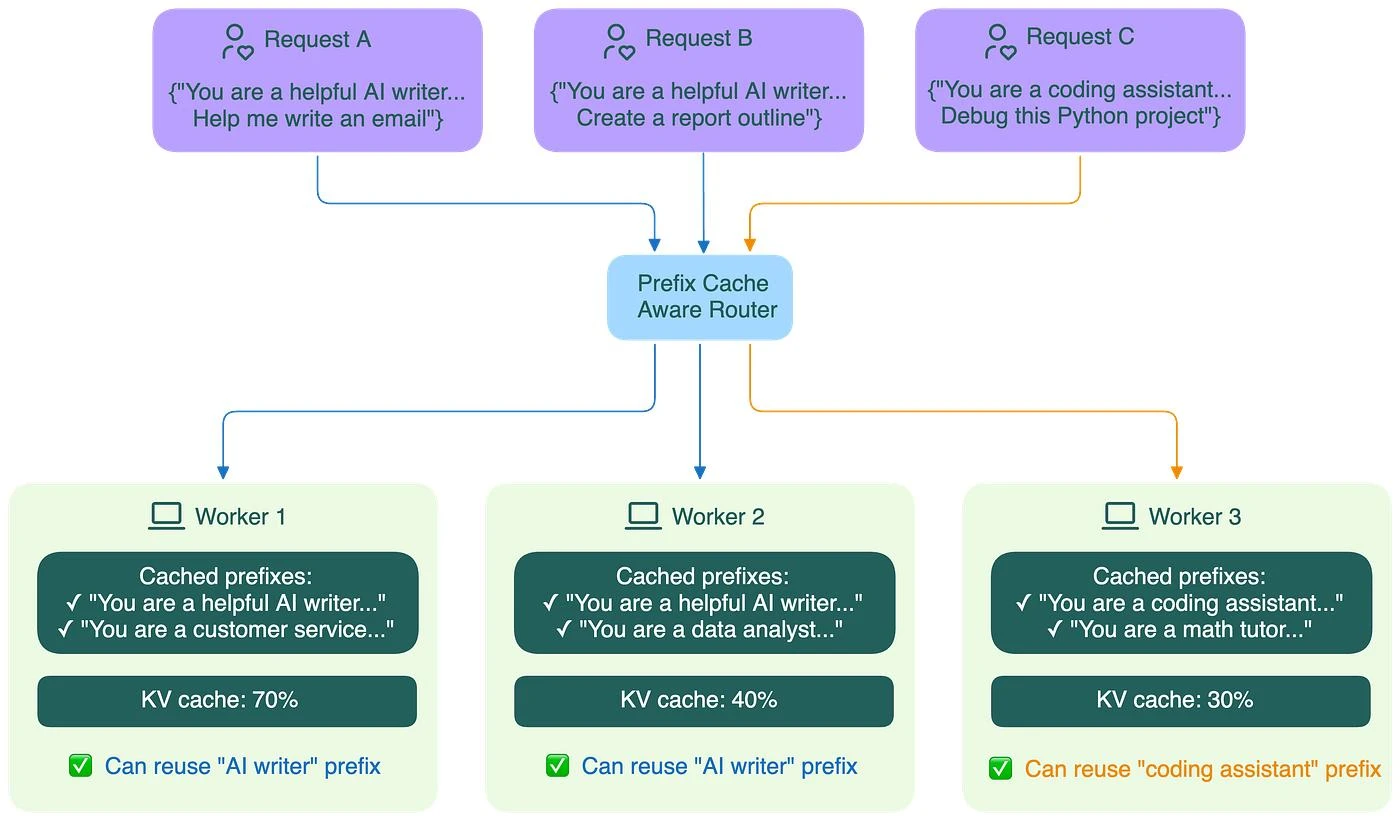
In distributed environments, load balancing is no longer just about CPU/GPU usage; it is about "cache locality." Advanced routers now direct requests to the specific GPU replica that holds the cached prefix for that user, preventing cache misses that would otherwise negate the performance gains of RadixAttention.
Security and Data Privacy
A critical, often overlooked implication is the "side-channel attack" vector. Because prefix caching stores data across user sessions, an attacker could potentially measure latency differences to infer whether a specific prompt was previously processed. To mitigate this, modern frameworks implement "cache salting," ensuring that keys are tied to specific tenant IDs, effectively walling off private data while maintaining the speed benefits of shared prefixes.
Hierarchical Caching
As context windows grow to millions of tokens, even the most efficient VRAM usage hits a wall. The current frontier is Hierarchical KV Caching, where engines treat GPU VRAM as an "L1" cache, host RAM as "L2," and remote storage as "L3." This tiered approach allows for massive, persistent context windows that appear instantaneous to the end-user.
Conclusion
The evolution of LLM serving is a story of moving away from brute-force computation toward intelligent, structured management of memory. PagedAttention and RadixAttention have transformed the KV cache from a bottleneck into a strategic asset.
For developers, the takeaway is clear: the architecture of the serving engine is now as important as the model weights themselves. By leveraging these technologies, companies can scale their AI services more efficiently, reduce latency for users, and unlock the ability to serve increasingly complex, long-context agents. As we look toward the future, the integration of these caching layers into hardware-level virtualization and distributed storage will likely define the next generation of high-performance AI infrastructure.
Frequently Asked Questions (FAQ)
Q1. Does PagedAttention change the model’s output quality?
No. PagedAttention is a memory management technique that preserves the exact same logic as a contiguous memory allocation. It only changes how the data is stored in VRAM.
Q2. Can I use RadixAttention without PagedAttention?
While you could theoretically implement a prefix cache without paged memory, it would be inefficient. You would likely encounter massive memory fragmentation, as you would be unable to easily manage the variable-length blocks required by different prompt prefixes. They are designed to work together.
Q3. How does Chain Hashing differ from a Radix Tree?
Chain Hashing (used in vLLM) uses cryptographic hashes to identify unique sequences of KV blocks. While both achieve prefix caching, the Radix Tree is often better suited for deeply branching conversational structures, whereas Chain Hashing provides a highly performant, distributed-friendly lookup for high-volume shared prefixes.
Q4. What is the biggest risk of prefix caching?
The biggest risk is the potential for data leakage via side-channel attacks. Without proper "salting" or tenant-isolation, a malicious actor could theoretically determine if a sensitive prefix has been cached by another user based on response latency. Always ensure your serving framework supports tenant-specific cache keys.