
Executive Summary
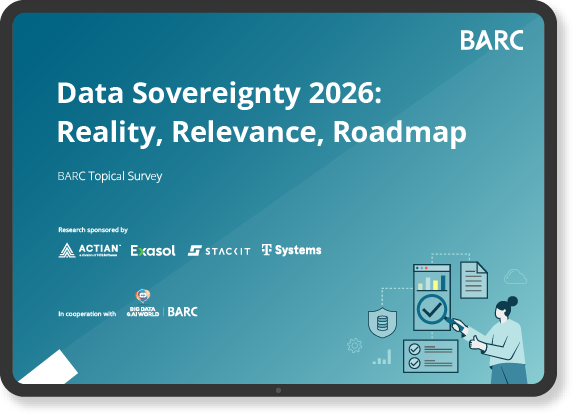
In an era where data is the undisputed lifeblood of the modern enterprise, the concept of "Data Sovereignty" has undergone a radical transformation. No longer merely a bureaucratic checkbox for compliance officers or a defensive measure against GDPR-related litigation, data sovereignty has matured into a critical strategic pillar. According to the newly released BARC study, "Data Sovereignty 2026: Reality, Relevance, Roadmap," organizations worldwide are pivoting toward a model where control over data infrastructure is synonymous with the ability to innovate securely.
Surveying 320 global organizations, the BARC report highlights a tectonic shift: businesses are moving away from passive data management and toward a proactive, architecture-led approach to sovereignty. This is the new baseline for operating data- and AI-driven processes at an acceptable risk threshold.
1. The Evolution of Data Sovereignty: From Compliance to Strategy
For years, the discourse surrounding data sovereignty was dominated by legal frameworks and jurisdictional disputes. Companies viewed the storage of data within specific geographic borders as a burdensome requirement imposed by regulators. However, the 2026 research indicates that this narrative is obsolete.
In the face of rapidly advancing Artificial Intelligence (AI) and Machine Learning (ML) deployment, the reliance on third-party cloud service providers has created a paradox: businesses want the scalability of the cloud but the autonomy of on-premise systems. Sovereignty is now the bridge between these two worlds. It encompasses the ability to control the lifecycle, access, and portability of data, ensuring that an organization—not a vendor—retains the ultimate authority over its most valuable asset.
Why 2026 is a Turning Point
The maturation of Generative AI has accelerated this trend. When enterprises feed proprietary data into Large Language Models (LLMs), the risk of data leakage or unintended model training becomes a board-level concern. Consequently, sovereignty is now being treated as a "strategic condition" for competitive advantage.
2. A Chronology of the Sovereign Shift
To understand the current landscape, one must look at the trajectory of the last five years:
- 2021–2022: The Awakening. Enterprises began grappling with the implications of the Schrems II ruling, realizing that transatlantic data transfers were legally precarious. Data localization became a defensive posture.
- 2023–2024: The Cloud Conflict. As AI adoption exploded, organizations faced a dilemma. Using global hyperscalers provided the best technical tools, but often at the cost of "vendor lock-in" and decreased control over data residency.
- 2025: The Rise of Sovereign Clouds. Major cloud providers began offering dedicated "sovereign cloud" regions, specifically designed to meet European and other regional regulatory standards. The market started to move from "either/or" to "and/also."
- 2026: The Roadmap to Resilience. The current year marks the consolidation of these efforts. Data sovereignty is now embedded into the R&D and procurement cycles of major enterprises, rather than being an afterthought of the IT security department.
3. Supporting Data: What the Survey Tells Us
The BARC survey of 320 global organizations provides quantitative evidence of this strategic pivot.
Key Findings:
- Risk Mitigation: 78% of respondents identified "acceptable risk" as the primary driver for implementing new data sovereignty frameworks. This represents a 15% increase from just two years prior.
- The AI Factor: Over 65% of companies reported that their AI roadmap is directly dependent on their ability to enforce data sovereignty. Without clear control, these companies are pausing the rollout of high-value, data-intensive AI models.
- The Cost of Inaction: Organizations that fail to address sovereignty are reporting a higher incidence of project abandonment. The complexity of retrofitting compliance into existing data architectures is cited as the leading cause of "stalled innovation."
These figures suggest that sovereignty is no longer a "nice-to-have." It is the architectural foundation upon which the future of AI-driven profitability is built.
4. Industry Perspectives and Expert Analysis
The insights provided by the research team at BARC, including Senior Analyst Timm Grosser and CEO Dr. Carsten Bange, underscore the necessity of a holistic approach.
The Analyst Perspective
Timm Grosser notes that the definition of sovereignty is expanding. "It is not just about where the data sits, but who can access it, how it is encrypted, and whether the provider can be compelled to reveal it," Grosser explains. "We are seeing a move toward ‘technical sovereignty,’ where encryption keys are managed by the client, ensuring that even the cloud provider cannot access the raw data."
The Executive Outlook
Dr. Carsten Bange, who has spent over 25 years guiding organizations through technological transformation, emphasizes that the cultural shift is as significant as the technical one. "Successful companies are those that treat data sovereignty as a business enabler. When you have full control over your data, you gain the confidence to integrate it into complex, cross-functional AI processes. It turns the fear of ‘data loss’ into the confidence of ‘data leverage’."
5. Strategic Implications for the Enterprise
What does this mean for the average data-driven enterprise? The implications are threefold:
A. Architectural Re-design
Organizations are moving away from monolithic data lakes hosted by a single provider. The trend is toward "federated data architectures," where data remains in its region of origin while being processed by centralized AI engines. This requires a significant investment in data virtualization and orchestration layers.
B. Vendor Management
Procurement processes are changing. Software vendors and service providers are now being evaluated not just on their feature sets, but on their "sovereignty certifications." Providers that cannot offer transparency into their data processing workflows are being systematically de-prioritized.
C. Governance as a Competitive Advantage
The ability to demonstrate rigorous data control is becoming a sales tool. In B2B markets, customers are increasingly asking their vendors, "Where is my data, and who has access to it?" Firms that can answer this with a robust, documented sovereignty framework are winning trust—and business—over competitors who rely on opaque legacy systems.

6. The Roadmap: How to Move Forward
For organizations looking to navigate this landscape, the BARC report outlines a clear, phased roadmap:
- Inventory and Classification: Before sovereignty can be enforced, it must be mapped. Companies must identify which data assets are critical, which are sensitive, and which are subject to specific regulatory regimes.
- Define the Risk Threshold: Not every piece of data requires the same level of sovereign protection. Organizations must adopt a risk-based approach to avoid over-engineering solutions that hinder agility.
- Invest in Sovereign Tooling: This includes exploring confidential computing, hardware-based encryption, and local cloud instances.
- Cultural Alignment: Sovereignty is a collaborative effort between Legal, IT, and Business Units. Breaking down the silos that separate these departments is the final, and often most difficult, step.
Conclusion
As we look toward the remainder of 2026 and beyond, the message from the research is clear: Data sovereignty is the bedrock of the modern, AI-augmented enterprise. It is a complex, multi-dimensional challenge, but it is also an opportunity to build a more secure, transparent, and innovative organization.
By shifting from a reactive compliance mindset to a proactive, strategic posture, leaders can ensure that their data remains their own—and that their AI ambitions are built on a foundation that is as resilient as it is revolutionary.
For further insights and to access the full survey results, professionals are encouraged to engage with the complete BARC report and join the growing community of data leaders at BARC.
About the Author(s):
Timm Grosser is a Senior Analyst at BARC, specializing in the intersection of data strategy, governance, and technology architecture. Dr. Carsten Bange is the CEO and founder of BARC, providing strategic counsel to global enterprises on the transformation into data-driven organizations.