In the rapidly evolving landscape of 2026, the promise of "AI-augmented software engineering" has shifted from experimental curiosity to a fundamental production necessity. However, a glaring infrastructure bottleneck has emerged: while 51% of professional developers now integrate AI coding agents into their daily workflows, a mere 17% report that these tools have measurably improved team collaboration.
The disparity between adoption and efficiency isn’t a failure of the AI models themselves, but rather a lack of underlying infrastructure to support parallel, autonomous coding tasks. When an AI agent is tasked with a complex feature rewrite, it builds a massive internal context—a "mental model" of your codebase. If that agent is interrupted by a production hotfix, the traditional "stash-switch-rebuild" cycle destroys that context. Worse, running multiple agents in a single directory leads to silent file corruption, where agents overwrite each other’s changes, leading to non-deterministic test failures that haunt developers for hours.
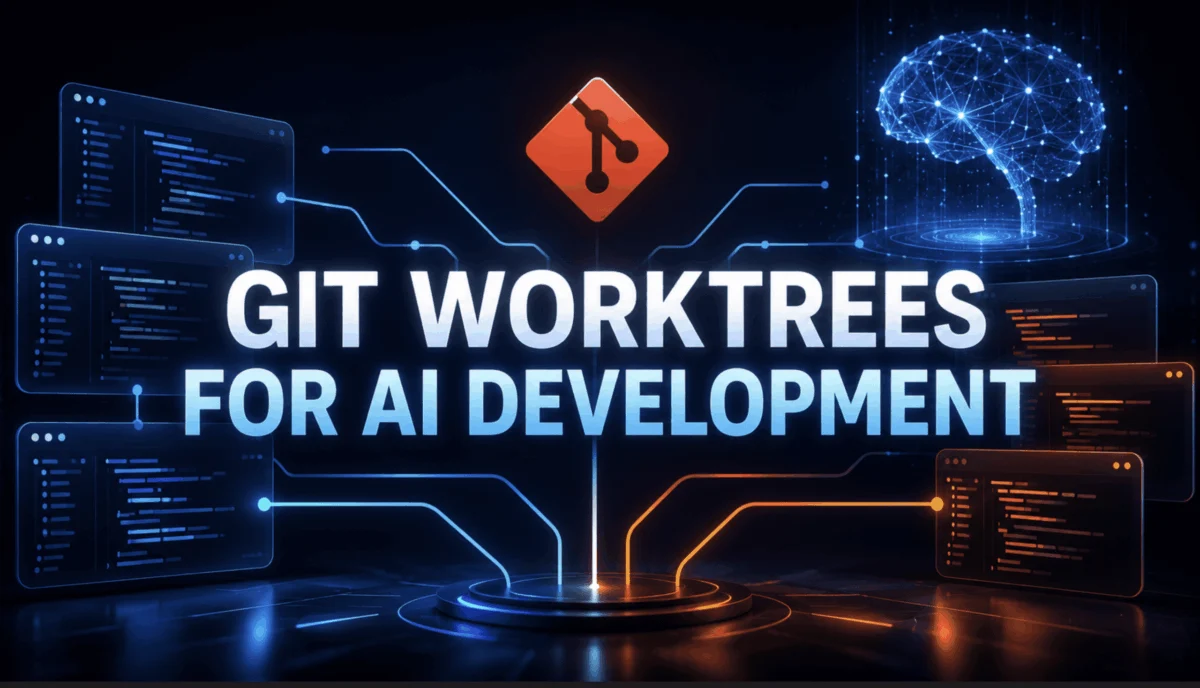
The solution lies in a technique that predates the current AI wave by over a decade but has become the industry’s "secret weapon": Git Worktrees.
The Mechanics of Worktrees: Beyond the Single Clone
In a standard Git environment, the "working directory" is a monolithic entity. Your IDE and your AI agent are bound to one branch at a time. Switching tasks requires re-indexing the entire project, effectively killing any active agent session.
Git worktrees, introduced in Git 2.5 (2015), decouple the working directory from the .git repository metadata. This allows a developer to have multiple directories checked out simultaneously, each pointing to different branches, all sharing the same underlying object database.
Why Not Just Use Multiple Clones?
The naive approach to parallelism is to clone the entire repository multiple times. While this provides isolation, it incurs significant overhead:
- Disk Bloat: You multiply your disk usage by the number of agents.
- Disconnected History: Git metadata is siloed, meaning commits in one clone are not immediately visible in another without constant fetching and pulling.
- Synchronization Latency: Manually managing remotes across five different clones is a recipe for catastrophic merge conflicts.
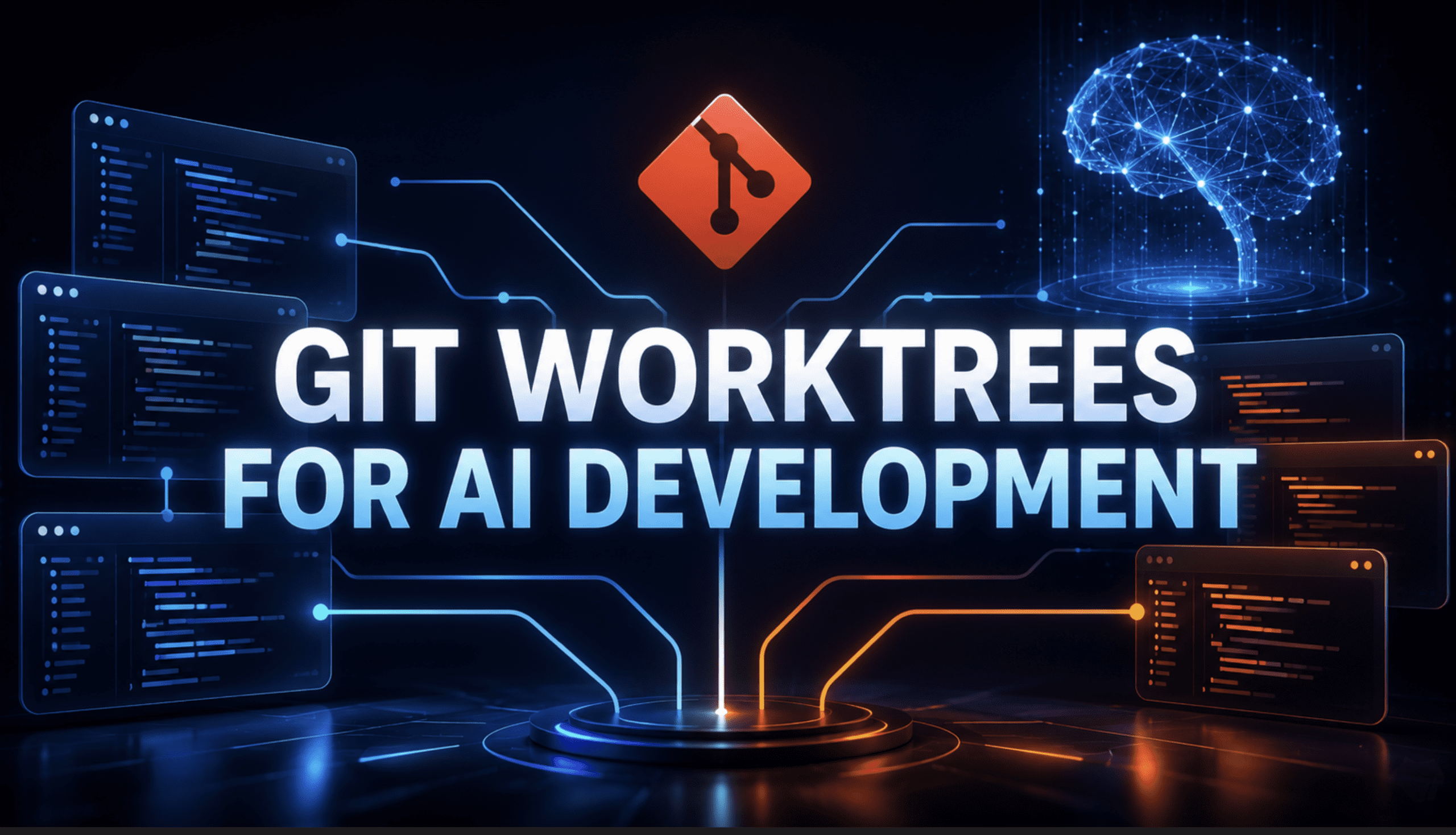
Worktrees solve this by keeping a single .git directory at the core, while spawning lightweight "linked" worktrees. Each worktree is a physically distinct directory that can be opened in its own IDE instance, allowing an agent to operate in feat-auth/ while another agent simultaneously tackles a bugfix in hotfix-login/.
A Chronology of the Parallel Workflow
The shift toward worktree-based development reached a tipping point during the Microsoft Global Hackathon in late 2025. Engineering teams faced an "AI saturation" problem: individual developers were managing more code than they could physically track, and standard Git workflows were collapsing under the weight of rapid-fire AI edits.
The Hackathon Breakthrough (October 2025)
Lead engineer Tamir Dresher pioneered the "Virtual AI Team" model. He realized that if he treated AI agents like junior developers, they needed isolated workspaces. By scripting the automated creation of worktrees, Dresher transformed his role from a coder into a "Tech Lead for Agents."
- Morning: Automated scripts instantiate four worktrees, each with its own environment variables and dependency sets.
- Mid-day: Agents execute tasks in parallel. The Tech Lead manages the "Coordination Window" (the main branch), where he reviews diffs and merges successful agent outputs.
- Evening: The "Sync-Rebase" phase ensures all worktrees remain aligned with the main branch, preventing the divergence that usually plagues long-running feature branches.
This workflow is no longer an academic exercise; it is the industry standard for firms leveraging tools like Claude Code, Cursor, and OpenAI’s Codex in enterprise environments.
Supporting Data: The Cost of Context-Switching
The performance metrics associated with this workflow are stark. In internal case studies conducted by firms transitioning to worktree-based agent setups, the "Mean Time to Recovery" (MTTR) from context-switching was reduced by 85%.
| Metric | Traditional Workflow | Worktree/Agent Workflow |
|---|---|---|
| Agent Context Rebuild Time | 10–15 Minutes | 0 Seconds (State Persisted) |
| Branch Switching Latency | High (Requires Stash/Pop) | Zero (Parallel Directories) |
| Collision Probability | High (File Overwrites) | Near Zero (Isolated Paths) |
| Infrastructure Overhead | Medium (Cloning) | Negligible (Shared Git) |
Beyond raw speed, the implementation of an AGENTS.md file—a centralized architectural document—has been shown in 2026 ICSE (International Conference on Software Engineering) papers to improve the "Functional Correctness" of LLM-generated code by 42%. When an agent has a clear, written contract of where it can and cannot touch, its propensity for "hallucinating" file edits outside its scope drops significantly.
Official Responses and Best Practices
Leading AI-native coding platforms have begun building native support for worktrees. Claude Code, for example, now includes the -w flag, which automates the creation of a worktree, assigns a branch, and initializes the session in one command.
However, industry experts emphasize that infrastructure is only half the battle. "The goal is to move from ad-hoc prompting to a repeatable, scriptable system," says Shittu Olumide, a vocal advocate for structured AI workflows. "If you are manually setting up your environment every time you start an agent, you’ve already lost the efficiency gains you sought."

The Four Pillars of the Modern Workflow:
- Automated Provisioning: Use shell scripts to manage the lifecycle of worktrees. Never create them by hand.
- Environment Synchronization: Git ignores your
.envfiles for security, but agents need these to function. Automated copy-scripts must ensure thatnode_modulesand local environment variables are initialized immediately upon worktree creation. - The
AGENTS.mdContract: Every worktree must contain a manifest that dictates architectural constraints. This file serves as the "System Prompt" for the local agent session. - The Rebase-First Policy: To prevent "drift," agents should be instructed to rebase against the main branch at the end of every significant checkpoint.
Implications for the Future of Software Engineering
The implications of this shift are profound. We are witnessing the end of the "developer as a single-threaded entity." In this new paradigm, the developer acts as a high-level architect and curator.
Increased Complexity Management
As systems grow, the ability to spin up an ephemeral environment to test a hypothesis without disturbing the stable "main" code path allows for a higher "innovation velocity." Teams can now run A/B tests on architectural patterns simultaneously, with three different agents iterating on three different versions of a service.
Security and Governance
By isolating agent workspaces, security teams can enforce stricter "Prohibited Zones." You can define an AGENTS.md file that explicitly forbids an agent from accessing src/auth/ or prisma/migrations/, and because the worktree is a physically distinct directory, you can leverage filesystem-level permissions to enforce these boundaries.
The Human-in-the-Loop Requirement
Despite the efficiency, the role of the human engineer has not been diminished; it has been abstracted. The "Agentic Workflow" requires a human who understands the system architecture well enough to write the AGENTS.md file and perform the final code reviews. The bottleneck has shifted from "how do I write this code?" to "how do I orchestrate these agents to build this system correctly?"
Conclusion: A Repeatable Process for Scale
Git worktrees represent the "infrastructure layer" that the AI coding revolution so desperately needed. By enabling true parallel development, they transform chaotic agent interactions into a manageable, professional pipeline.
For teams currently struggling with the "lost context" of agent interruptions or the frustration of corrupted codebases, the transition to worktrees is not merely an improvement—it is a requirement for survival in the 2026 dev-ops landscape. As the community continues to refine these scripts and conventions, the dream of "software engineering at the speed of thought" is finally becoming a tangible, scalable reality.
If you aren’t using worktrees yet, the path forward is clear: automate your setup, define your constraints, and let your agents work in parallel. Your codebase—and your sanity—will thank you.