As the second term of the Donald Trump administration intensifies its focus on aggressive immigration enforcement, a new survey from the Pew Research Center reveals that public sentiment toward Immigration and Customs Enforcement (ICE) has reached a new nadir. With the agency serving as the primary vehicle for the administration’s declared mission to curb what the President has termed an "invasion" of criminals, the American public has increasingly turned against the organization.
According to the data, a majority of Americans (56%) now hold an unfavorable opinion of ICE, while only 35% view the agency favorably. This makes ICE the least popular of the 12 major federal agencies evaluated in the survey, which was conducted between September 28 and October 4, 2026, among a representative sample of 5,062 U.S. adults.
The Context: A Nation Divided by Enforcement
The decline in public favorability is not limited to a single demographic or political ideology. While a significant partisan divide persists, the downward trend in approval is broad-based, suggesting that the administration’s "zero-tolerance" deportation strategy is polarizing the electorate even further.
The Trump administration’s second-term agenda has been explicitly built upon the promise of mass deportations. By framing the presence of undocumented immigrants as a national security and criminal justice crisis, the White House has prioritized the expansion of ICE’s operational footprint. However, this high-visibility approach has seemingly come at a cost to the agency’s public image, as the visual reality of courtroom sweeps and increased detention activities dominates the national discourse.

Chronology of Declining Support
The trend of declining favorability is not an overnight phenomenon but the result of a steady drift over the past 12 months.
- 2025 – The Baseline: One year ago, the agency held a higher standing with the public. At that time, 40% of Americans viewed ICE favorably, while 49% held an unfavorable view. The divide was already significant, but the "not sure" category (10%) provided a buffer that has since narrowed.
- Early 2026 – Escalation: As the administration’s rhetoric hardened, so did the agency’s tactics. Throughout the spring of 2026, reports of heightened enforcement in major metropolitan areas, such as the March 17 operation at the New York Federal Plaza Immigration Court, began to shift public perception.
- Late 2026 – The Current Reality: The most recent data confirms that 56% of the public now views the agency unfavorably—a 7-percentage-point increase in negative sentiment in just one year.
Supporting Data: Partisan and Racial Disparities
The survey highlights a deep chasm between Republicans and Democrats, yet perhaps more telling is the erosion of support within the Republican base itself.
The Partisan Divide
Two-thirds (67%) of Republicans and Republican-leaning independents currently view ICE favorably. While this remains a strong majority, it represents a decline from 72% a year ago. Among Democrats and Democratic-leaning independents, the sentiment is overwhelmingly negative: 84% express an unfavorable view, up from 78% in 2025.
Racial and Ethnic Perspectives
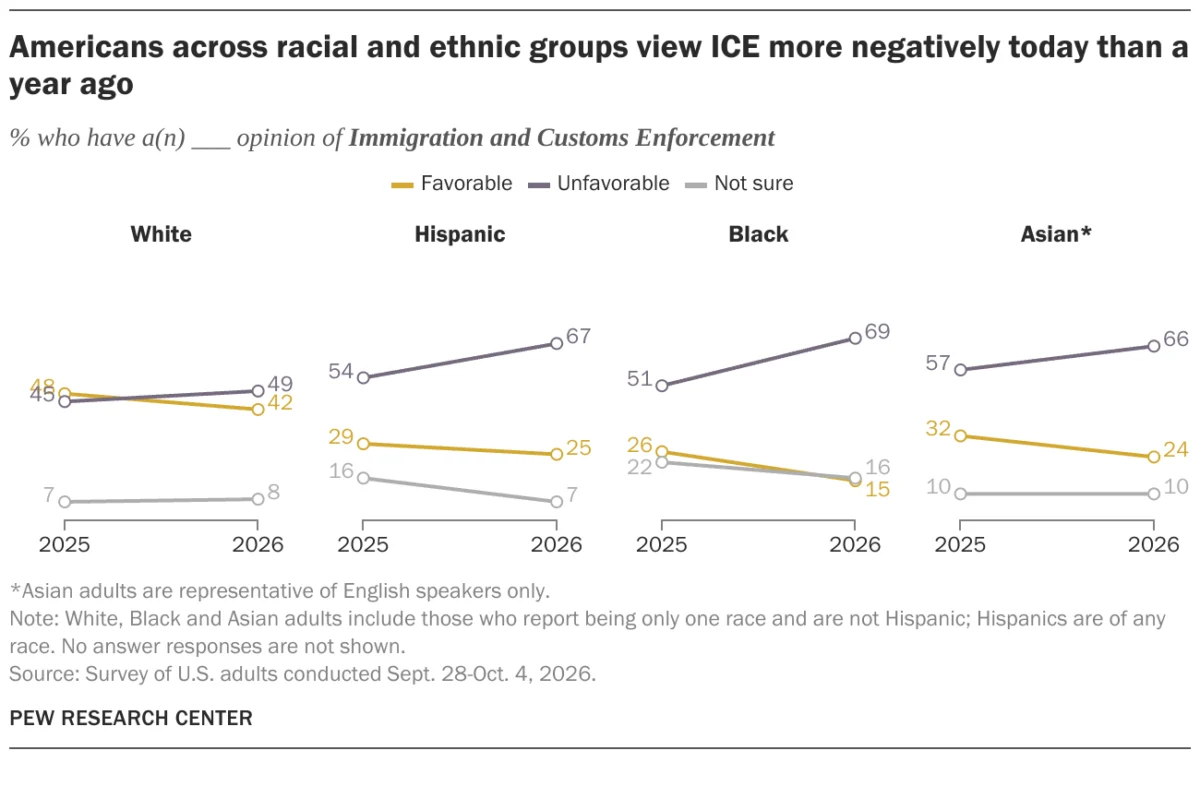
The negative shift is remarkably consistent across racial and ethnic lines, though the intensity varies.

- Black Adults: 69% now hold a negative view of ICE, a significant rise in opposition.
- Hispanic Adults: 67% view the agency unfavorably, compared to 54% a year ago.
- Asian Adults: 66% hold a negative opinion, up from 57%.
- White Adults: While they remain the most likely group to hold a favorable view, they are not immune to the trend. Nearly half (49%) now express an unfavorable opinion, up from 45% last year, while positive ratings have dropped from 48% to 42%.
Nuance in Political Alignments
Even when controlling for race, the partisan divide remains the most potent predictor of sentiment. White Republicans remain the strongest supporters of the agency, with 71% holding a favorable view. Conversely, 89% of White Democrats, 82% of Asian Democrats, and 79% of Hispanic Democrats hold an unfavorable view. Interestingly, Hispanic Republicans are more divided, with 53% favorable and 39% unfavorable, indicating that the immigration debate is nuanced even within communities that have historically been the target of enforcement actions.
Official Responses and Administrative Stance
The White House has remained steadfast in its support for the agency. Despite the cooling public reception, administration officials have frequently argued that public opinion polls do not account for the "necessity of law and order." In press briefings throughout the autumn of 2026, spokespeople have doubled down on the narrative that the agency is merely performing its statutory duty to protect American communities.
"The mission of ICE is not to be a popular institution; it is to be an effective one," a senior administration official stated during a briefing on immigration enforcement. "The President was elected on a mandate to secure our borders and remove those who are here illegally. We are fulfilling that mandate regardless of the political winds."
Conversely, civil rights organizations and immigrant advocacy groups have utilized these polling numbers to bolster their arguments against the administration’s policies. Many point to the record-low approval ratings as evidence that the public, regardless of their political affiliation, is becoming increasingly uncomfortable with the methods employed by the agency.

Implications for the Future
The implications of this polling data are far-reaching as the nation approaches the next legislative cycle.
1. Legislative Scrutiny
With public favorability at such a low ebb, congressional Democrats are likely to increase their oversight of the Department of Homeland Security and ICE. We can expect more committee hearings, budget-related challenges, and demands for transparency regarding detention conditions and enforcement tactics.
2. The 2027 Political Climate
The 2026 midterm results, heavily influenced by the immigration debate, suggest that the issue remains a double-edged sword. While the administration believes "law and order" messaging wins votes, the broad-based decline in support for the agency suggests that there is a growing segment of the electorate—including independents—that is becoming alienated by the current trajectory of immigration policy.
3. Institutional Morale
The role of a federal agency is often complicated when it becomes a lightning rod for political controversy. The internal culture of ICE, and its ability to recruit and retain staff, may be impacted by the negative public perception. When an agency’s mission is perceived as being in direct conflict with the values of a majority of the population, it creates a challenging work environment for career civil servants and law enforcement officers.

4. Policy Adjustments
While the administration is unlikely to abandon its core policy platform, it may face pressure to adjust its messaging or tactics to mitigate further loss of public trust. Whether this manifests as a shift toward "targeted enforcement" rather than broad, highly visible operations, or a greater emphasis on public relations, remains to be seen.
Conclusion
The data provided by the Pew Research Center serves as a critical thermometer for the American political climate. The fact that more than half of the country now views one of the federal government’s most powerful enforcement agencies negatively is a signal that the ongoing debate over immigration has transcended standard political lines. As the Trump administration continues to push its agenda, the struggle to reconcile operational goals with public sentiment will remain one of the defining challenges of this political era.
The divide, as evidenced by the numbers, is not just about immigration policy itself, but about the role of the state in executing that policy. Whether this trend continues to move downward or eventually plateaus depends on the administration’s ability to communicate the necessity of its actions to a skeptical and increasingly weary public.
Note: This article is based on a survey of 5,062 U.S. adults conducted by the Pew Research Center from September 28 to October 4, 2026. For further information, including full methodology and questionnaire details, please visit the Pew Research Center website.