By Financial News Desk
January 9, 2026
The U.S. residential construction sector is signaling a period of significant recalibration as the latest data from the Census Bureau reveals a contraction in housing starts for October. As the industry navigates a complex landscape of interest rate fluctuations, supply chain pressures, and broader economic volatility, the figures released this morning underscore the challenges facing developers and prospective homeowners alike.
According to the official report, privately-owned housing starts plummeted to a seasonally adjusted annual rate of 1,246,000 units in October. This figure represents a 4.6% decline from the revised September estimate of 1,306,000 and marks a significant 7.8% drop compared to the same month one year prior.
Main Facts: A Tale of Two Markets
The headline number—a total decrease in starts—masks a divergent reality between single-family homes and multi-family developments. While the aggregate numbers show a contraction, the underlying components tell a more nuanced story of market demand and builder confidence.
Single-family housing starts, which are often viewed as a bellwether for the broader residential real estate market, showed signs of resilience in October. Builders broke ground on single-family units at a seasonally adjusted annual rate of 874,000, representing a 5.4% increase over the revised September figure of 829,000. This uptick suggests that despite high borrowing costs, demand for individual homeownership remains a persistent driver of economic activity.
Conversely, the multi-family sector—defined as buildings containing five or more units—bore the brunt of the decline. With a rate of 347,000 starts in October, this segment experienced a notable month-over-month decrease. Industry analysts point to a saturation in certain urban apartment markets and tighter lending standards for commercial real estate development as primary culprits for this cooling trend.
Building permits, a leading indicator of future construction activity, remained largely stagnant, reflecting a cautious outlook among developers. Total authorizations for privately-owned housing units hit a seasonally adjusted annual rate of 1,412,000 in October, a marginal 0.2% decrease from September and 1.1% lower than October 2024 levels. Single-family authorizations also saw a slight contraction, dipping 0.5% to 876,000.
Chronology: The Road to October 2026
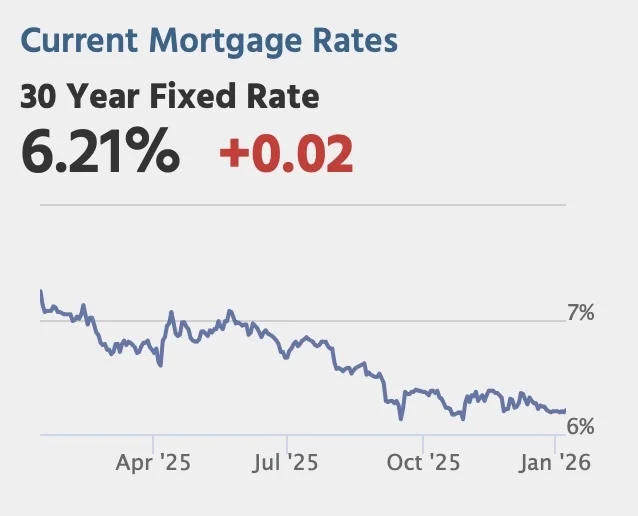
To understand the current state of the housing market, one must examine the trajectory of the preceding months. Throughout 2025, the construction industry struggled to find a sustainable equilibrium. The summer of 2025 saw a series of fluctuating permit applications as developers reacted to shifting signals from the Federal Reserve regarding the cost of capital.

By late August and September 2025, the market had begun to show signs of stabilizing, though the "revised" data released this month highlights that the volatility was more pronounced than initially estimated. The shift from September to October 2026 represents a critical junction; while single-family starts showed a brief recovery, the broader economic environment—compounded by ongoing federal fiscal challenges—has clearly chilled the appetite for larger, multi-unit projects.
Of particular note to economists is the "missing data" gap. Due to the ongoing government shutdown, statistics for November 2026 remain unavailable. This creates a data vacuum that complicates the ability of policy makers and market participants to determine if the October dip was an anomaly or the beginning of a prolonged downward trend.
Supporting Data: Historical Context and Trends
The provided data, when viewed through a historical lens, reveals that the housing market is currently performing well below the peaks observed during the post-pandemic construction boom.
Long-Term Analysis
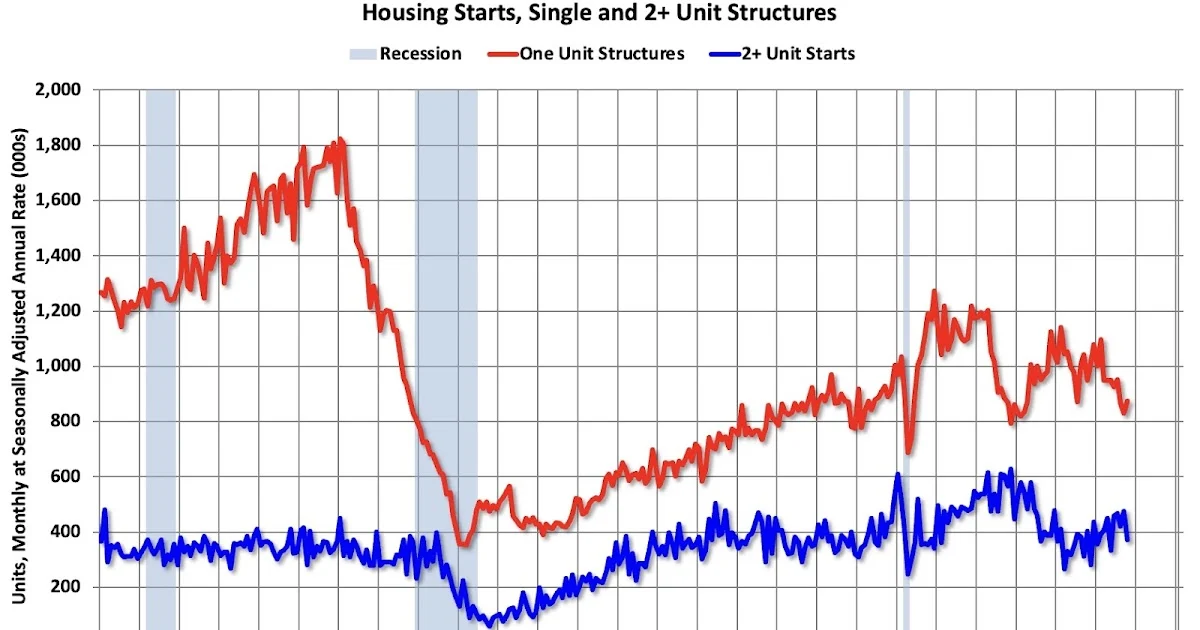
Looking at the data since 1968, the current rate of 1.246 million starts highlights a period of structural under-building relative to population growth. While the 2000s saw a massive explosion in residential construction, the post-2008 era, and particularly the 2024–2026 window, has been characterized by "stutter-step" growth.
The graphs provided by industry observers, such as Calculated Risk, illustrate that while single-family starts are attempting to claw back from previous lows, the multi-family sector (the blue-lined metric on long-term charts) has entered a period of contraction. Year-over-year, multi-family starts have declined by approximately 7.9%, a statistic that suggests institutional investors are increasingly wary of the current rental market outlook.
Comparative Metrics
| Category | October 2026 Rate | MoM Change | YoY Change |
|---|---|---|---|
| Total Starts | 1.246 Million | -4.6% | -7.8% |
| Single-Family Starts | 874,000 | +5.4% | -7.8% |
| Total Permits | 1.412 Million | -0.2% | -1.1% |
| Single-Family Permits | 876,000 | -0.5% | -0.5% |
Official Responses and Industry Sentiment
The lack of official guidance from federal agencies, necessitated by the government shutdown, has left a void in the public narrative. Without the standard commentary from the Department of Housing and Urban Development (HUD) or the Census Bureau, market analysts are filling the gap with cautious interpretation.
Industry groups, including the National Association of Home Builders (NAHB), have previously noted that the biggest hurdle to new construction is not necessarily a lack of demand, but a combination of labor shortages and the high cost of financing land development. "The math simply hasn’t worked for many developers," notes one senior analyst. "When you combine the cost of capital with the regulatory hurdles of new construction, the margin for error has shrunk to almost zero."
The consensus among private-sector economists is that the sector is currently in a "wait-and-see" mode. The resilience of the single-family segment suggests that potential buyers are still eager to enter the market, provided that inventory becomes available. However, the drop in multi-family permits suggests that the supply of new apartments, which helped cool rental inflation in 2024 and 2025, may be set to tighten significantly in the coming 18 to 24 months.

Implications: What This Means for the Future
The implications of the October housing data are multi-faceted and touch upon several pillars of the American economy.
1. The Rental Market Outlook
The contraction in multi-family starts is a double-edged sword. While it represents a lack of confidence among developers, it also suggests that the current surplus of luxury apartment units may be absorbed sooner than expected. If construction continues to slow, the vacancy rates for rentals could tighten again, potentially putting upward pressure on rents in late 2026 and 2027.
2. The Single-Family Inventory Crisis
The persistent year-over-year decline in single-family starts (down 7.8%) continues to exacerbate the chronic lack of existing home inventory. Because existing homeowners are "locked in" to low-interest rates from years prior, they are hesitant to sell, forcing buyers into the new-construction market. If builders cannot scale up production to meet this demand, home prices are likely to remain elevated, further challenging affordability.
3. Broader Economic Impact
Construction is a massive engine for employment and materials demand, including lumber, steel, and appliances. A sustained downturn in starts ripples through the entire supply chain. If the trend seen in October persists, we may see a softening in the manufacturing sector and potentially a rise in unemployment within the construction trades.
4. The Policy Gap
The government shutdown has significantly hampered the ability of the private sector to react to market changes with precision. Investors rely on high-frequency, reliable data to allocate capital. Without a clear picture of what transpired in November, the market is effectively operating in the dark. The return of federal data collection will be a critical inflection point for the housing sector.
Conclusion
As we look toward the remainder of the winter, the housing market stands at a crossroads. The October data is a clear warning that the momentum gained in previous months has been interrupted. The strength of the single-family market is a bright spot, but it is not sufficient to carry the industry on its own.
Until interest rates stabilize further and the broader economic climate—including the resolution of the current government shutdown—becomes clearer, the housing sector will likely remain in a state of flux. Stakeholders will be watching the next available reports with heightened scrutiny, hoping for a clearer signal that the foundational strength of the American housing market can withstand these current headwinds. For now, the narrative is one of caution, characterized by reduced activity and a watchful eye on the horizon.