As artificial intelligence continues to permeate the architecture of the American workplace, a complex and potentially concerning trend has begun to emerge. While public discourse has long been fixated on the "existential threat" of mass unemployment—the fear that robots will simply replace human labor—the reality of the past three years suggests a more nuanced, and perhaps more insidious, development: a widening gender gap in employment growth within AI-exposed sectors.
New research from the Pew Research Center, analyzing data from the U.S. Department of Labor and the Current Population Survey (CPS), indicates that the rise of generative AI is not affecting all workers equally. While overall employment in occupations with high AI exposure has grown rather than shrunk, that growth is being distributed unevenly. Specifically, men are seeing substantially more job growth in AI-exposed fields than their female counterparts.
Main Facts: The Unequal Growth of the AI Era
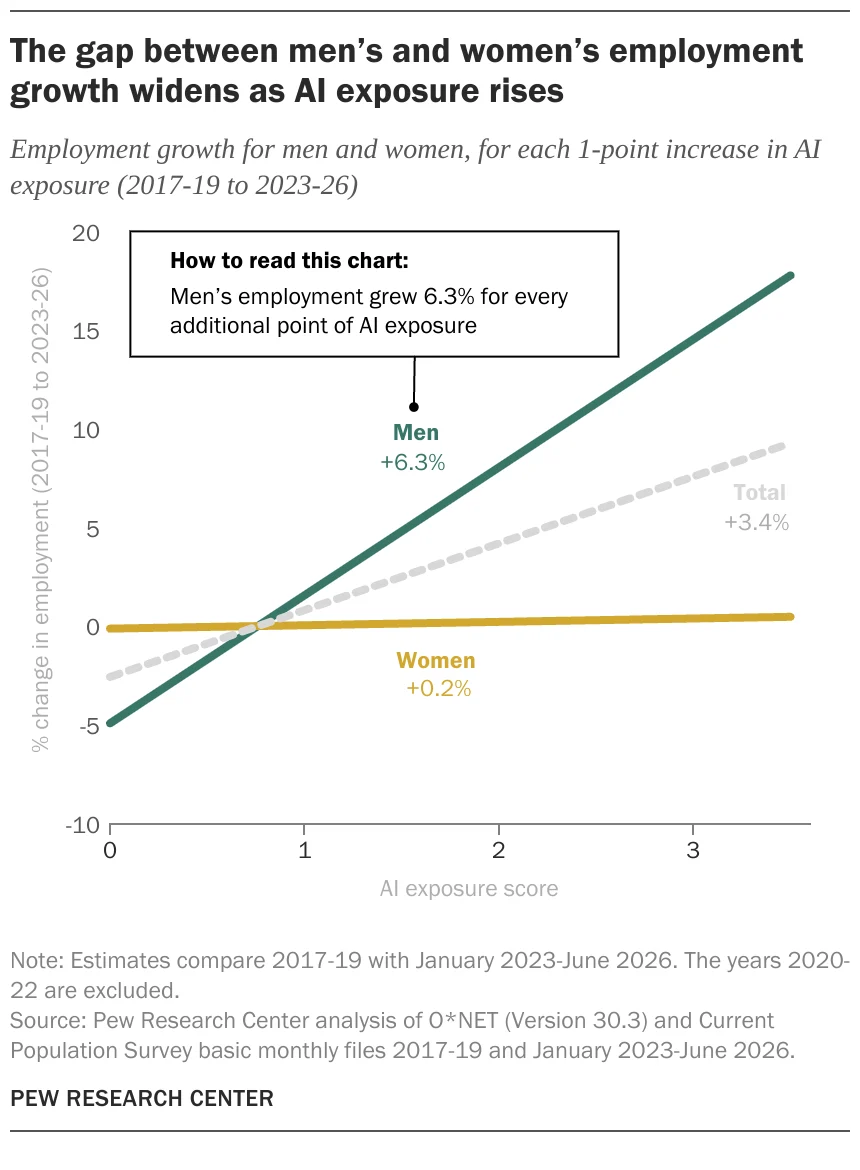
The core finding of this research is striking: for every 1-point increase in an occupation’s AI exposure score, men’s employment grew by 6.3%, while women’s employment remained virtually stagnant, showing a negligible change of 0.2%.
This divergence is not merely a statistical anomaly; it represents a fundamental shift in how different segments of the labor force are interacting with new technologies. AI exposure, as defined by the Occupational Information Network (O*NET), measures the extent to which generative AI can perform or assist with the critical tasks required in a specific profession. Occupations such as software development, financial management, and accounting—roles that involve heavy information processing—rank high on this scale. Conversely, roles in construction, manual labor, or specialized physical care rank low.
The data suggests that as we moved from the pre-generative AI landscape of 2017–2019 into the current era (2023–2026), the labor market has favored men in the high-exposure categories. This creates a "growth gap" that expands in direct proportion to how much a job relies on AI-capable tasks.
Chronology: Defining the "Before" and "After" of Generative AI
To understand the impact of AI, researchers established a clear chronological baseline, excluding the turbulent years of the COVID-19 pandemic (2020–2022) to ensure the findings reflected technological shifts rather than pandemic-induced economic shocks.
The Baseline (2017–2019)
During this period, generative AI was largely in its infancy. Large language models were not yet ubiquitous in enterprise software, and the "AI-exposed" job market looked very different. Employment patterns were largely driven by traditional economic cycles, and the rapid, widespread adoption of tools like ChatGPT or Claude had not yet forced a reassessment of daily workflows.
The Transitional Gap (2023–2026)
Following the wide-scale commercial release of advanced generative models, the workplace began to change. The current analysis compares these recent years to the 2017–2019 baseline. During this window, the integration of AI became a competitive necessity for many firms. The research tracks the net change in the number of people employed in specific roles, revealing that as firms optimized their workflows with AI, the demand for human labor shifted in ways that disproportionately benefited male-dominated clusters within those high-exposure fields.

Supporting Data: Dissecting the Exposure Scale
The research relies on an AI exposure score ranging from zero to 3.5. It is crucial to note that a score of zero does not signify an "AI-proof" job, but rather the least exposed occupation in the dataset.
- Low Exposure (0.0 to 1.0): Roles like construction laborers, truck drivers, and housekeepers. Here, the impact of AI is limited because the work is inherently physical and requires dexterity that current robotics and AI cannot replicate.
- Medium Exposure (1.5 to 2.0): Roles like medical assistants and tellers. These roles involve significant information handling, making them ripe for AI-assisted documentation or automated customer interaction.
- High Exposure (2.5 to 3.5): Roles like accountants, auditors, and software developers. These positions involve the very tasks generative AI excels at: synthesizing, writing, and analyzing large volumes of data.
The data reveals a stark contrast in outcomes. In the most AI-exposed categories, men’s employment grew significantly, while women’s growth remained flat. This suggests that the "efficiency gains" provided by AI are currently being leveraged in ways that do not necessarily lead to an increase in female headcount, even in sectors where women have historically maintained a presence.
The Education Factor: A Critical Variable
Perhaps the most alarming aspect of the report is how the gender gap interacts with educational attainment. The data suggests that the "widening gap" is most pronounced among workers without a bachelor’s degree.
For individuals with a high school diploma or less, the discrepancy is stark: in occupations with higher AI exposure, men saw an 8.8% growth in employment, while women saw a 9.5% decline. This suggests that for lower-educated workers, AI may be acting as a displacement tool for women while simultaneously acting as a growth-enabler for men.
The situation is different for those with a bachelor’s degree or higher. For this cohort, the growth gap nearly disappears, as both men and women see relatively similar, albeit modest, employment changes as AI exposure increases. This indicates that higher education provides a buffer, or perhaps a skill set that allows for more seamless adaptation to AI-integrated environments, regardless of gender.
Implications: Why the Gap Exists
The research stops short of declaring a single cause, but it provides a roadmap for future inquiry. The disparity likely stems from the types of occupations men and women hold within these AI-exposed sectors.
For instance, men without college degrees who find themselves in AI-exposed roles often occupy niches that are benefiting from new technical support structures. Conversely, women without college degrees are heavily represented in roles such as secretaries, receptionists, and customer service clerks. These specific jobs are precisely the ones most susceptible to being streamlined or "downsized" by AI-driven chatbots and automated administrative systems.
Essentially, the "AI-exposed" category is not a monolith. It contains both high-level professional roles (like financial managers) and entry-level administrative support roles. If women are concentrated in the latter, they are at higher risk of having their roles automated away or reduced, while men in the former may be benefiting from the increased productivity that AI provides.

Official Perspectives and Expert Commentary
While the Pew Research Center report provides the empirical foundation, it also invites broader reflection from economists and policy analysts.
"The findings do not suggest that certain occupations are inherently ‘men’s work’ or ‘women’s work,’" the researchers emphasized. "Rather, the data points to the need for a closer look at how task-based automation is redistributing labor."
Policy experts are already beginning to debate the implications. If the gender gap continues to widen, it could reverse years of progress in workplace equality. Some economists suggest that vocational training and reskilling programs must be gender-aware, ensuring that women in administrative roles are trained to use the very tools that are currently threatening to replace them, rather than being pushed out of the labor force entirely.
Future Outlook: Navigating a Shifting Landscape
As we move deeper into the 2026–2030 period, the trajectory of this gender gap will likely depend on three key factors:
- Reskilling Initiatives: Will organizations invest in helping their administrative and support staff transition into roles that manage AI, rather than just being replaced by it?
- Market Demand: Will the growth in AI-exposed sectors continue to favor roles traditionally held by men, or will new, AI-adjacent roles emerge that favor women?
- Policy and Regulation: Will there be a legislative push to ensure that the deployment of AI in the workplace adheres to non-discriminatory practices?
The "AI revolution" is not a singular event but an ongoing process. This research serves as an early warning signal. If the current trends hold, the digital divide will manifest not just as a gap between the tech-savvy and the tech-illiterate, but as a systemic gender-based divide in job security and economic mobility.
For now, the message is clear: the impact of AI on the workforce is not just about the technology itself, but about the structure of the jobs that technology interacts with. Addressing the gender gap requires more than just acknowledging the data—it requires a concerted effort by employers, policymakers, and educational institutions to ensure that the AI-powered future is one that offers equitable opportunity to all workers, regardless of their gender or their current educational attainment.
As the data from the 2023–2026 period proves, the future of work is being written today. The question remains: who will be holding the pen? If we are to avoid a future of deepening inequality, the answer must be that both men and women are equally equipped to navigate the changing currents of the AI-driven economy.