Tirana, Albania – October 24, 2026 – After a tense period of relative calm, Albania’s capital, Tirana, was once again plunged into unrest today as violent protests erupted outside the Prime Minister’s Office in Skanderbeg Square. Clashes between demonstrators and law enforcement escalated rapidly, with Albanian police deploying rubber bullets and water cannons in response to what authorities described as aggressive behavior from a segment of the protest crowd. The scenes marked a dramatic return to the street confrontations that have periodically gripped the nation, casting a shadow over calls for dialogue from Prime Minister Edi Rama’s government.
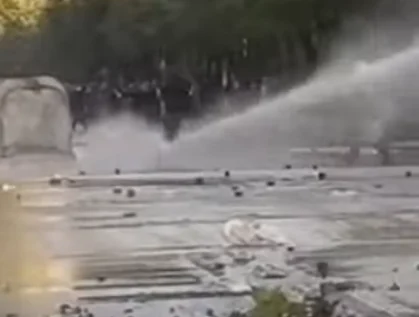
The renewed demonstrations highlight deep-seated frustrations within Albanian society, ranging from economic grievances and allegations of corruption to concerns over governance and democratic freedoms. Eyewitness accounts and footage circulated by local media outlets, including News 24, captured moments of intense confrontation, notably showing a police water cannon striking a protester, forcefully knocking them to the ground—an image that quickly became a symbol of the day’s events and fueled further outrage among activists.
This latest surge of unrest follows several days of fragile peace, a period during which many hoped the simmering tensions might de-escalate. However, the underlying issues appear to have remained unaddressed, leading to a resurgence of public anger that culminated in today’s volatile scenes. The government’s immediate response focused on restoring order, but critics argue that a deeper engagement with the protesters’ demands is essential to prevent further instability.
A Day of Renewed Confrontation: A Detailed Chronology
The events of October 24th unfolded rapidly, transforming a planned demonstration into a theatre of conflict. The "days of calm" preceding this outbreak had been marked by a cautious optimism in some quarters, following a series of government pledges to address specific grievances related to infrastructure projects and public sector reforms. However, a widespread perception of inaction and a lack of tangible results from these promises appear to have ignited the latest wave of public indignation.
Morning Buildup (10:00 – 13:00): The day began with a relatively peaceful gathering of several hundred protesters in Skanderbeg Square, initially comprising student groups, environmental activists, and civil society representatives. Their stated purpose was to deliver a petition to the Prime Minister’s Office, demanding greater transparency in public spending and an independent investigation into recent land development controversies. The atmosphere, while charged, remained largely non-violent, characterized by chants, banners, and speeches.
Escalation Begins (13:00 – 15:00): As the crowd swelled to an estimated few thousand by early afternoon, fueled by supporters of opposition parties and ordinary citizens frustrated with the cost of living, the mood began to shift. A contingent of younger, more radicalized protesters attempted to breach the police cordon protecting the Prime Minister’s Office. Initial attempts were met with firm but passive resistance from riot police. The rhetoric from some of the protest leaders grew more impassioned, accusing the government of deliberately ignoring their concerns.
First Clashes and Police Response (15:00 – 17:00): The first significant clashes erupted when protesters, reportedly frustrated by the perceived lack of engagement from government officials and the impenetrable police lines, began throwing plastic bottles and smoke flares towards the building and police ranks. This action prompted the police to issue repeated warnings over loudspeakers, urging the crowd to disperse and threatening the use of force. When these warnings were largely unheeded, water cannons were deployed.
The powerful jets of water were initially aimed at dispersing the crowd, but the situation quickly escalated. Footage from News 24, widely circulated online, captured the critical moment when a water cannon, seemingly aimed at a group attempting to push through the barricades, directly struck a male protester. The force of the water lifted him off his feet and threw him several meters backwards, leaving him motionless on the ground for a brief period before other protesters rushed to his aid. This incident, perceived by many as excessive force, ignited further fury among the demonstrators, leading to a more aggressive response from their side, including throwing rocks and other projectiles.
Deployment of Rubber Bullets and Sustained Confrontation (17:00 – 19:00): In response to the intensified assault from protesters, police escalated their tactics, deploying rubber bullets. The air filled with the sting of tear gas, forcing many demonstrators to retreat, while others, particularly those at the front lines, donned masks and continued to engage. The confrontations spread beyond the immediate vicinity of the Prime Minister’s Office, spilling into adjacent streets, disrupting traffic, and causing panic among bystanders. Reports of injuries began to emerge from both sides, though official numbers were not immediately available. Several police officers were seen being assisted by colleagues, presumably due to impacts from thrown objects.
Dispersal and Lingering Tensions (19:00 onwards): By early evening, the bulk of the protest had been dispersed through sustained police action. However, smaller groups of demonstrators continued to engage in cat-and-mouse skirmishes with police in side streets, setting fire to rubbish bins and causing minor property damage. Police units remained heavily deployed throughout the city center, maintaining a visible presence and conducting patrols. The immediate aftermath left a landscape of scattered debris, tear gas canisters, and a palpable sense of lingering tension, indicating that while the street battles had subsided for the day, the underlying grievances remained fiercely alive.
Deep Roots of Discontent: Supporting Data and Context
The resurgence of protests in Tirana is not an isolated incident but rather a symptom of deeper, systemic issues that have plagued Albania for years. The "days of calm" were merely a lull, not a resolution, in a protracted struggle between a segment of the populace and the government.
Economic Hardship and Disillusionment: A primary driver of public anger is the persistent economic struggle faced by many Albanians. Despite official figures often painting a rosier picture, widespread unemployment, particularly among the youth, remains a critical challenge. The cost of living continues to rise, outpacing wage growth, leading to a significant erosion of purchasing power. Many young professionals and skilled workers see emigration as their only viable path to a better future, contributing to a brain drain that further hampers the country’s development prospects. Protesters frequently voice concerns over perceived crony capitalism, where large government contracts are allegedly awarded to a select few, exacerbating wealth inequality.
Pervasive Corruption: Allegations of corruption are omnipresent in Albanian public discourse and a constant refrain among protesters. From high-level government officials to local administration, the perception that corruption is endemic undermines public trust in institutions. Recent high-profile scandals involving misuse of public funds, opaque procurement processes, and allegations of political interference in the judiciary have fueled public cynicism. Activists demand greater accountability and an end to impunity for corrupt officials, arguing that the justice reform efforts, while internationally praised, have been slow to yield tangible results in prosecuting high-profile cases.
Governance Concerns and Democratic Backsliding: Critics, including civil society organizations and opposition parties, frequently raise concerns about the state of democracy and governance in Albania. There are accusations of a shrinking space for dissent, with government actions often perceived as attempts to silence critical voices in the media and civil society. The concentration of power, perceived lack of checks and balances, and questions surrounding the fairness of electoral processes contribute to a sense of disenfranchisement among a significant portion of the population. The government’s handling of certain urban development projects, often bypassing public consultation and leading to forced evictions, has also been a recurring flashpoint for protests.

Historical Precedent of Protests: Albania has a rich history of public demonstrations, particularly since the fall of communism. From the student movements of the early 1990s that ushered in democracy, to mass opposition rallies in recent decades, street protests have often served as a crucial, albeit sometimes volatile, mechanism for expressing popular discontent. This historical context suggests that the current wave of protests is not an anomaly but part of a broader pattern of civic engagement and dissent in the face of perceived government failings.
Demographics and Organisation: Today’s protest, like many before it, drew a diverse cross-section of Albanian society. Students, often at the forefront of social movements, were prominent, alongside environmental activists protesting specific infrastructure projects, and a significant number of ordinary citizens disillusioned with the current political and economic climate. While some opposition politicians were present, the movement largely presented itself as organic, driven by civil society groups and informal networks. Groups such as "Përgjegjësia Qytetare" (Citizen Responsibility) and "Lëvizja për Drejtësi Sociale" (Movement for Social Justice) have been instrumental in mobilizing support and articulating demands, emphasizing that these are not merely political rallies but expressions of fundamental societal grievances.
Official Responses: Calls for Dialogue Amidst Condemnation
The government’s response to the renewed protests has been a blend of condemnation of violence, justification of police actions, and a reiterated call for dialogue. However, the sincerity and effectiveness of these calls are increasingly questioned by both protesters and international observers.
Prime Minister Edi Rama’s Stance: Prime Minister Edi Rama, in a televised address delivered shortly after the dispersal of the main protest, condemned the violence, labeling the acts of aggression against police and public property as "unacceptable and destructive." He acknowledged the existence of legitimate grievances but differentiated them sharply from what he termed "orchestrated chaos" aimed at destabilizing the country. "My door remains open for genuine dialogue with anyone who seeks constructive solutions, not destructive confrontation," Rama stated, reiterating his long-standing offer for discussions. However, he emphasized that such dialogue could only occur within the framework of law and order, and would not tolerate attempts to undermine state institutions through violence. Critics argue that his calls for dialogue often come across as conditional, placing the onus on protesters to cease their demonstrations before engagement, rather than initiating a proactive and inclusive discussion on their terms.
Police and Interior Ministry Statements: The Ministry of Interior and the Albanian State Police issued a joint statement defending the actions of law enforcement. They asserted that police had acted "proportionately and in accordance with standard protocols" to protect public order, government buildings, and prevent further escalation of violence. The statement cited numerous instances of projectiles thrown at officers and attempts to breach security perimeters as justification for the use of water cannons and rubber bullets. They confirmed several arrests were made for "disrupting public order and assaulting police officers," without providing exact figures. The police spokesperson reiterated that an internal review would be conducted on any claims of excessive force, but maintained that the primary objective was to ensure the safety of all citizens and property.
Government Ministers’ Perspectives: Other government officials echoed the Prime Minister’s sentiments. The Minister of Justice highlighted the importance of upholding the rule of law, while the Minister of Finance spoke about the economic damage caused by such unrest, urging for stability to attract investment and foster growth. These statements collectively conveyed a message of firmness in maintaining order, while offering a conditional olive branch for dialogue, seemingly placing the onus on protesters to de-escalate.
International Reactions: The events in Tirana quickly drew the attention of the international community, particularly the European Union, given Albania’s status as an EU candidate country. The European Union Delegation to Albania issued a statement expressing "serious concern" over the violent clashes, urging all parties to "exercise restraint, de-escalate the situation, and engage in constructive dialogue." The statement underscored the importance of respect for fundamental rights, including the right to peaceful protest, while also condemning any acts of violence. It called for an independent investigation into reports of excessive force.
The United States Embassy in Tirana similarly released a statement appealing for calm and peaceful resolution, stressing that "violence has no place in a democratic society." It encouraged the Albanian government to address the underlying causes of discontent through transparent and inclusive processes. Amnesty International and other human rights organizations condemned the reported use of rubber bullets and the incident with the water cannon, calling for immediate, impartial investigations into all allegations of excessive force by law enforcement and urging the government to respect the right to peaceful assembly. These international reactions highlight the scrutiny Albania faces regarding its democratic credentials and rule of law as it pursues closer integration with the West.
Implications for Albania’s Future
The return of violent protests carries significant implications for Albania’s political stability, social cohesion, and its aspirations for European integration. The events of October 24, 2026, could mark a critical juncture for the nation.
Political Stability and Governance: The persistent unrest poses a direct challenge to the stability of Prime Minister Rama’s government. While his mandate currently appears secure, prolonged and increasingly violent protests could erode public confidence, potentially leading to calls for early elections or a deepening political crisis. The government’s ability to effectively address the root causes of discontent will be crucial. A failure to do so risks entrenching a cycle of protest and repression, further weakening democratic institutions and public trust in the political system. The opposition, while currently fragmented, may capitalize on the public’s frustration, potentially leading to a more unified front against the ruling party.
Social Cohesion and Trust: The violent clashes exacerbate existing societal divisions. The use of force by police, particularly incidents like the water cannon striking a protester, deepens the chasm of mistrust between citizens and the state. Such events can polarize public opinion, making genuine reconciliation and dialogue increasingly difficult. There is a risk of a more confrontational political culture taking root, where grievances are primarily expressed through street action rather than institutional channels.
Economic Repercussions: Political instability and street violence are detrimental to Albania’s economic prospects. They deter foreign investment, which is crucial for job creation and economic growth. The image of a volatile capital can also negatively impact the vital tourism sector, a significant contributor to the national economy. Businesses, both local and international, thrive on predictability and stability, and the current climate of unrest threatens to undermine these conditions, potentially leading to capital flight and a slowdown in economic development.
EU Accession Process: Perhaps one of the most significant long-term implications lies in Albania’s arduous journey towards full membership in the European Union. The EU places a high premium on the rule of law, democratic governance, respect for human rights, and political stability among its candidate countries. The recurring protests, particularly those involving violence and alleged excessive force by the state, raise serious questions about Albania’s progress in these critical areas. Such events could lead to increased scrutiny from Brussels, potentially delaying the opening of new negotiation chapters or even freezing parts of the accession process. This would be a major setback for a country that has invested heavily in its European future.
Future Outlook: The immediate future for Albania appears fraught with challenges. Without a genuine, inclusive, and transparent dialogue that addresses the fundamental grievances related to corruption, economic disparity, and governance, the cycle of protests is likely to continue. The government faces the delicate task of balancing the need to maintain public order with upholding fundamental democratic rights, particularly the right to peaceful assembly. The international community, especially the EU and the US, will likely intensify its calls for restraint and dialogue, emphasizing the importance of a peaceful resolution to the current tensions. The outcome of this period of unrest will largely depend on the willingness of both the government and the protest movements to find common ground and commit to a path of constructive engagement rather than continued confrontation.