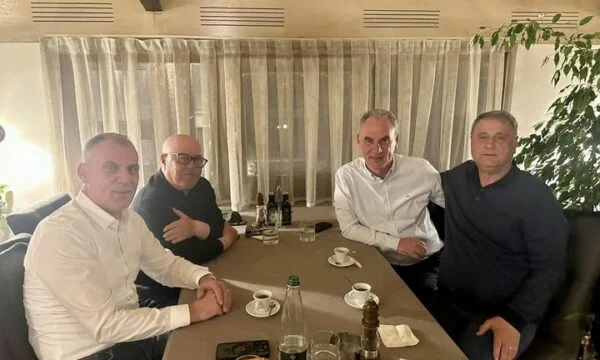
Pristina, Kosovo – A seemingly innocuous social media post has sent ripples of speculation through Kosovo’s political landscape, hinting at potential shifts in allegiances and a subtle redefinition of old rivalries. Adil Behramaj, a former aide to the now-indicted former President Hashim Thaçi, recently shared a photograph on his social media platform depicting Thaçi’s brothers engaged in conversation with Fatmir Limaj, a prominent political figure in his own right, and his brother. The image, accompanied by the caption "Coffee between friends," has ignited a flurry of analysis, particularly given the historical context of political maneuvering and the upcoming electoral cycles.
The photograph itself is deceptively simple. It captures a moment of camaraderie, yet its implications are far-reaching. The presence of Thaçi’s brothers, individuals not typically in the public political spotlight but nonetheless connected to the former president’s powerful network, alongside Limaj, a figure who has navigated Kosovo’s complex political terrain for decades, suggests a confluence of interests or at least a thawing of past frostiness. Behramaj, by sharing this image and framing it as a casual meeting, has inadvertently amplified its significance, drawing attention to a potential realignment that could have tangible consequences for Kosovo’s political future.
This development comes at a critical juncture. Kosovo is grappling with numerous challenges, including economic development, the ongoing dialogue with Serbia, and the persistent issue of corruption. Political unity, or at least strategic cooperation, can be a vital asset in navigating these complexities. Conversely, internal divisions and unresolved historical animosities can hinder progress. The meeting, however informal it may have been presented, offers a glimpse into the intricate webs of relationships that underpin Kosovo’s political ecosystem.
The Visual Clue: A Photograph and Its Subtext
The photograph, posted by Behramaj, serves as the primary catalyst for this discussion. It depicts individuals who, by virtue of their familial ties to key political figures, carry a certain weight. Hashim Thaçi, the former president, remains a dominant figure in the national consciousness, even while facing charges at the Kosovo Specialist Chambers. His brothers, while operating outside the direct political arena, are undeniably part of his influential circle. Their presence alongside Fatmir Limaj, a seasoned politician with a significant following and a history of independent political action, is noteworthy.
Limaj himself has carved out a distinct political identity. He was once a prominent member of the Democratic Party of Kosovo (PDK), the party founded by Thaçi. However, his political journey has been marked by periods of both alliance and divergence with Thaçi’s political camp. His departure from the PDK and the formation of his own political entities, most recently the Social Democratic Initiative (NISMA), underscore his independent trajectory.
The caption, "Coffee between friends," is also laden with subtext. It is a deliberate attempt to downplay the political significance, yet the very act of sharing it suggests an awareness of its potential impact. Furthermore, the reference to the "finger gesture," as noted by Behramaj, is a subtle nod to Thaçi’s past campaign symbolism, further weaving the narrative back to the former president and his legacy. This seemingly casual remark serves to connect the present gathering to a broader political history, implying that the relationships being fostered or rekindled are not entirely new but are rooted in shared past experiences and perhaps a shared vision for the future.
A Shifting Political Landscape: The PDK’s Stance
The timing of this photograph and its subsequent discussion is particularly relevant in light of recent pronouncements from the Democratic Party of Kosovo (PDK). In the lead-up to the upcoming elections, the PDK, now led by Bedri Hamza, has been deliberating on its electoral strategy and potential alliances. Notably, Fatmir Limaj had reportedly expressed an interest in participating in the PDK’s electoral list.
However, following a meeting of the PDK’s leadership, Hamza publicly declared that while the party values contributions, Limaj would not be included on the PDK’s list for the upcoming elections. This official rejection by the PDK leadership, juxtaposed with the photograph of Limaj seemingly in amiable conversation with Thaçi’s brothers, creates a complex narrative. It suggests that while the formal political channels within the PDK may have closed the door on Limaj’s direct participation in their electoral slate, informal connections and potential understandings might still be at play.
This divergence between official party policy and the appearance of informal networking raises questions about the inner workings of Kosovo’s political parties and the influence of personal relationships on strategic decisions. It hints at a possible scenario where individual political actors, even if not formally aligned with a party’s electoral strategy, can still wield influence or forge connections that could impact future political developments. The PDK’s decision, while ostensibly definitive, may not be the final word on potential collaborations or mutual support in the broader political arena.
Chronology of Political Relationships: From Allies to Independents
The relationship between Hashim Thaçi and Fatmir Limaj is deeply intertwined with the history of Kosovo’s post-war political development. Both emerged as key figures in the Kosovo Liberation Army (KLA) and subsequently became prominent leaders in the PDK, the dominant political force in the country for many years.
-
Early Alliance and PDK Dominance: For a significant period, Thaçi and Limaj were close political allies within the PDK. They were instrumental in shaping the party’s agenda and its rise to power. During this era, their political fortunes were closely linked, and they often presented a united front.
-
Divergence and Internal Tensions: Over time, however, political differences and aspirations led to growing tensions. Limaj, known for his independent streak, began to carve out his own political space. These divergences culminated in his eventual departure from the PDK.
-
Formation of New Political Entities: Following his departure, Limaj founded his own political parties, most notably the Social Democratic Initiative (NISMA). This move signaled a clear break from the PDK and established him as an independent political force, often positioned as an alternative to the traditional power structures.
-
Independent Political Stance: In recent years, Limaj has operated as an independent political player, forming coalitions and alliances as he saw fit, often with parties outside the direct orbit of the PDK, while maintaining a degree of strategic engagement with various political actors.
-
Recent Developments: The current situation, where Limaj’s bid to join the PDK’s electoral list has been rejected, but he is seen in a photograph with Thaçi’s brothers, represents a new chapter in this evolving dynamic. It suggests that while formal electoral pacts may be off the table, the personal and historical connections between these figures and their networks might still hold sway.
Supporting Data and Political Context
To fully appreciate the significance of this development, it is crucial to consider the broader political context in Kosovo:
-
Upcoming Elections: The timing of this photograph is particularly relevant given the imminent electoral cycles in Kosovo. Political parties are actively strategizing, forming alliances, and positioning themselves for electoral success. Any indication of shifting alliances or unexpected collaborations can have a direct impact on the electoral landscape.
-
The Legacy of Hashim Thaçi: Despite his current legal challenges, Hashim Thaçi remains a significant figure in Kosovo’s political memory. His network of influence, built over decades, is still considered potent. The involvement of his brothers in such a meeting underscores the enduring reach of his connections.
-
Fatmir Limaj’s Political Capital: Limaj is not a marginal figure. He commands a loyal following and has demonstrated an ability to mobilize support. His political decisions and potential alliances are closely watched by both supporters and rivals.
-
The PDK’s Internal Dynamics: The PDK, as a major political force, is constantly navigating internal power struggles and strategic decisions. The rejection of Limaj’s bid for their list, while public, might not fully reflect the nuances of their internal deliberations or the potential for other forms of cooperation.
-
Regional Political Landscape: Kosovo’s political landscape is also influenced by regional dynamics and the ongoing dialogue with Serbia. The stability and effectiveness of Kosovo’s government are crucial for progress on these fronts. Any perceived shifts in political alliances could be interpreted through this lens.
Official Responses and Political Reactions
As of the publication of this article, official responses from the individuals directly involved or their respective parties have been minimal, largely adhering to the initial framing of the photograph.
-
Adil Behramaj: By posting the photograph with the caption "Coffee between friends," Behramaj has set the tone for the public interpretation. His role as a former aide to Thaçi lends a degree of authenticity to the connection he is highlighting.
-
Fatmir Limaj: Limaj himself has not made any public statements directly addressing the photograph or its implications. His political strategy has often involved a degree of strategic ambiguity, allowing for multiple interpretations of his actions.
-
Hashim Thaçi’s Brothers: As individuals not actively involved in public politics, their direct engagement with media queries is unlikely. Their presence in the photograph speaks volumes, but any explicit commentary from them would be unprecedented.
-
PDK Leadership: Bedri Hamza’s statement regarding Limaj’s exclusion from the PDK’s list remains the most definitive official response from a major political party. This public declaration stands in contrast to the informal networking suggested by the photograph.
The lack of overt political pronouncements from those directly involved allows for a vacuum to be filled by speculation and analysis. This ambiguity can be a deliberate political tactic, allowing for flexibility and denying rivals concrete points of attack. However, it also fuels uncertainty and can lead to a multiplicity of interpretations, some of which may be more speculative than grounded in fact.
Implications and Future Trajectories
The photograph and the accompanying discussion carry several significant implications for Kosovo’s political future:
-
Potential for Informal Alliances: The meeting suggests that even if formal electoral pacts are not formed, informal alliances and understandings can still be cultivated. This could manifest in various ways, such as mutual support in parliamentary votes, coordinated public statements, or behind-the-scenes influence.
-
Re-evaluation of Political Rivalries: The perceived thawing of relations between figures associated with Thaçi and Limaj could signal a re-evaluation of old political rivalries. In the ever-shifting landscape of Kosovo politics, past animosities can sometimes give way to pragmatic considerations or shared interests.
-
Impact on Electoral Dynamics: While Limaj may not be on the PDK’s list, this potential alignment could still influence electoral dynamics. It might galvanize certain voter bases or create new strategic considerations for other political parties.
-
The Enduring Influence of Networks: The incident underscores the enduring importance of personal networks and familial ties in Kosovo’s political system. These informal structures often operate alongside or even supersede formal political processes.
-
A Glimpse into the Future: This seemingly small event offers a tantalizing glimpse into the complex, often opaque, machinations of Kosovo’s political elite. It highlights the importance of observing not just public pronouncements but also the subtle cues and informal interactions that shape the nation’s political trajectory. As Kosovo navigates its path forward, the ability to foster strategic cooperation and manage diverse political interests will be paramount. This coffee meeting, however informal, might just be a signpost on that evolving journey.