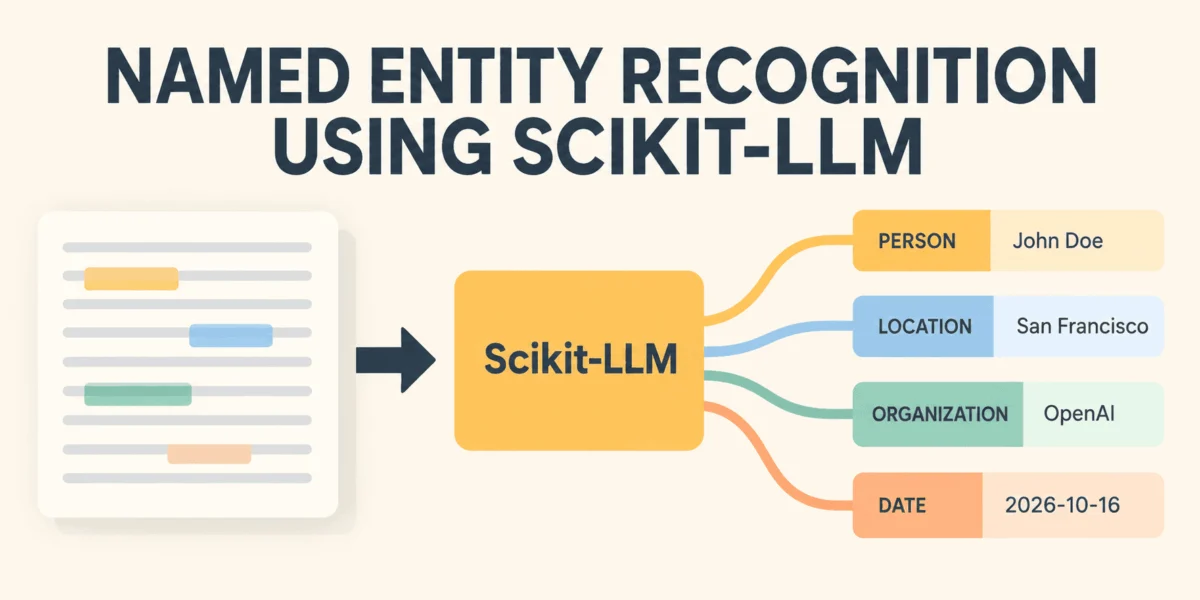
In the rapidly evolving landscape of artificial intelligence, the ability to distill actionable intelligence from the chaotic, unstructured sprawl of human language remains a "holy grail" for data scientists. Named Entity Recognition (NER)—the process of identifying and categorizing key information such as names, organizations, locations, and products—has long been a cornerstone of this effort. Historically, however, NER was a resource-intensive endeavor, demanding massive annotated datasets and grueling fine-tuning cycles.
Today, a paradigm shift is underway. The emergence of Scikit-LLM is democratizing the power of Large Language Models (LLMs), enabling developers to integrate sophisticated reasoning capabilities into standard machine learning pipelines. By bridging the gap between classical scikit-learn workflows and modern generative AI, Scikit-LLM allows for the extraction of structured data from text with unprecedented speed and minimal overhead.
The Evolution of Named Entity Recognition
The Traditional Bottleneck
For over a decade, NER relied on statistical models like Conditional Random Fields (CRFs) or, more recently, transformer-based architectures like BERT. While effective, these models were rigid. If a business needed to extract a highly specialized entity—such as a proprietary chemical compound or a specific legal clause—the data science team had to curate thousands of labeled examples and invest weeks into model training. This "cold start" problem often stalled innovation in smaller organizations that lacked the vast datasets or compute power of tech giants.
The Rise of LLM-Driven Pipelines
The advent of Large Language Models changed the calculus. LLMs possess an inherent, latent understanding of context, grammar, and entity classification that is essentially "pre-trained" on the collective knowledge of the internet. Scikit-LLM leverages this by treating the LLM as a modular component in a broader pipeline. It allows developers to define entity schemas via natural language descriptions, essentially "prompting" the model to perform classification rather than "training" it in the classical sense.
Implementation: A Step-by-Step Guide
The beauty of the Scikit-LLM approach lies in its accessibility. By utilizing cloud-based APIs like those offered by Groq—which provide high-speed inference—developers can perform complex NER tasks in a notebook environment like Google Colab without needing a local GPU cluster.
1. Setting the Foundation
To begin, one must configure the environment. Scikit-LLM is designed to be compatible with existing OpenAI-standard API formats, but it offers the flexibility to redirect requests to other providers.
!pip install scikit-llm -q

from skllm.config import SKLLMConfig
from google.colab import userdata

# Securely retrieve the Groq API key
groq_key = userdata.get('GROQ_API_KEY')

# Configure Scikit-LLM to utilize Groq's high-performance endpoint
SKLLMConfig.set_gpt_url("https://api.groq.com/openai/v1")
SKLLMConfig.set_openai_key(groq_key)
2. Defining the Entity Schema
The "intelligence" of this pipeline resides in the entity dictionary. Unlike traditional models that rely on opaque numerical weights, Scikit-LLM allows us to define our target entities using clear, human-readable instructions.
entities =
    "EXECUTIVE": "The full name of a company leader or individual.",
    "CORPORATION": "The name of a technology company or business.",
    "PRODUCT": "A specific hardware device, software, or technology feature.",
    "CITY": "A geographical location or municipality."
This step is crucial: by providing a descriptive definition, we guide the LLM’s reasoning process, significantly reducing the probability of misclassification.
3. Executing the Extraction
With the configuration complete, the GPTExplainableNER class acts as the orchestrator. It processes raw strings through the LLM, which identifies entities and returns a structured, reasoning-backed response.
The process is remarkably efficient. By passing the entities dictionary and the target text to the fit_transform method, the pipeline handles the prompt engineering, context injection, and parsing logic automatically.
Implications for the Industry
The shift toward LLM-based NER has profound implications for data strategy.
Enhanced Agility
Organizations no longer need to wait for a model training cycle to pivot their data extraction needs. If a marketing department decides to start tracking "Sustainability Initiatives" as a new entity type, they can simply update the dictionary and re-run the pipeline. This agility transforms data teams from "model maintenance" roles into "insight generation" roles.
Cost and Scalability
By utilizing high-performance, cost-effective inference engines like Groq, companies can process millions of documents at a fraction of the cost of traditional, GPU-bound inference. The ability to perform NER in real-time opens the door to live sentiment analysis, competitive intelligence monitoring, and automated CRM enrichment.
Addressing the "Hallucination" Factor
One might ask: is this as accurate as a fine-tuned BERT model? While LLMs are prone to occasional "hallucinations" or formatting inconsistencies, Scikit-LLM mitigates this through structured prompting and post-processing. As demonstrated in our implementation, using regex-based parsing to extract tagged values from the LLM’s output ensures that the final data is clean, consistent, and ready for ingestion into a database or a downstream predictive model.
Official Perspectives and Expert Insight
Iván Palomares Carrascosa, a recognized authority in AI and LLM implementation, emphasizes that the true value of tools like Scikit-LLM lies in their "democratization of complex AI workflows." According to Carrascosa, the transition from manual, rule-based extraction to generative extraction represents the "industrialization of NLP."
"When we remove the barriers of entry—the complex codebases, the need for massive labeled datasets, and the infrastructure costs—we allow domain experts to define what is important," Carrascosa notes. "The machine is no longer just a black box; it is a tool that responds to the logic provided by the business, not just the logic buried in training data."
Future Directions: Beyond Simple NER
While NER is the starting point, the underlying technology used here is part of a broader trend: Structured Reasoning.
- Semantic Enrichment: Future iterations of these pipelines will likely include "zero-shot" entity relationship extraction, where the model doesn’t just identify the CEO, but also identifies the relationship between that person and their corporation.
- Multimodal Extraction: As LLMs become increasingly multimodal, we can expect Scikit-LLM to expand to extract entities not just from text, but from PDFs containing tables, charts, and images.
- Autonomous Pipelines: We are moving toward a world where the pipeline itself identifies missing schema information and asks the user for clarification, effectively "self-healing" its own extraction logic.
Conclusion
The convergence of Scikit-LLM and advanced inference APIs marks a definitive end to the "brute force" era of Natural Language Processing. By abstracting the complexity of LLM interaction into a familiar, scikit-learn-style interface, developers and data analysts are empowered to build robust, scalable NER systems in hours rather than months.
As we look toward the future, the ability to rapidly convert unstructured data into structured assets will define the winners in the AI-driven economy. Whether you are extracting executive movements, tracking product launches, or mapping geographical market reach, the tools to transform your unstructured data are now at your fingertips. The era of the "AI-augmented data scientist" has officially arrived, and it is built on the elegant, accessible, and powerful foundations of modular LLM pipelines.