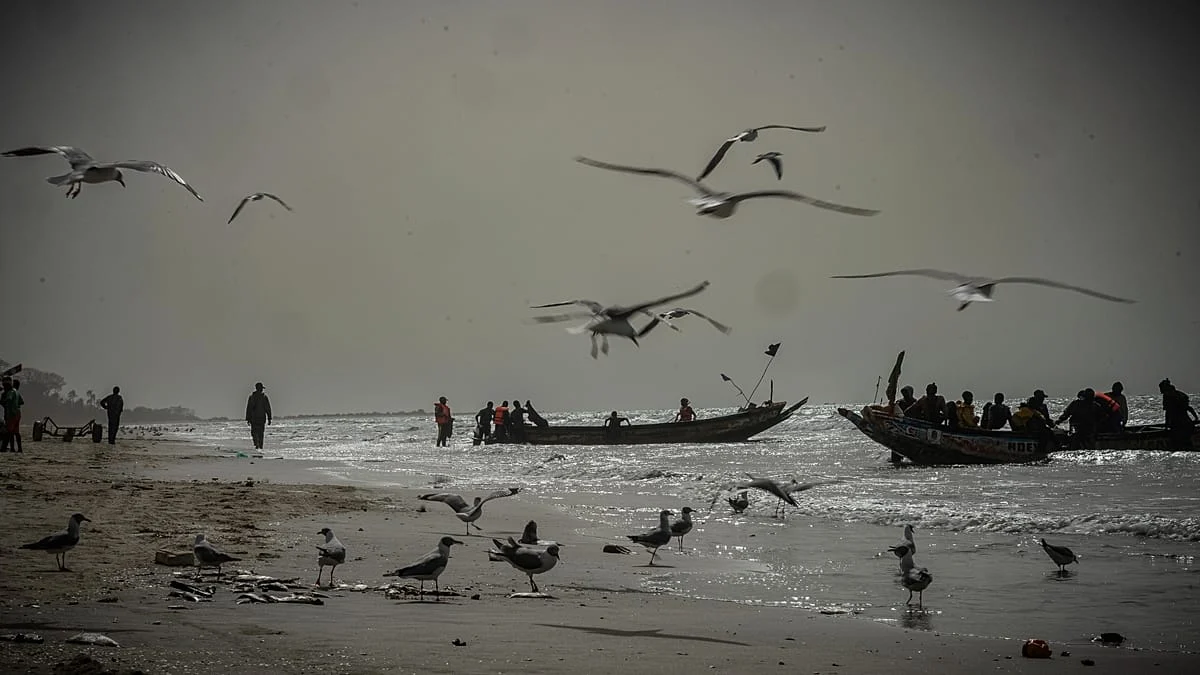
BANJUL — A perilous maritime tragedy unfolded on Thursday as a vessel carrying migrants seeking a new life in Europe capsized off the coast of The Gambia. The Gambia Red Cross Society (GRCS) confirmed that at least 12 individuals have perished in the accident, with fears mounting that the death toll will rise as search-and-rescue operations continue in the treacherous waters of the North Bank region.
The incident occurred near the village of Jinack Kajata on Jinack Island, a location that has increasingly become a clandestine departure point for those attempting the arduous journey across the Atlantic to Spain’s Canary Islands. As authorities scramble to account for the missing, the disaster serves as a grim reminder of the escalating risks associated with the West African Atlantic Route—a path now widely considered one of the deadliest maritime migration corridors in the world.
The Facts: A Catastrophe in the North Bank
The shipwreck, reported on the morning of October 16, 2026, involved a vessel departing from the shores of Jinack Kajata. While the exact number of passengers aboard remains unconfirmed, local reports suggest the boat was significantly overcrowded, a common characteristic of vessels operated by smuggling networks.
"The number of people missing remains uncertain, and further updates are expected as response efforts continue," the Gambia Red Cross Society stated in an official press release. The GRCS confirmed they are working in tandem with national authorities and international response partners to manage the aftermath, provide psychosocial support to survivors, and coordinate the recovery of bodies.
The geography of the incident is significant. Jinack Island, separated from the Gambian mainland by the Niumi National Park, offers a secluded coastline that has drawn the attention of migrant smugglers. By bypassing more heavily patrolled ports, these networks attempt to evade detection, but in doing so, they push migrants into deeper, more unforgiving waters with minimal safety equipment.
Chronology of a Deadly Route
To understand the gravity of the October 16 incident, one must look at the evolution of the West African Atlantic Route over the last three years.
- Early 2024: The Atlantic route experienced a massive surge in traffic, with record numbers of migrants arriving in the Canary Islands. The sheer volume of boats created a humanitarian crisis that strained local resources in Spain.
- Late 2024 to 2025: Faced with intense pressure, transit countries—specifically Morocco, Mauritania, and Senegal—implemented significantly stricter border controls and surveillance measures. While this succeeded in reducing the total number of arrivals in the Canary Islands by approximately 62% during this period, it did not stop the migration flow; it merely displaced it.
- July 2026: A vessel traveling from The Gambia suffered a catastrophic wreck off the coast of Mauritania, leaving dozens dead or missing. This incident signaled a shift in departure patterns, as migrants began relying on southern, more remote coastal regions.
- October 16, 2026: The Jinack Kajata shipwreck. This event marks the latest in a series of tragedies occurring as a direct result of the "displacement effect," where migrants are forced to undertake longer, more dangerous journeys to avoid security crackdowns in the north.
Supporting Data: The Statistics of Survival
The International Organization for Migration (IOM) recently released data that paints a haunting picture of the current state of maritime migration in West Africa. Despite a notable decrease in the volume of successful crossings, the fatality rate remains stubbornly high.
According to the IOM, between 2024 and 2025, recorded deaths and disappearances fell by only 4%—from 1,215 to 1,172. This marginal decline, when contrasted with the 62% drop in total arrivals, indicates that the journey has become exponentially more lethal.
The Math of Danger
The IOM highlights that increased patrols in traditional departure hubs have forced vessels to launch from points further south, such as The Gambia. This shift has added up to 750 kilometers to the standard route, extending the total distance of the voyage to approximately 2,200 kilometers.
When a vessel is forced to cover an extra 750 kilometers, the risks multiply:
- Extended Exposure: Passengers spend significantly more time at sea, increasing the risk of dehydration, starvation, and exposure.
- Remote Waters: Vessels are pushed into less monitored, deep-sea channels where rescue vessels cannot reach them in time.
- Vessel Integrity: Most of the boats used in these crossings—often simple wooden pirogues—are not designed for long-haul ocean travel. The structural fatigue caused by an extra 750 kilometers of buffeting by Atlantic swells often leads to the exact kind of capsize witnessed in Jinack Kajata.
Official Responses and Humanitarian Appeals
The international community and local Gambian authorities are currently facing a complex humanitarian challenge.
The Gambia Red Cross Society (GRCS)
The GRCS has prioritized the identification of victims and the support of families. Their primary challenge is the lack of information regarding the boat’s manifest, which often leaves families in a state of agonizing uncertainty for weeks. "We are working closely with relevant authorities and response partners as the situation unfolds," the GRCS stated, emphasizing that their focus remains on the humanitarian aspects of the disaster.
The International Perspective
The IOM has reiterated its call for safer, legal pathways for migration. By focusing purely on border militarization and increased security, the IOM argues, the international community is inadvertently incentivizing the use of more dangerous, long-distance routes.
"These alternative departure points can add up to 750 kilometers to the crossing, exposing people to longer periods at sea… and greater risks of shipwreck, dehydration, and disappearance," an IOM spokesperson remarked earlier this week. The organization continues to lobby for regional cooperation that emphasizes search-and-rescue capabilities as much as it does border security.
Implications: The Future of Migration
The tragedy at Jinack Kajata is not an isolated incident; it is a structural symptom of a failed migration policy cycle. As European nations continue to pressure African transit states to "close the gates," the outcome has been a shift toward more southern, more perilous departure points.
The "Balloon Effect"
Migration researchers often refer to this as the "balloon effect": when you squeeze one part of the migration route, it bulges in another, often more dangerous, location. By forcing the migration path further south into Gambian waters, the route has become longer and more complex, and the profit margins for smuggling syndicates have remained high.
Regional Instability and Socio-economic Drivers
It is crucial to acknowledge that for many migrants, the decision to embark on such a perilous journey is not one made lightly. Socio-economic instability, unemployment, and the impacts of climate change on local fishing and agriculture sectors in The Gambia act as "push factors." Until the economic conditions that drive young people to view the Atlantic as a viable option for a future are addressed, the demand for these illegal crossings will likely persist.
A Call for Coordinated Action
The tragedy has reignited debates within the Economic Community of West African States (ECOWAS) and the European Union regarding the necessity of a unified migration strategy. Critics of current policies argue that the current focus on "fortress Europe" is failing, and that the deaths of at least 12 people off the coast of The Gambia are a direct consequence of policies that prioritize deterrence over human safety.
As the search operations continue off the North Bank region, the families of the victims are left to mourn, while the international community is left to reckon with the reality that the Atlantic Ocean continues to serve as a graveyard for the dreams of thousands. Without a fundamental shift in how the migration crisis is managed—one that balances border integrity with the protection of human life—the waters off Jinack Island may sadly not be the last site of such a tragedy.
For now, the priority remains clear: finding the missing, supporting the families, and preventing further loss of life on the increasingly lethal routes of the Atlantic.