By Political Correspondent
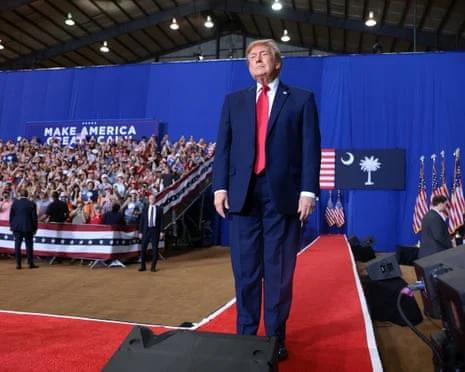
The 2026 midterm election season, already defined by a climate of deepening partisan divide and administrative volatility, reached a new level of volatility on Wednesday as a campaign rally for Donald Trump in South Carolina devolved into physical confrontation. The incident at Clemson University’s T. Ed Garrison Arena underscored the increasingly fraught nature of the American political landscape just 13 days before voters head to the polls.
The Clemson Incident: A Rally Marked by Violence
As Donald Trump took the stage in Pendleton, South Carolina, to bolster the candidacy of Darline Graham—who is seeking to secure the Senate seat left vacant by the death of her brother, the late Senator Lindsey Graham—the atmosphere inside the arena was heavily charged. Throughout the evening, several protesters interrupted the President’s remarks. While such disruptions have become a staple of Trump’s campaign events, the reaction from the crowd and the candidate on Wednesday drew immediate national scrutiny.
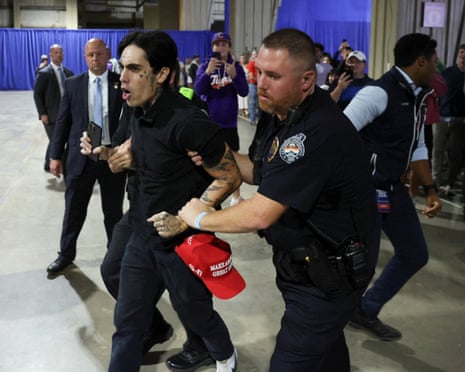
During the event, a demonstrator was reportedly struck by a rally attendee. Rather than calling for calm or de-escalation, the President appeared to encourage the behavior. As the protester was being removed by security, Trump remarked from the podium, "That was great, man. Wow. Man, I loved that."
Trump then turned his attention to the individual who delivered the blow, seemingly seeking to identify him. "Who’s the guy that threw the punch?" he asked, before comparing the attendee to former heavyweight boxing champion Evander Holyfield. "You know, you reminded me of Evander. The real deal Holyfield. You gotta give them credit. It takes courage to do that."
The incident was not isolated. Footage circulated widely on social media showing another attendee striking a different protester in the back of the head as they were being escorted out by local law enforcement. These outbursts of physical violence occurred against the backdrop of a campaign event intended to consolidate Republican support in a competitive race against Democratic nominee Annie Andrews.

The Senate Race: A Family Legacy and Policy Friction
The rally was ostensibly held to galvanize support for Darline Graham. However, the candidate has found herself in a delicate position, navigating both a competitive race and a tenuous relationship with the President himself. Last week, the campaign was marked by significant friction when Trump chose to unilaterally waive a new package of sanctions targeting Russia—a package that had been championed by the late Senator Lindsey Graham and was supported by his sister.
The legislation aimed to penalize Russian officials, banks, and the "shadow fleet" of tankers that form the backbone of Russia’s energy export infrastructure. While Darline Graham had publicly expressed pride in the bill, she has been forced to walk a fine line. "Personally, I would choose to put the pressure on Russia to end the war and get gas prices down," she stated at a recent event, according to the New York Times. "Because I don’t trust Putin, and I don’t trust Russia."
Her campaign has also faced internal challenges, including public scrutiny regarding her political inexperience, highlighted by a notable struggle to articulate a coherent position on Taiwan and broader US national security interests.
The Broader Context: A Day of Escalating Tensions
The violence in South Carolina occurred amidst a day of broad, interconnected crises across the American political spectrum.
Suspicious Mailings and Congressional Intimidation
Earlier on Wednesday, the office of Speaker Emerita Nancy Pelosi reported receiving a "suspicious letter," marking the latest in a series of threats targeting members of Congress. This follows a report from the Guardian earlier in the week indicating that over three dozen congressional offices across the political spectrum had received envelopes containing white powder. While preliminary tests in some instances have suggested the substances are not hazardous, the cumulative effect has been a heightening of fear within the Capitol.
"Speaker Pelosi remains focused on serving the people of San Francisco and is concerned for the members and staff whose offices have experienced similar incidents," said Nicholas Martin, a spokesperson for the Speaker Emerita. The FBI, the US Capitol Police, and the US Postal Inspection Service are currently investigating more than 100 such letters circulating through the mail system, affecting both congressional offices and state election boards.
The "Stop Whining" Doctrine: Vance and the Ramaswamy Ad
Tensions were further stoked by Vice-President JD Vance, who addressed the growing backlash surrounding a controversial campaign ad produced by gubernatorial candidate Vivek Ramaswamy. The ad features the estranged mother of Ramaswamy’s opponent, Amy Acton, accusing her daughter of lying about her childhood.
The ad has been widely condemned, particularly after it was revealed that Acton was a victim of sexual abuse by her mother’s husband, a situation that led to her removal from her mother’s care. Despite the outcry, Vance defended the spot during a campaign stop in Cincinnati. "I have to admit that I’m a little bit disgusted when I see Republicans across the country who are whining more about that advertisement than they are about what the congressional Democrats and other Democrats want to do to the United States of America," Vance said. He urged his party to "stop whining and go win the race."
Judicial Rebuffs and Regulatory Battles
The administration also faced a setback in the Supreme Court, which refused to allow the implementation of a policy aimed at denying gender-affirming care to transgender individuals in federal prisons. The high court left in place a lower-court block on the policy, which had been initiated by a January 2025 executive order from the President.
Simultaneously, the legal environment for big tech shifted dramatically as a judge in New Mexico ordered Meta to pay a $25 billion penalty. The ruling followed a jury’s determination that the company had misled consumers regarding the privacy of their data during the period surrounding the 2016 election, specifically concerning the activities of the political consulting firm Cambridge Analytica.
Diplomatic Maneuvers: The Witkoff-Putin Meeting
On the international stage, the administration’s focus remained on the conflict in Ukraine. Special Envoy Steve Witkoff announced the release of Stephen Hubbard, a 74-year-old American teacher who had been detained in Russia since 2022. While the release was hailed by the administration as a diplomatic victory, Witkoff’s characterization of Vladimir Putin as a "humanitarian" during his visit to St. Petersburg drew sharp bipartisan backlash.
"Vladimir Putin is not our friend, and he is certainly no humanitarian," said retiring Republican Senator Joni Ernst, echoing the sentiments of many lawmakers who remain deeply skeptical of the administration’s approach to the Kremlin.
Analysis: Implications for the Midterms
As the nation moves into the final 13 days of the election season, several trends are becoming clear. Polling from the New York Times and Siena University suggests a 11-point lead for Democratic candidates among likely voters, with the President’s approval rating dipping to a historic low of 36%.
The shift in party perception is also notable. The percentage of voters who view the Democratic Party as the party of the working class has increased by five points to 53%, while Republican standing in the same category has dropped by five points to 40%.
The surge in early voting—with over 16 million ballots already cast—indicates high engagement, though it remains to be seen whether this activity signals a "red undertow" or a consolidation of Democratic strength. Strategists are monitoring the high turnout in battleground states like Georgia, Michigan, and North Carolina, where turnout is pacing significantly ahead of the 2022 midterm figures.
Conclusion
The combination of physical violence at a presidential rally, the proliferation of threatening mailings to elected officials, and the intensifying rhetoric surrounding personal attacks in political advertising paints a picture of a nation at a tipping point. As the country approaches the midterm elections, the rhetoric from the highest levels of government appears to be mirroring the volatility seen on the ground, leaving voters to navigate an increasingly hostile political environment. Whether the electorate responds to this climate with further polarization or a decisive move toward moderation will be the defining question of the next two weeks.