The professional social media landscape is currently undergoing a massive structural shift. As generative artificial intelligence tools become increasingly sophisticated and accessible, the barrier to content creation has effectively vanished. However, this democratization of output has brought with it an unintended and pervasive consequence: the flood of "AI slop." This term, now widely adopted within industry circles, refers to the deluge of generic, repetitive, and hollow content that offers little to no genuine insight. LinkedIn, the world’s preeminent professional networking platform, has officially declared war on this trend, implementing a sophisticated, multi-layered technological defense strategy to preserve the integrity of its user experience.
The Core Challenge: Defining and Identifying "Slop"
At its most fundamental level, LinkedIn defines "AI slop" as content that lacks human value. These are posts often churned out in bulk—sometimes by bots, sometimes by individuals leveraging automated prompts—that offer superficial commentary, redundant career advice, or disingenuous "thought leadership."
For a platform built on the premise of professional networking and authentic human connection, the erosion of quality poses an existential threat. If users are forced to scroll through hundreds of AI-generated platitudes to find a single relevant, human-authored update, the platform’s utility rapidly diminishes. The frustration has reached a boiling point, prompting LinkedIn to move from passive observation to active enforcement.
A Chronology of the Crackdown
The initiative to purge the feed of low-quality AI content gained significant momentum in the late summer of 2024.
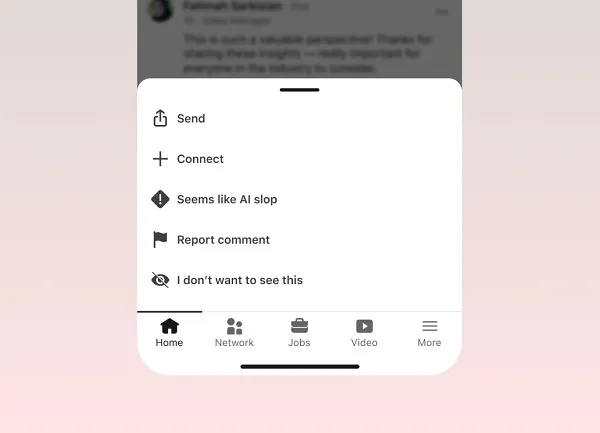
- August 2024: LinkedIn introduced a dedicated "Report" feature specifically designed for AI-generated content. This provided a direct feedback loop for the platform’s 1 billion+ users to flag posts that felt automated, repetitive, or devoid of substance.
- Late August 2024: The response was immediate and overwhelming. Within just three weeks of the feature’s launch, more than 1 million users had utilized the tool, signaling a massive, pent-up demand for a cleaner feed.
- October 2024: LinkedIn’s VP of Engineering, Tim Jurka, pulled back the curtain on the technical architecture behind these efforts. He articulated a long-term roadmap for detection that relies on a symbiotic relationship between human feedback and machine learning.
The Technical Architecture: Teacher-Student AI Models
To combat AI, LinkedIn is effectively using AI against itself. The strategy, as outlined by Tim Jurka, utilizes a "teacher-student" framework. In this setup, larger, highly sophisticated "teacher" models are tasked with analyzing the vast, shifting landscape of AI-generated content. These models are designed to identify the subtle patterns, linguistic quirks, and repetitive structures that define "slop."
Once these larger models detect a new pattern of junk content, they generate high-quality training data. This data is then used to "teach" smaller, more efficient models. These smaller models can then scan and classify content in real-time, allowing LinkedIn to filter the feed at scale without incurring the latency or processing costs associated with running massive models on every single post. It is a self-optimizing ecosystem: the more the platform is "fed" examples of slop, the better it becomes at recognizing and suppressing it before it reaches the end user’s screen.
Agentic Workflows and Human-in-the-Loop Oversight
Beyond the teacher-student framework, LinkedIn has deployed a series of specialized "AI agents." Unlike general-purpose models, these agents are assigned specific policy mandates. One agent might be tasked with identifying overly promotional spam, while another focuses on generic "achievement" posts that lack specific context.
Each agent is governed by a strict policy rubric. If an agent encounters a post that sits in a "grey area"—perhaps a piece of content that is technically AI-assisted but possesses enough unique, human-contributed context to be valuable—it doesn’t simply make a binary decision. Instead, it escalates the post to human moderators. These human reviewers provide the final verdict, and that decision is fed back into the agent’s logic, allowing the system to "learn" how to handle similar edge cases in the future.
Data-Driven Results: Precision and Impact
The effectiveness of this multi-pronged approach is measurable. According to internal metrics shared by LinkedIn, the platform has achieved a 94% precision rate in detecting AI slop for posts distributed beyond a user’s immediate network.

The impact on the user experience has been equally significant. LinkedIn reported that its initial intervention strategies resulted in a 40% reduction in the visibility of AI-generated junk. By effectively curating the "public" feed, the platform is ensuring that the content reaching users’ screens is more likely to be authored by real professionals sharing genuine, context-rich experiences.
Implications for the Social Media Landscape
The implications of LinkedIn’s aggressive posture extend far beyond its own servers. The rise of generative AI has created a crisis of trust across all social media platforms. When users cannot distinguish between a human thought and a machine-generated string of tokens, skepticism rises. This "epistemic exhaustion"—the fatigue associated with questioning the authenticity of every image, video, or post—is becoming a major pain point for digital life.
The Death of the "Pastiche"
Most AI-generated content suffers from what critics call the "pastiche effect." It creates a collage of ideas, often mimicking the structure of high-quality content without understanding the intent or the emotion behind it. These posts are often visually loud or grammatically perfect but emotionally empty.
As the digital ecosystem becomes saturated with this synthetic noise, human-authored content is becoming a premium commodity. Platforms that successfully implement "AI filters" will likely see higher user retention. The market is shifting from an era of "volume-based growth" (who can post the most) to an era of "value-based growth" (who can provide the most relevant insight).
The Future of "The Off Switch"
LinkedIn’s success in mitigating AI overwhelm serves as a blueprint for competitors. Experts predict that in the coming years, we will see the rise of "AI-lite" or "human-verified" tiers across social apps. Users are increasingly demanding a degree of control over the algorithms that populate their feeds. Whether through user-facing toggles that hide AI-generated content or backend systems that prioritize verified human identity, the demand for an "AI off switch" is no longer a fringe desire; it is becoming a mainstream expectation.
Conclusion: The Path Toward Digital Authenticity
LinkedIn’s war on "slop" is a microcosm of the broader struggle for the soul of the internet. As AI continues to evolve, the distinction between human creativity and machine mimicry will become harder to perceive. However, by leveraging sophisticated teacher-student AI models and human-in-the-loop oversight, LinkedIn has demonstrated that it is possible to maintain a professional standard in an era of automated abundance.
The challenge, however, remains ongoing. As the technology to generate content evolves, so too will the techniques used by those who create "slop." The platform’s success will depend on its ability to stay one step ahead of this cycle, constantly refining its definitions and its policies. For now, the professional world is breathing a sigh of relief, watching as the noise begins to subside, replaced by the original, thoughtful, and human-driven discourse that first made the platform a cornerstone of the professional experience.
The era of unchecked AI volume is coming to a close; the era of verified, human-centric quality is, hopefully, beginning.