In a stunning development that has sent ripples through the gaming and cybersecurity communities, a security researcher has successfully demonstrated a software-only "userland" jailbreak for Nintendo’s latest console, the Switch 2. The exploit, which grants users the ability to execute homebrew software, modify game files, and interface with system peripherals, represents a significant hurdle for Nintendo’s hardware security architecture only months after the console’s highly anticipated launch.
The exploit, dubbed "ns2jb," was publicized by researcher Sammy Hajhamid—known online as Pepsipu. While the jailbreak is currently limited to "userland" access—meaning it does not provide full, unrestricted kernel-level control—it offers enough privileges to fundamentally alter the console’s functionality.
The Core Facts: What the ns2jb Exploit Accomplishes
The "ns2jb" jailbreak is a tethered, software-based exploit that requires the console to be connected to a local network running a specific Node.js package on a macOS or Linux machine. Once the connection is established, the user can bypass standard security restrictions to access the Switch 2’s underlying system memory.
According to Hajhamid, the scope of this exploit includes:
- Homebrew Execution: The ability to run custom, non-Nintendo-authorized software.
- Game Modification: The capacity to inject custom assets, models, and scripts into existing games.
- Save File Management: Direct access to back up or modify game save data, a feature typically restricted by Nintendo’s cloud-only or system-locked protocols.
- Peripheral Access: Direct communication with system hardware via Memory-Mapped I/O (MMIO), allowing for deeper hardware-level interaction.
This breakthrough is particularly notable for its reliance on an existing, seemingly benign application: SmileBasic 4. By leveraging a legacy programming environment that Nintendo has long permitted on its hardware, the exploit effectively weaponizes an officially sanctioned tool to undermine the console’s security stack.
Chronology of a Vulnerability: From Codex to Code Execution
The journey to cracking the Switch 2 was neither accidental nor instantaneous. Hajhamid’s blog post details a rigorous, two-week "poking" process that utilized cutting-edge AI tools to identify structural weaknesses in the console’s software environment.
Phase 1: The AI-Assisted Discovery
Hajhamid utilized OpenAI’s Codex, an advanced code-generation model, to systematically audit the SmileBasic 4 language interpreter. By creating a custom hardware harness capable of sending USB commands and monitoring output via HDMI—and even automating system power cycles using a smart-home Bluetooth light switch—the researcher created a "fuzzing" loop.
After two weeks of automated testing, the harness flagged a critical 32-bit integer overflow. This vulnerability occurred specifically when the interpreter processed the removal of items from an array. By triggering this overflow, Hajhamid was able to manipulate an array pointer, effectively gaining the ability to read from and write to portions of the console’s system memory.
Phase 2: Escalation through Sysmodules
With a foothold in memory, the next step was to target the console’s internal "sysmodules"—the background services that manage everything from network connectivity to file system operations. Hajhamid discovered a secondary buffer overflow within the console’s FileSystem services module. This vulnerability exposed a cached data pointer, granting the researcher arbitrary read and write privileges.
By abusing these privileges, Hajhamid was able to execute "privileged filesystem actions," eventually tricking the console into running native code by masquerading it as a legitimate system process.
Supporting Data and Proof of Concept
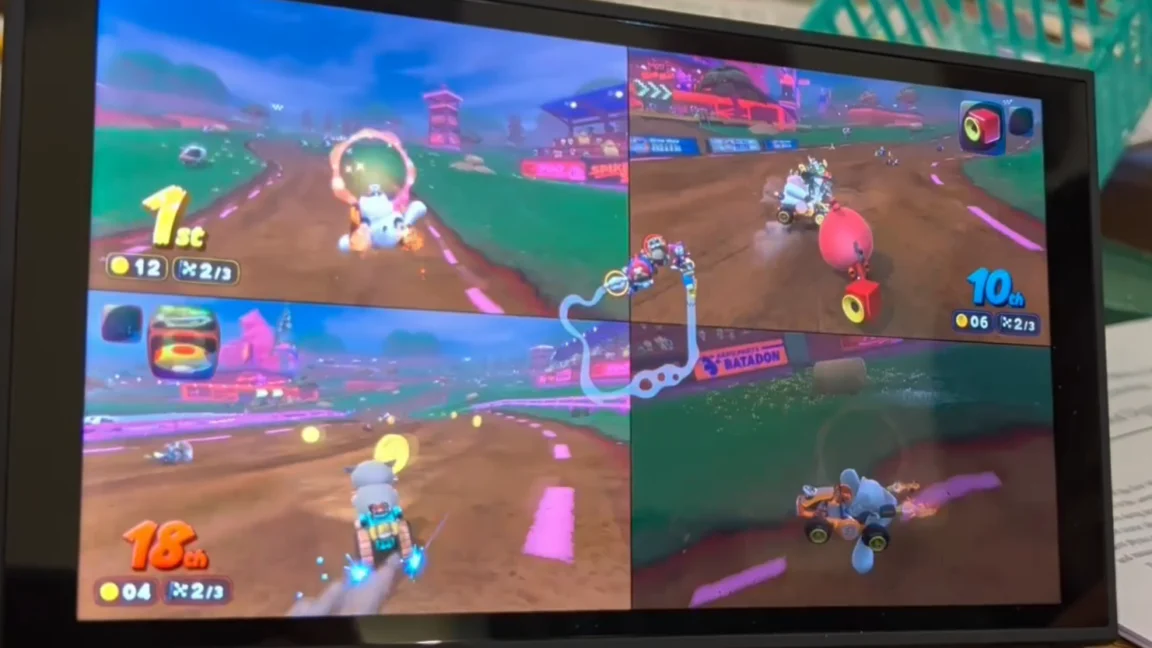
The legitimacy of the exploit has been substantiated by visual evidence provided by the researcher and the broader modding community. Hajhamid shared footage of Mario Kart World running on an exploited Switch 2, displaying modified character models that do not exist in the retail version of the game.
The community has been quick to react. Following the publication of the exploit, users on platforms like Reddit and X (formerly Twitter) have begun showcasing early development tools. Some have successfully demonstrated a full Vulkan GPU implementation running in userland, a significant step toward running non-native games or high-performance emulators on the hardware.
The reliance on a Node.js-based tether means that, for now, the jailbreak is not "permanent" or "cold-boot." Users must repeat the process after each reboot. However, the software-only nature of the hack suggests that patching it may require Nintendo to issue a system-level firmware update that specifically targets the SmileBasic 4 interpreter—a move that could potentially break other legitimate applications.
Official Responses and Industry Context
As of this writing, Nintendo has not issued a formal statement regarding the ns2jb jailbreak. Historically, Nintendo has taken an aggressive stance toward console security, often filing lawsuits against developers of modchips and emulators, and quickly pushing out firmware updates that "brick" or disable devices running unauthorized code.
Industry analysts suggest that Nintendo is likely treating this as a high-priority security flaw. The use of SmileBasic 4 is particularly problematic for the company, as it presents a dilemma: Nintendo must decide whether to remove the application from its eShop, effectively penalizing legitimate users, or release a patch that closes the integer overflow vulnerability, potentially cat-and-mousing with the homebrew community for the remainder of the console’s lifecycle.
Implications: The Future of the Switch 2 Ecosystem
The successful jailbreak of the Switch 2 has far-reaching implications for the console’s market and the security landscape of modern gaming hardware.
1. The Security Cat-and-Mouse Game
This exploit marks the beginning of a cycle that plagued the original Nintendo Switch: the constant struggle between Nintendo’s "closed garden" approach and the homebrew community’s desire for open-platform capability. The fact that an AI-assisted search found a critical vulnerability in just two weeks highlights the increasing power of automated security auditing tools.
2. Impact on Developers and Anti-Cheat
For game developers, the ability to modify game files and execute native code is a significant concern. The integrity of online multiplayer games like Mario Kart World is now at risk. If users can modify local files to gain competitive advantages, Nintendo will need to implement more robust server-side validation to ensure that game states remain synchronized and fair.
3. The "Homebrew" Renaissance
Conversely, the homebrew community views this as a victory for consumer ownership. Enthusiasts argue that once a consumer purchases hardware, they should have the right to run whatever code they choose. The ns2jb exploit opens the door for custom emulators, fan-made translations of games that were never localized, and accessibility mods that could improve the gaming experience for those with disabilities.
4. Hardware Longevity
Historically, jailbroken consoles see an extended lifespan. When official support from the manufacturer eventually ends, homebrew communities often keep the hardware relevant for decades. By gaining userland access now, developers are effectively building the foundation for the "post-official" era of the Switch 2.
Final Thoughts
While the current exploit is a "userland" breach rather than a total system compromise, the trajectory is clear. The vulnerability in SmileBasic 4 serves as a stark reminder that even the most secure ecosystems are susceptible to human-designed software flaws. As the community continues to refine the ns2jb tool, the pressure will be on Nintendo to provide a robust, system-wide defense. Whether this marks the end of the console’s initial security phase or the beginning of a long, sustained battle, the Switch 2’s status as an "unhackable" fortress has officially come to an end.