In the quiet corners of corporate IT departments, a profound shift is underway. For decades, the primary challenge of the software development lifecycle was scarcity: a lack of skilled developers, prohibitive infrastructure costs, and the grueling time required to move from concept to deployment. Today, that constraint has evaporated. Driven by generative AI, the cost of creating code, requirements, and workflows is plummeting toward zero.
However, this newfound ease of creation has birthed a complex, unintended consequence. As Forrester analysts Diego Lo Giudice and his colleagues have observed, we have entered the era of the "Abundance Paradox." When software becomes trivial to build, the enterprise is flooded with it. The challenge for modern CIOs and CTOs is no longer how to build more; it is how to survive the deluge of what has already been built.
The Mechanics of Abundance: A New Development Paradigm
To understand the current shift, one must look at how generative AI has fundamentally altered the economics of engineering. Traditionally, software development was a high-friction process involving rigorous planning, resource allocation, and a long tail of technical debt.
Today, AI acts as a force multiplier across the entire stack:
- Automated Code Generation: LLMs can now write boilerplate code, unit tests, and documentation in seconds.
- Requirement Synthesis: AI models can distill complex business needs into actionable user stories and functional workflows.
- Democratized Creation: Low-code and no-code platforms, augmented by AI, allow non-technical business units to build their own tools, bypassing traditional IT bottlenecks.
The result is a surge in digital velocity. More teams can build software, more functions can be automated, and more specialized niche problems can now justify a digital solution that would have been dismissed as "too expensive" only five years ago.
The Paradox: When Efficiency Creates Complexity
While the immediate benefits of AI-accelerated creation are clear—increased agility and reduced time-to-market—the long-term implications are far more treacherous. Abundance does not guarantee quality. In fact, history suggests that when the cost of production drops, the quality of the average output often declines.
For the enterprise, this manifests as a "complexity tax." When every department can spin up its own AI-generated application, the organization inevitably faces:
- Technical Debt at Scale: Code generated by AI is often difficult to maintain, audit, or secure. If a business unit builds a tool without IT oversight, the enterprise inherits a "black box" of legacy code.
- Shadow IT Proliferation: The ease of creation empowers business units to build outside of corporate governance, creating security risks and data silos that IT teams are not equipped to manage.
- The Maintenance Burden: Every application, once built, requires ongoing maintenance, patching, and integration. An infinite supply of software leads to an infinite supply of maintenance tickets.
Stewardship: The Defining Responsibility of the Modern Leader
As the barrier to entry for software creation falls, the barrier to excellence rises. Stewardship has emerged as the critical competency for technology leaders. It is the practice of inspecting the fruits of AI-driven production and making the hard, decisive calls on what deserves to exist within the corporate ecosystem.
Stewardship involves four core pillars:
- Inspection: Identifying which AI-generated solutions provide genuine business value versus those that simply add to the noise.
- Rationalization: Determining which tools should be scaled across the organization, which should be reused, and which should be retired.
- Governance: Setting the guardrails for AI creation to ensure that tools are compliant, secure, and aligned with corporate strategy.
- Strategic Decommissioning: Perhaps the most important skill—the ability to kill projects that should never have been built in the first place.
The Myth of the Free Lunch
As the industry moves into this new phase, several popular narratives are beginning to circulate, many of which Forrester analysts are working to dismantle.
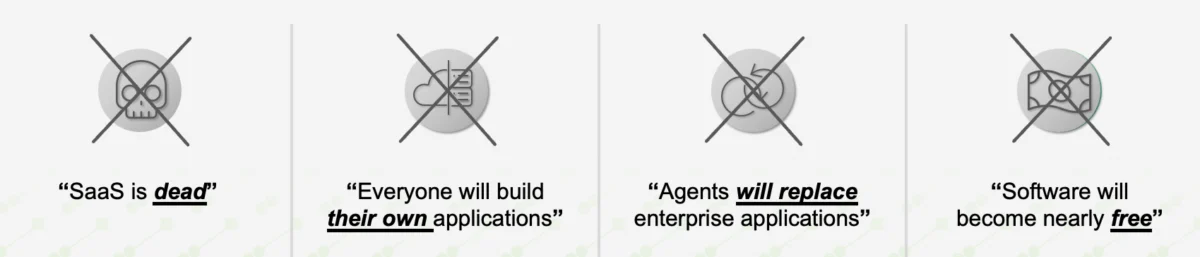
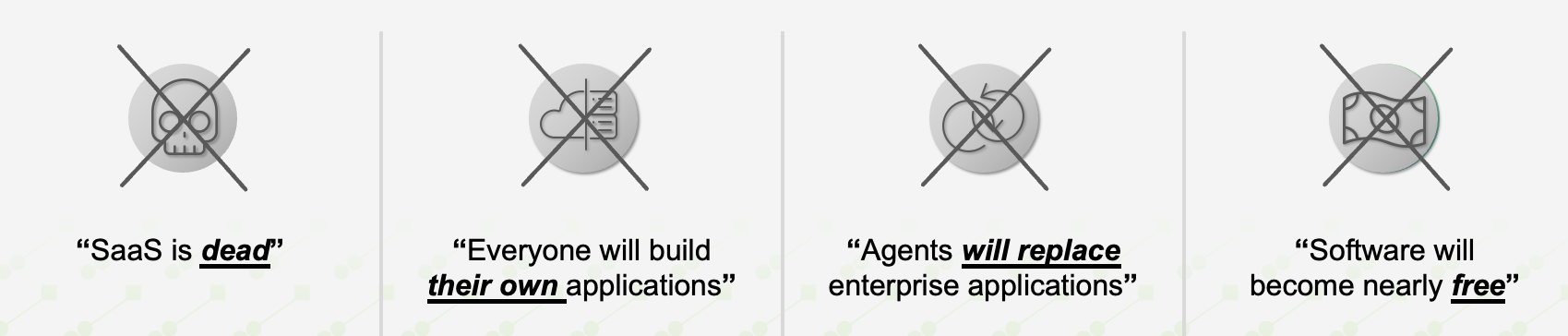
Myth 1: "SaaS is Dead"
The rise of custom-built, AI-generated applications has led some to claim that traditional SaaS is obsolete. This is a misunderstanding of value. While niche tools can now be built internally, the core systems of record—the "backbone" of the enterprise—remain as critical as ever. Stewardship means knowing when to buy a stable, enterprise-grade platform and when to build a unique, proprietary solution.
Myth 2: "Developers are Dispensable"
The argument that AI will replace developers is a simplification of the role. While AI handles the syntax and the boilerplate, it lacks the architectural judgment, the understanding of business context, and the ethical responsibility required to build enterprise-grade systems. Instead of becoming "dispensable," developers are evolving into "architects of abundance," moving from typing code to orchestrating AI-driven systems.
Myth 3: "Software Will Become Free"
While the marginal cost of writing a line of code is dropping, the total cost of ownership (TCO) is rising. The complexity of managing an expansive, heterogeneous software portfolio means that the human labor involved in governance, security, and integration remains an expensive, essential, and non-negotiable cost.
Preparing for the Future: A Call to Action
The transition from a scarcity-driven model to an abundance-driven model requires a cultural shift in leadership. The leaders of tomorrow will not be measured by the number of features they ship, but by the cleanliness and efficiency of their software portfolios.
Key Decisions CIOs Must Face
As the industry prepares for upcoming forums and summits, such as the Technology & Innovation Forum East, the conversation is shifting toward these pivotal questions:
- Authority vs. Ownership: How much autonomy should be granted to autonomous agents and AI-driven processes, and where must humans remain in the loop?
- Adaptive Manufacturing: In industries like global manufacturing, software-led resets are moving companies from a model of cost-advantage to one of adaptive agility. Leaders must decide how to integrate AI into their operational core without losing control of their intellectual property.
- Strategic Retirement: How do we systematically prune our software portfolio? In a world where we can build anything, the greatest sign of maturity is the ability to say "no" to redundant or non-value-adding software.
Conclusion: The New Leadership Archetype
The coming years will be defined by a series of difficult, high-stakes decisions. As Forrester analysts point out, leaders will make more decisions about "what remains" than at any other point in history.
The successful CIO will be one who stops obsessing over the ability to build—that is now a commodity—and starts focusing on the wisdom of what should be owned, maintained, and integrated. Stewardship is not merely a bureaucratic function; it is a strategic imperative. In an era where you can have anything you want, the ability to choose what you should have will be the ultimate competitive advantage.
As we look toward the horizon, the message to technology leaders is clear: The software revolution is no longer about the speed of creation. It is about the quality of the ecosystem. Prepare to manage the abundance, or be buried by it.