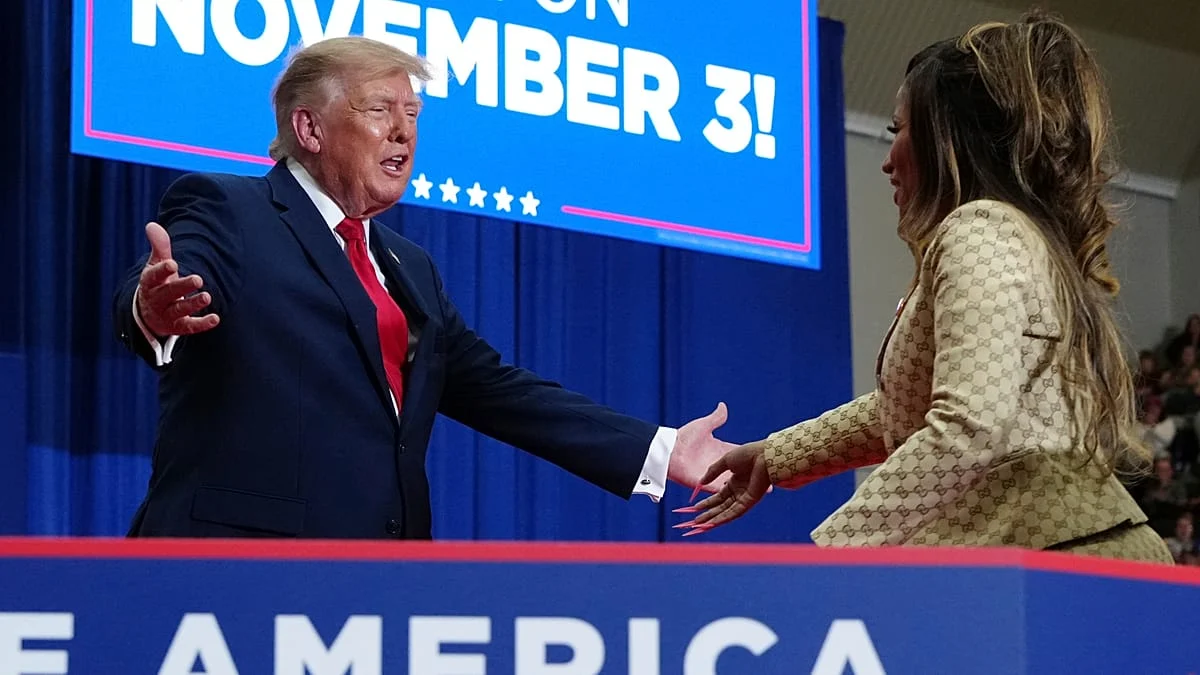
In an unexpected convergence of pop culture and high-stakes partisan politics, global hip-hop icon Nicki Minaj made a headline-grabbing appearance at a Republican campaign rally in Port Huron, Michigan, on Sunday, October 25. The event, held in the lead-up to the pivotal midterm elections, saw the Trinidadian-born rapper join former President Donald Trump on stage, signaling a dramatic pivot in her political alignment and underscoring the influence of celebrity endorsements in an increasingly polarized American landscape.
Main Facts: A High-Profile Endorsement
The atmosphere in Port Huron was electric as Minaj, arriving aboard Air Force One—a rare honor typically reserved for political dignitaries and high-ranking officials—emerged to a receptive crowd. Her presence was not merely a ceremonial gesture; it was a declarative statement. Addressing the audience, the "Super Bass" artist unequivocally stated, "We love Trump," and pledged her allegiance to the former president, asserting she would support him "forever."
This endorsement represents one of the most significant shifts in contemporary celebrity political involvement. Minaj, whose career has been defined by provocative artistry and themes that often clash with conservative social values, has now firmly planted herself in the MAGA movement. The spectacle concluded with lighthearted banter, captured on social media by White House communications director Steven Cheung, in which Minaj joked about the prospect of serving as the administration’s press secretary—a quip that, while humorous, underscores the deep rapport currently existing between the rapper and the Trump camp.
Chronology: The Evolution of a Political Pivot
To understand the magnitude of this endorsement, one must examine the trajectory of Minaj’s political discourse over the past several years.
The 2020 Critique
Only a few years ago, Minaj was a vocal critic of the Trump administration. During the height of the 2020 election cycle, she frequently utilized her massive social media platform to condemn the administration’s hardline immigration policies. Specifically, she was a fierce opponent of the "zero-tolerance" policy that resulted in the separation of migrant children from their parents at the U.S.-Mexico border. At the time, her rhetoric aligned with progressive activists who viewed the administration’s actions as a humanitarian failure.
The Gradual Realignment
The transition from critic to ally did not happen overnight. In the months leading up to the Port Huron rally, observers noted a subtle shift in the rapper’s public engagements. She began appearing at events indirectly associated with the former president’s circle, signaling a thawing of relations. Whether driven by personal convictions regarding economic policy, disillusionment with the current administration, or a strategic repositioning of her personal brand, Minaj’s journey from vocal detractor to star guest at a Trump rally illustrates the fluidity of modern celebrity political identity.
Supporting Data: The Impact of Celebrity Influence
The inclusion of a figure like Nicki Minaj in a political rally serves several strategic functions for the Republican party.
The Reach of the "Barbz"
Nicki Minaj commands a digital empire. With hundreds of millions of followers across Instagram, X (formerly Twitter), and TikTok, her ability to mobilize the youth vote—a demographic that traditionally leans Democratic—cannot be overstated. Political analysts suggest that celebrity endorsements are less about converting hardened partisans and more about "soft mobilization": convincing apathetic or undecided voters to engage with a candidate they might otherwise ignore.
The Michigan Battleground
Michigan remains a critical swing state in the American electoral map. By choosing Port Huron for this rally, the Trump campaign aimed to consolidate support among blue-collar workers and suburban voters. The presence of a global superstar provided a "media multiplier" effect, ensuring that coverage of the event reached far beyond the physical confines of the rally venue, dominating headlines and social media feeds for days afterward.
Official Responses: Tensions on the Campaign Trail
The rally was not limited to celebrity fanfare; it was also the stage for significant political aggression. President Trump utilized the platform to launch a fresh series of attacks against Abdul El-Sayed, the Democratic candidate for the U.S. Senate.
The Controversy Surrounding El-Sayed
Trump’s rhetoric focused on questioning El-Sayed’s loyalty to the United States. These allegations, which revolve around the former public health official’s background and policy positions, have been consistently and vehemently rejected by the El-Sayed campaign. By casting doubt on his opponent’s patriotism, Trump employed a well-worn populist tactic: framing the election as a binary choice between "real Americans" and those who would "undermine" the nation.
Public and Political Reaction
The response to these remarks was immediate. Democratic strategists condemned the rhetoric as xenophobic and dangerous, while Republican supporters lauded the president for his "tough" stance against political rivals. Minaj’s presence, meanwhile, provided a layer of insulation for the campaign; by pivoting to the excitement of her appearance, the media narrative became a complex blend of policy critique and pop culture spectacle, effectively diluting the scrutiny that might have otherwise focused solely on the president’s inflammatory comments.
Implications: What This Means for the Midterms and Beyond
The implications of the Minaj-Trump alliance extend far beyond the immediate electoral cycle.
The "Celebrity-Industrial" Complex
We are witnessing the maturation of the "Celebrity-Industrial Complex" in politics. Candidates are no longer just seeking endorsements from labor unions or industry associations; they are seeking the validation of cultural influencers who can bypass traditional news gatekeepers. When a celebrity of Minaj’s stature aligns with a candidate, they provide a "permission structure" for their fans to reconsider their own political biases.
Shifting Demographics
For the Republican Party, the goal is clear: to erode the traditional Democratic stronghold on minority voters and younger demographics. By aligning with a prominent Black female artist, the Trump campaign hopes to present a more diverse face for the conservative movement. Whether this strategy will yield tangible results at the ballot box in November remains to be seen, but the optics of the Port Huron event have undoubtedly shifted the narrative.
The Cost of Controversy
For Minaj, this alliance comes with inherent risks. Her fanbase is diverse, and a significant portion of her core audience holds progressive values. Publicly embracing a figure as polarizing as Donald Trump risks alienating segments of her long-term supporters. Yet, Minaj has shown throughout her career that she is willing to court controversy to stay relevant. By embracing the MAGA brand, she has positioned herself not just as an entertainer, but as a political power player capable of defying industry norms and expectations.
Conclusion: A New Era of Political Theater
The rally in Port Huron serves as a microcosm of the modern American political experience: a high-decibel, high-stakes performance where the boundaries between entertainment and governance are increasingly blurred. As the nation approaches the midterm elections, the role of figures like Nicki Minaj will likely become even more pronounced.
Whether this alliance represents a genuine ideological shift or a strategic move for cultural relevance, it has fundamentally altered the political discourse of the 2024 cycle. The spectacle in Michigan was a reminder that in the age of social media, the most powerful political currency is attention—and by securing the support of one of the world’s most recognizable voices, Donald Trump has ensured that the spotlight remains firmly fixed on his vision for the country. As the ballots are cast and the political dust settles, the "Minaj Factor" will be a central subject of study for historians and political scientists alike, marking this moment as a definitive chapter in the evolving relationship between the American stage and the ballot box.